


Hej alle sammen! Som lovet publicerer vi resultaterne af belastningstesten af det russiskfremstillede datalagringssystem – AERODISK ENGINE N2.
I den tidligere artikel udførte vi crash-tests af storage-systemet, og resultaterne var positive (det vil sige, vi kunne ikke bryde systemet). Resultaterne af crash-testen kan ses .
I kommentarerne til den forrige artikel kom der ønsker om mere avancerede crash-tests. Vi har noteret os dem og vil helt sikkert implementere dem i en af de kommende artikler. Du kan desuden besøge vores laboratorium i Moskva når som helst (kom personligt eller gør det online) og udføre testene selv (det er også muligt at teste under et specifikt projekt :-)). Skriv til os, så ser vi på alle scenarier!
Derudover, hvis du ikke er i Moskva, kan du også lære vores lagringssystem bedre at kende ved at deltage i et gratis træningsarrangement i et kompetencecenter nær dig.
Nedenfor finder du en liste over kommende arrangementer og datoer for kompetencecentrene.
- Jekaterinburg. 16. maj 2019. Uddannelsesseminar. Du kan registrere dig via linket:
- Jekaterinburg. 20. maj – 21. juni 2019. Kompetencecenter. Kom forbi når som helst i arbejdstiden for en live demonstration af AERODISK ENGINE N2. Den præcise adresse og registreringslink vil blive offentliggjort senere. Hold øje med vores nyheder.
- Novosibirsk. HOLD ØJE MED INFORMATIONER PÅ VORES HJEMMESIDE eller på ХАБР.
oktober 2019 - Kazan. HOLD ØJE MED INFORMATIONER PÅ VORES HJEMMESIDE eller på ХАБР.
oktober 2019 - Krasnojarsk. HOLD ØJE MED INFORMATIONER PÅ VORES HJEMMESIDE eller på ХАБР.
november 2019
Vi vil også gerne dele en anden glædelig nyhed: vores kanal er endelig fuldt operationel, hvor man kan se videoer fra tidligere arrangementer. Her uploader vi også jævnligt vores undervisningsvideoer.
Testbænk
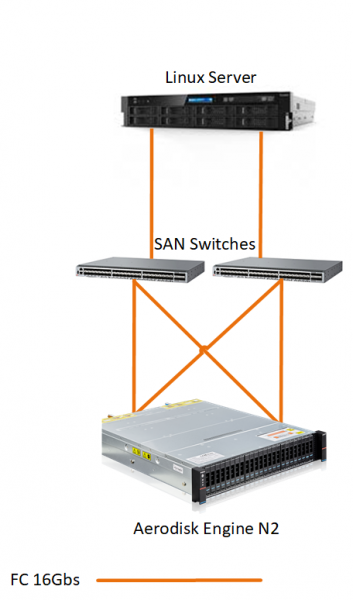
Så lad os vende tilbage til testene. Vi har opgraderet vores laboratorie storage system ENGINE N2 ved at installere ekstra SAS SSD-diske samt Fibre Channel 16G front-end adaptere. Symmetrisk har vi også opgraderet serveren, som vi vil sende belastningen fra, ved at tilføje FC 16G adaptere.
Som resultat har vi i laboratoriet et 2-controller lagringssystem med 24 SAS SSD-diske på 1,6 TB, 3 DWPD, som er tilsluttet en fysisk Linux-server via FC 16G SAN-switches.
Skemaet for testopstillingen ses på billedet nedenfor.
Testmetode
For optimal performance on block access, we will use DDP (Dynamic Disk Pool), which we initially created for ALL-FLASH systems.
For testing, we created two LUNs each with a capacity of 1 TB and a RAID-10 protection level. We will distribute each LUN across 12 disks (a total of 24) to fully utilize the potential of each installed disk in the storage system.
The LUNs are presented to the server through different controllers to maximize storage resource utilization.
Each test will last for one hour and will be conducted using the Flexible IO (FIO) program, with FIO data automatically exported to Excel where graphs are generated for clarity.
Load profiles
In total, we will conduct three one-hour tests, excluding the warm-up time, for which we allocate 15 minutes (this is the time required to warm up a set of 24 SSDs). These tests emulate the most common load profiles we encounter, particularly various DBMS, video surveillance systems, media content broadcasting, and backups.
In all tests, we have deliberately disabled caching to RAM on both the storage system and the host. This will naturally degrade the results, but we believe that under these conditions, the test will be more honest.
Test Results
Test #1. Random load with small blocks. Emulating the operation of a high-load transactional DBMS.
- Block size = 4k
- Read/Write = 70%/30%
- Number of operations = 16
- Queue depth = 32
- Load characteristics = Full Random
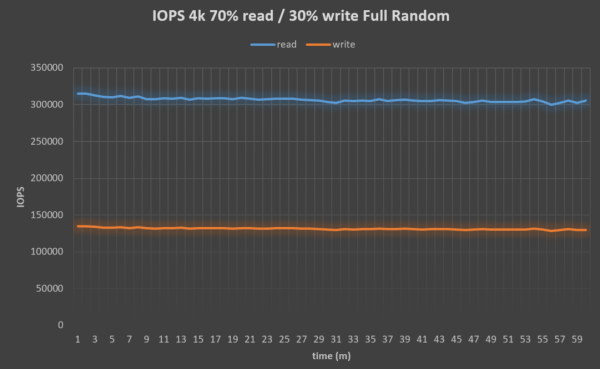
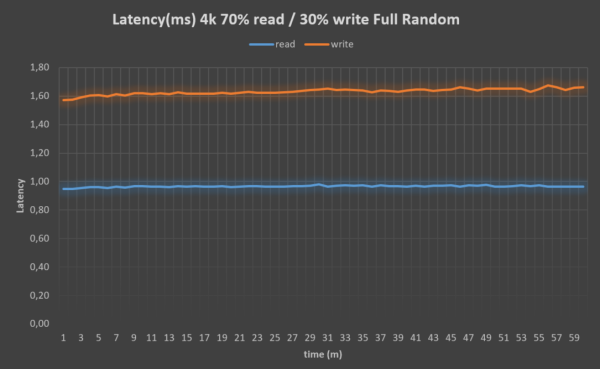
Test results:

In total, with the mid-range Engine N2 system, we achieved 438k IOPS with a latency of 2.6 milliseconds. Considering the system class, we believe the result is quite commendable. To determine if this is the limit for the system, we will look at the utilization of the storage controllers' resources.
We are primarily interested in the CPU, as mentioned earlier, since we intentionally disabled the RAM cache to avoid skewing the test results.
On both storage controllers, we see a similar picture.
Thus, the CPU load is 50%. This indicates that this storage system is far from its limits and can still be scaled up comfortably. To give a preview: all subsequent tests also showed controller CPU loads around 50%, so we will not repeat this.
If we consider random IOPS with 4k blocks, the comfortable limit of the AERODISK Engine N2 system, based on our lab tests, is around ~700,000 IOPS. If that's not enough and you need to aim for a million, we have the more advanced ENGINE N4 model.
So the story about millions of IOPS relates to the ENGINE N4, and if a million is too much for you, feel free to use the N2.
Let’s return to the tests.
Test #2. Sequential writing with large blocks. Emulating surveillance systems, loading data into an analytical DBMS, or writing backups.
In this test, we are no longer interested in IOPS, as they hold no meaning under sequential load with large blocks. What matters to us primarily are: write throughput (megabytes per second) and latencies, which, of course, will be higher for large blocks than for small ones.
- Block size = 128k
- Read/Write = 0%/100%
- Number of operations = 16
- Queue depth = 32
- Load characteristic – Sequential

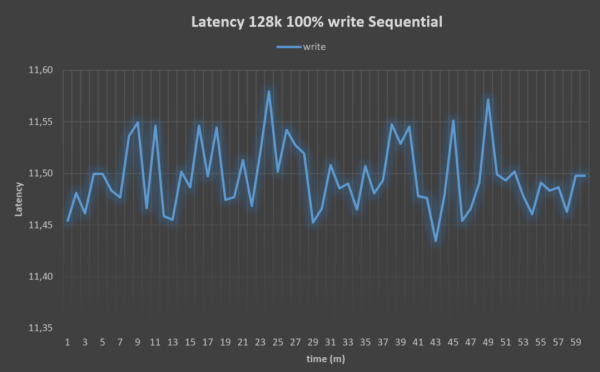

In total: we have a write speed of five and a half gigabytes per second with latencies at eleven milliseconds. When comparing with the closest foreign competitors, the result is, in our opinion, excellent and is not a limit for the ENGINE N2 system.
Test #3. Sequential reading with large blocks. Emulating media streaming, generating reports from an analytical DBMS, or recovering data from backups.
As in the previous test, we are interested in throughput and latencies.
- Block size = 128k
- Read/Write = 100%/0%
- Number of operations = 16
- Queue depth = 32
- Load characteristic – Sequential
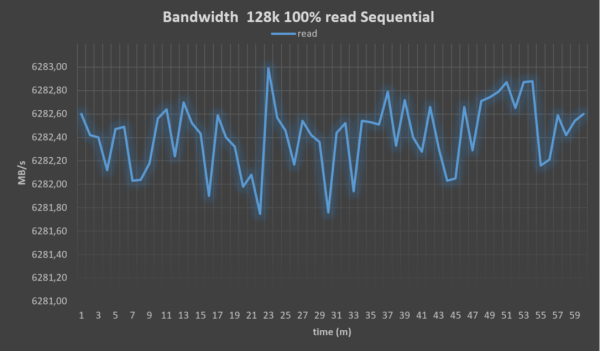
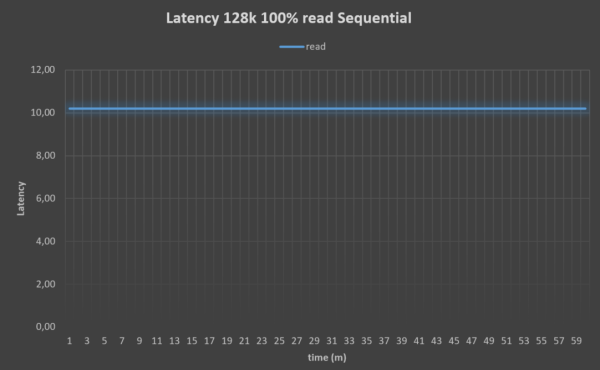

The streaming read rates are predictably slightly better than those of streaming write.
Interestingly, the latency measurements throughout the test are identical (straight line). This is not an error; under sequential reading with large blocks, this is a common situation for us.
Of course, if the system is left in this state for a couple of weeks, we will eventually see periodic spikes on the graphs associated with external factors. However, in general, they will not affect the overall picture.
Konklusioner
From the dual-controller AERODISK ENGINE N2 system, we were able to achieve quite serious results (~438,000 IOPS and ~5-6 gigabytes per second). The load tests showed that we are certainly proud of our storage solution. On the contrary, the results are very impressive and correspond to a good storage system.
Som vi nævnte tidligere, er Engine N2 den mindste model, og de resultater, der vises i denne artikel, er ikke dens grænse. Senere vil vi offentliggøre en tilsvarende test med vores ældre model ENGINE N4.
Naturligvis kan vi ikke dække alle mulige tests i én artikel, så vi opfordrer læserne til at dele deres ønsker til fremtidige tests i kommentarerne, og vi vil helt sikkert tage dem i betragtning i vores kommende publikationer.
Derudover minder vi om, at vi i år aktivt fokuserer på træning, så vi inviterer dig til vores kompetencecentre, hvor du kan deltage i kurser om AERODISK-lagringssystemer, og samtidig få en sjov og interessant tid.
Jeg gentager informationen om de kommende træningsarrangementer.
- Jekaterinburg. 16. maj 2019. Uddannelsesseminar. Du kan registrere dig via linket:
- Jekaterinburg. 20. maj – 21. juni 2019. Kompetencecenter. Kom forbi når som helst i arbejdstiden for en live demonstration af AERODISK ENGINE N2. Den præcise adresse og registreringslink vil blive offentliggjort senere. Hold øje med vores nyheder.
- Novosibirsk. HOLD ØJE MED INFORMATIONER PÅ VORES HJEMMESIDE eller på ХАБР.
oktober 2019 - Kazan. HOLD ØJE MED INFORMATIONER PÅ VORES HJEMMESIDE eller på ХАБР.
oktober 2019 - Krasnojarsk. HOLD ØJE MED INFORMATIONER PÅ VORES HJEMMESIDE eller på ХАБР.
november 2019
Kilde: habr.com
