

Tim Berners-Lee har annonceret sin beslutning om at give specifikationen, der definerer decentraliserede identiteter for web (DID, Decentralized Identifier), status som en anbefalet standard. Indsigelserne fra selskaberne Google og Mozilla er blevet afvist.
DID-specifikationen introducerer en ny type unikke globale identifikatorer, der ikke er knyttet til enkelte centraliserede tjenester og organisationer som domæneregistratorer og certifikatmyndigheder. En identifikator kan associeres med enhver ressource og genereres ved hjælp af systemer, som ejeren af ressourcen har tillid til. For at bekræfte identifikatorens ægthed anvendes autentificering med ejerskabsbevis baseret på kryptografiske mekanismer som digitale signaturer. Specifikationen tillader brug af forskellige metoder til distribueret styring og indhentning af oplysninger om identifikatorer, herunder metoder baseret på blockchain.
Formatet af den nye URI dannes som «did:metode:unik_identifikator», hvor «did» definerer det nye URI-skema, «metode» angiver mekanismen til behandling af identifikatoren, og «unik_identifikator» repræsenterer en identifierspecifik ressource, f.eks. «did:example:123456789abcdefghi». I metoden angives navnet på den tjeneste, der gemmer de verificerede data, hvilket garanterer identifikatorens unikhed, definerer dens format og sikrer bindingen af identifikatoren til den ressource, den er oprettet til. URI'en med identifikatoren konverteres til et dokument i JSON-format med metadata, der beskriver den anmodede objekt og inkluderer offentlige nøgler til verificering af ejeren.
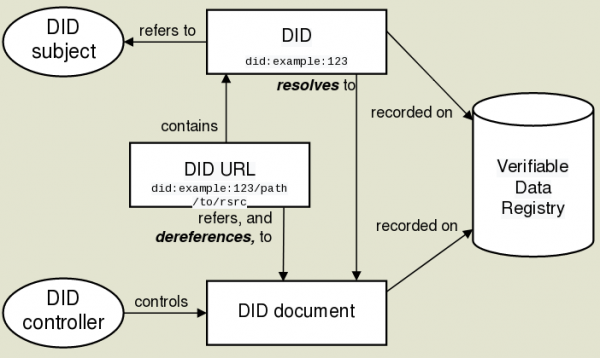
Implementeringer af metoder går ud over DID-standarden, defineres i deres egne specifikationer og understøttes i et separat register. I øjeblikket er 135 metoder baseret på forskellige blockchains, kryptografiske algoritmer, distribuerede teknologier, decentrale databaser, P2P-systemer og identifikationsmekanismer blevet foreslået. Det er også tilladt at skabe DID-bundter oven på centraliserede systemer, eksempelvis tillader metoden web at bruge binding til traditionelle værtens navne (f.eks. «did:web:example.com»).
Google's objections are related to the separation of the specification for the general mechanism of decentralized identifiers from the specifications for the final implementations of methods, which makes it impossible to analyze the correctness of the core specification without studying the method specifications. The publication of the core specification before the method specifications are ready complicates the review process, and Google has suggested postponing the standardization of the general DID specification until several best methods are ready for standardization, as subtle points may arise during the standardization of methods that require refinement of the core specification.
Mozilla's objections stem from the fact that the specification does not properly encourage portability, pushing this issue to the side of the method registry. More than a hundred methods have already been proposed in the registry, created without regard for compatibility and the unification of standard solutions. In its current form, the creation of a new method for each task is encouraged instead of attempting to adapt existing methods to their needs.
The W3C's position is that the standardization of the DID specification, which defines a new extensible class of identifiers and associated syntax, will stimulate the development of methods and achieve consensus regarding the standardization of those methods. Currently, there is considerable evidence of the applicability of the core specification to solve tasks that are in demand within the community developing decentralized technologies. The proposed implementations of methods should not be evaluated by analogy with new URL schemes, and the creation of a large number of methods can be seen as corresponding to the basic specification's needs of developers.
The standardization of certain methods is seen as a more complex task, in terms of achieving consensus among developers, than the standardization of a general class of identifiers. Therefore, the adoption of the general specification before the standardization of methods is considered a solution that could potentially cause less harm to the community implementing decentralized identifiers.
Kilde: opennet.ru
