

The release of Zulip 4.0 has been announced, a server platform for deploying corporate messengers suitable for facilitating communication among employees and developer groups. The project was initially developed by Zulip and was made open-source after its acquisition by Dropbox under the Apache 2.0 license. The server-side code is written in Python using the Django framework. Client software is available for Linux, Windows, macOS, Android, and iOS, along with a built-in web interface.
The system supports both direct messaging between two individuals and group discussions. Zulip can be compared to the Slack service and can be viewed as an internal corporate equivalent of Twitter, used for communication and discussions on work matters within large employee groups. It provides tools for tracking participation and status across multiple discussions simultaneously, using a threaded message display model, which optimally balances room-specific interactions in Slack with a single public space like Twitter. The simultaneous threaded display of all discussions allows for encompassing all groups in one place while maintaining logical divisions between them.
Among Zulip's features, it also supports sending messages to users in offline mode (messages will be delivered once they come online), preserving the complete history of discussions on server and tools for archive searching, the ability to send files using Drag-and-drop, automatic syntax highlighting for code blocks in messages, a built-in markup language for quickly formatting lists and text, tools for group notifications, the ability to create private groups, integration with Trac, Nagios, Github, Jenkins, Git, Subversion, JIRA, Puppet, RSS, Twitter, and other services, as well as tools for attaching visual tags to messages.
Key innovations:
- Users are now able to mute the activity of other users to avoid seeing their messages.
- A new role, 'moderator,' has been added to the permissions system, allowing users to manage publication sections (streams) and discussions without granting them rights to modify settings.
- The ability to move discussions between sections has been implemented, including the option to transfer topics to private areas.
- Support for the GIPHY service has been integrated, enabling users to select and insert memes and animated images.
- A quick copy feature for code blocks to the clipboard has been added, as well as editing capabilities for selected blocks in an external editor.
- Instead of a separate compact 'Reply' button for starting a response, a universal input area has been introduced, allowing users to start typing immediately, showing recipient information and offering a more familiar interface for users of other chat applications.
- The user presence indicator is now available in the autocomplete suggestion during input.
- By default, when the application is opened, the Recent Topics list is now displayed with a filter option to view discussions that include messages from the current user.
- Starred favorite messages are now shown by default in the left panel, allowing users to utilize this feature as a reminder for messages and discussions they need to revisit.
- The number of available sound notifications has been expanded.
- An About widget has been added to quickly view information about the Zulip server version number.
- A warning is displayed in the web interface and desktop applications if the user connects to server, which has not been updated for over 18 months.
- Work has been done to increase the scalability and performance of the server.
- The FormatJS library has been implemented for interface internationalization, replacing the previously used i18next library.
- Integration with the open proxy Smokescreen has been provided, used to prevent SSRF attacks on other services (through Smokescreen, all transitions to external links can be redirected).
- Modules for integration with Freshping, JotForm, and Uptime Robot have been added, along with improved integration with Bitbucket, Clubhouse, GitHub, GitLab, NewRelic, and Zabbix. A new GitHub action has been added for sending messages to Zulip.
- In new installations, PostgreSQL 13 is now used as the default DBMS. The Django framework has been updated to 3.2.x. Initial support for Debian 11 has been added.
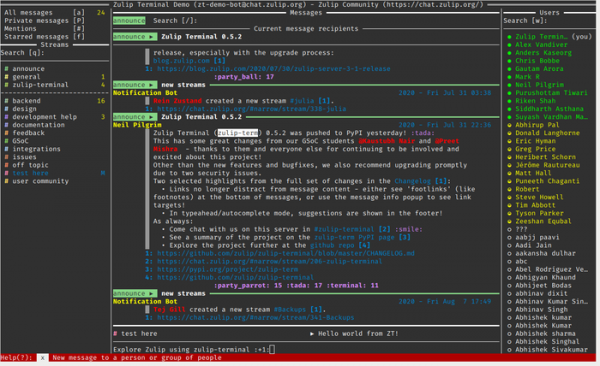
- A client application for working with Zulip from the text terminal has been implemented, closely resembling the main web client in functionality, including block layout on the screen and keyboard shortcuts.

Source: opennet.ru
