

Google has begun testing the third beta version of the open mobile platform Android 12. The release of Android 12 is expected in the third quarter of 2021. Firmware builds are prepared for Pixel 3 / 3 XL, Pixel 3a / 3a XL, Pixel 4 / 4 XL, Pixel 4a / 4a 5G, and Pixel 5, as well as for certain devices from ASUS, OnePlus, Oppo, Realme, Sharp, TCL, Transsion, Vivo, Xiaomi, and ZTE.
Key changes compared to the second beta version:
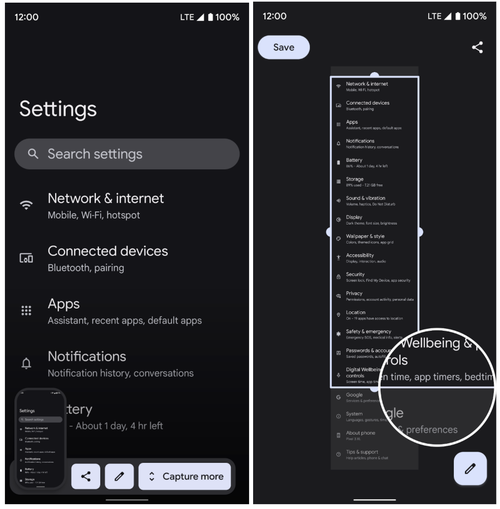
- The ability to take screenshots that capture not just the visible area but also the content in the scrolling area has been added. The capability to save content outside the visible area works for all applications using the View class for output. To implement support for scrolling screenshots in programs that use specific interfaces, an API called ScrollCapture has been proposed.

- A new high-performance search engine, AppSearch, has been included, allowing indexing of information on the device and performing full-text search with ranking of results. AppSearch provides two types of indexes — for organizing searches within individual applications and for searching throughout the system.
- The WindowInsets class has been augmented with an API to determine the display position of camera and microphone usage indicators (these indicators can overlap controls in full-screen apps, and through the specified API, the application can adjust its interface).
- For centrally managed devices, an option has been added to prohibit the use of switches to turn off the microphone and camera.
- For background CDM applications (Companion Device Manager), which manage companion devices like smartwatches and fitness trackers, the ability to run active (foreground) services has been provided.
- The automatic screen rotation feature has been improved, which can now use facial recognition from the front camera to determine the need to rotate the screen, for example, when a person is using the phone lying down. To ensure privacy, information is processed on-the-fly without intermediate image storage. This capability is currently only available on Pixel 4 smartphones and newer models.
- Optimized animation during screen rotation, reducing the lag before rotation by about 25%.
- Added Game Mode API and corresponding settings to manage game performance profiles — for instance, sacrificing performance to extend battery life or utilizing all available resources for maximum FPS.
- Introduced the play-as-you-download feature for background downloading of game resources during installation, allowing players to start gaming before the download completes.
Additionally, a July security patch set for Android has been released, fixing 44 vulnerabilities, seven of which are rated critical and the rest high risk. Most critical issues allow for remote code execution attacks on the system. Issues labeled as high risk permit code execution within the context of a privileged process through manipulations of local applications.
Six critical vulnerabilities affect closed components for Qualcomm chips, along with one DRM module Widevine (buffer overflow when processing third-party content). Additionally, vulnerabilities have been noted in Android Framework, Android Media Framework, and Android System components that can elevate system privileges.
Source: opennet.ru
