

After a year of development, the third beta release of the Haiku R1 operating system has been published. The project was originally created in response to the closure of BeOS and was developed under the name OpenBeOS, but was renamed in 2004 due to trademark claims regarding the name BeOS. Several bootable Live images (x86, x86-64) have been prepared to evaluate the performance of the new release. The source code for most of the Haiku OS is distributed under the MIT license, with some libraries, media codecs, and components borrowed from other projects being exceptions.
The Haiku OS is focused on personal computers, utilizing its own kernel built on a modular architecture optimized for high responsiveness to user actions and effective execution of multithreaded applications. It offers an object-oriented API for developers. The system is directly based on BeOS 5 technologies and aims for binary compatibility with applications designed for that OS. The minimum hardware requirement is a Pentium II CPU with 384 MB of RAM (recommended: Intel Core i3 and 2 GB of RAM).
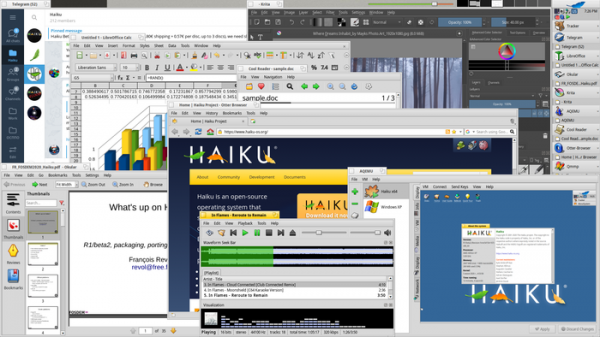
The file system used is OpenBFS, which supports extended file attributes, journaling, 64-bit pointers, support for storing meta-tags (attributes can be saved for each file in a key=value form, making the file system similar to a database), and special indexes to speed up data retrieval. Directory structures utilize 'B+ tree' structures. The file manager Tracker and the Deskbar panel from BeOS have been included in Haiku, with their source codes released after BeOS exited the scene.
Key innovations:
- The web browser WebPositive, developed by the project, has been switched to use the WebKit 612.1.21 engine. Stability and compatibility with other browsers have been significantly improved.
- The installation process has been enhanced. The interface for partitioning disks has been simplified, and the driver configuration interface has been modernized.
- Hardware support has been expanded. Drivers for wireless devices have been ported from FreeBSD 13. New drivers for sound cards, storage systems, and USB devices have been added. Support for USB 3 has been improved. Performance has been boosted on systems with NVIDIA graphics cards (GeForce 6200 to GeForce Go 6400).
- The ability to resume updates interrupted due to network failures has been implemented.
- Improved support for dark color themes.
- The input system settings now include the option to disable the touchpad.
- Enhanced support for XFS and NFS file systems.
- Support for Sun VTOC partition tables has been added.
- Scrolling bars now scale according to font size.
- Enhanced localization support.
- Improved stability of the MediaPlayer. Added support for 4K resolution video.
- The package manager now supports running handler scripts during package removal.
- Software versions have been updated. Python 2 has been deprecated and replaced by Python 3.7.
- In the graphical server app_server, memory management has been redesigned and additional composite rendering operations have been added (used in the browser for rendering canvas elements).
- The terminal emulator now supports escape sequences for outputting repeating characters.
- Compatibility with POSIX specifications has been improved, including support for mlock/munlock, ppoll, and exp10/exp10f/exp10l operations.
Source: opennet.ru
