

The release of the open platform webOS Open Source Edition 2.14 has been published, which can be used on various portable devices, boards, and automotive infotainment systems. The Raspberry Pi 4 boards are considered the reference hardware platform. The platform is developed in a public repository under the Apache 2.0 license, with the development overseen by the community, adhering to a collaborative development management model.
The webOS platform was originally developed by Palm in 2008 and was used on the Palm Pre and Pixie smartphones. In 2020, following the acquisition of Palm, the platform came under Hewlett-Packard, which then attempted to use this platform in its printers, tablets, laptops, and PCs. In 2012, HP announced the transition of webOS to an independent open project and began releasing the source code of its components in 2013. In 2013, the platform was purchased from Hewlett-Packard by LG and is now utilized in over 70 million LG TVs and consumer devices. In 2018, the webOS Open Source Edition project was established, through which LG attempted to return to an open development model, attract other contributors, and expand the range of devices supported by webOS.
The webOS system environment is formed using the OpenEmbedded tools and base packages, as well as the build system and metadata set from the Yocto project. Key components of webOS include the System and Application Manager (SAM), which is responsible for running applications and services, and the Luna Surface Manager (LSM), which creates the user interface. The components are written using the Qt framework and the Chromium browser engine.
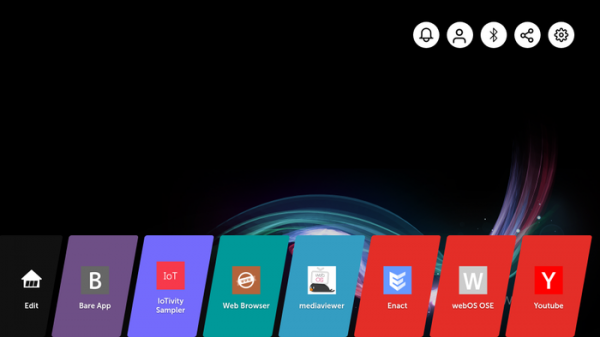
Rendering is done through a composite manager using the Wayland protocol. For developing user applications, it is recommended to use web technologies (CSS, HTML5, and JavaScript) and the Enact framework based on React, although it is also possible to create programs in C and C++ with a Qt-based interface. The user interface and built-in graphical applications are mainly implemented as native programs written using QML technology. By default, the Home Launcher interface is offered, optimized for touch screen navigation and featuring a concept of interchangeable cards instead of windows.
Data is stored in a structured format using JSON with the DB8 storage system, which uses LevelDB as the backend. Initialization is done through bootd based on systemd. For multimedia content processing, the uMediaServer and Media Display Controller (MDC) subsystems are available, and PulseAudio is used for sound. server For automatic firmware updates, OSTree and atomic partition replacement are used (two system partitions are created, one of which is active while the other is used for updating).
Key changes in the new release:
- Among the default application examples included is a camera application. This application provides basic functionality for taking photos and recording videos and can be used as a foundation for developing more advanced camera-related applications.
- The transition to the creation of 64-bit builds has been completed, including builds for the Raspberry Pi 4 board (rpi4-64) and the emulator (qemux86). Support for 32-bit builds has been declared deprecated.
- An extension for the open source code editor Visual Studio Code has been proposed, simplifying the development of webOS-specific web applications, Enact applications, and JavaScript services.
- The early response service for memory shortage in the system, systemd-oomd, has been activated, allowing for the detection of the onset of delays due to resource shortages and the selective termination of resource-intensive processes at a stage when the system is still not in a critical condition and has not yet begun to aggressively trim cache and swap data.
- In Network Manager, the wpa-supplicant service is set up to run in builds for Raspberry Pi 4 boards.
- Executable files occlientbasicops and ocserverbasicops have been added to the emulator build, and udev rules for the LGE UWB module have been updated.
- The g-camera-pipeline component has improved functionality related to audio recording.
- The browser engine has been updated to Chromium 91.
- The platform components for creating embedded Linux systems Yocto have been updated to release 3.1.
- D-Bus signal handling has been implemented in Memory Manager.
Additionally, the OpenLGTV project focuses on reverse-engineering firmware for LG televisions to enhance functionality, fix bugs, and ensure compliance with copyleft licenses when using open components in the firmware (partially open firmware). The project develops the epk2extract tools for extracting and decrypting firmware and various data from LG, Hisense, Sharp, Philips/TPV, and Thompson televisions, as well as the webOS Brew package repository and tools for gaining root access on the television (RootMyTV). The project provides build environments for creating system images for TVs based on LG NC4 and LG115x boards, along with old modified firmware for Saturn S6, Saturn S7, and LG 2010 and 2011 televisions based on Broadcom chips.
Source: opennet.ru
