

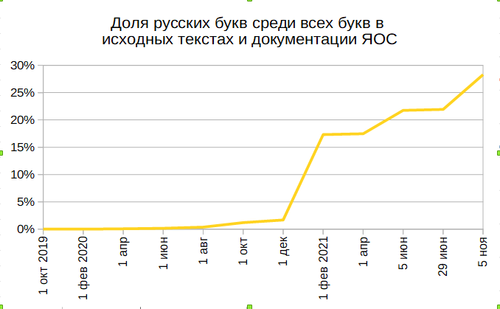
The YOC project is developing a branch of the A2 operating system, also known as Bluebottle and Active Oberon. One of the main goals of the project is the comprehensive integration of the Russian language throughout the system, including (at least partial) translation of the source texts into Russian. YOC can operate as an application in a window under Linux or Windows, and also as a standalone operating system on x86 and ARM hardware (supporting Zybo Z7-10 and Raspberry Pi 2 boards). The code is written in Active Oberon and is distributed under the BSD license.
The project serves as a foundation for the development of ideas in Russian-language programming, enhancing the comfort of working with Cyrillic and the Russian language, and testing various approaches to terminology issues and translation depth in practice. Unlike existing Russian programming languages like 1C, Kumir, and Glagol, the project aims to provide an operating system entirely in Russian, which includes translations of the bootloader, kernel, compiler, and drivers. In addition to the system's Russian localization, notable differences from A2 include a step-by-step debugger, cross-compilation, a functioning implementation of the SET64 type, bug fixes, and expanded documentation.
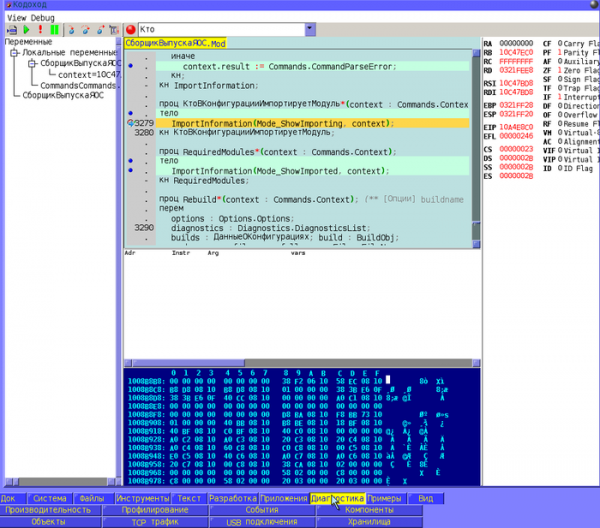
The operating system A2, used as the foundation, falls into the category of educational-industrial single-user OS and is applied for microcontrollers. The system provides a multi-window graphical interface and is equipped with a network stack and a cryptographic library, supports automatic memory management, and can perform tasks in soft real-time mode. Instead of a command interpreter, the system offers an integrated environment for executing code in Active Oberon, which operates without unnecessary layers.
An integrated development environment, form editor, compiler, and debugging tools are provided for developers. Code reliability can be ensured through formal verification of modules and built-in unit testing capabilities. The source code for the entire system contains approximately 700 thousand lines (for comparison, the Linux 5.13 kernel includes 29 million lines of code). Applications such as a multimedia player, image viewer, TV tuner, code editor, HTTP server, archivers, messenger, and VNC server for remote access to the graphical environment have been developed for the system.
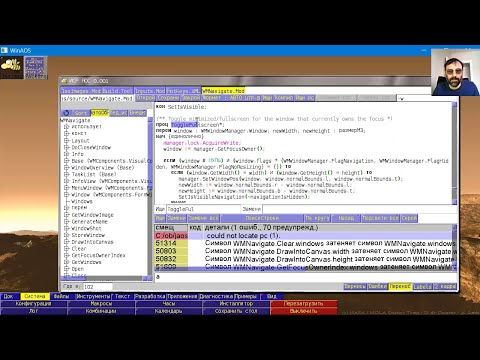
The author of YOS, Denis Valeryevich Budyak, presented a report emphasizing the security of information systems, particularly Linux. The report was published during the Oberon Week 2021. The program for further presentations is published in PDF format.
Source: opennet.ru
