

The developers of the open-source operating system Haiku, which continues to evolve the ideas of BeOS, have prepared an initial implementation of a layer to ensure compatibility with the Xlib library, allowing X11 applications to run in Haiku without the need for an X server. The layer is implemented through the emulation of Xlib functions by translating calls into Haiku's high-level graphical API.
In its current form, the layer provides most of the commonly used Xlib interfaces, but some calls are still replaced with stubs. The layer allows for the compilation and execution of applications based on the GTK library, but the quality of the element layout in windows still needs improvement. Input handling via keyboard and mouse clicks has not yet been finalized (only mouse movement event handling has been added).
Support for the Qt library in Haiku was previously implemented by creating a native Qt port that operates on top of the Haiku API. However, for GTK support, using X11 emulation is considered the more preferable option, as the internals of GTK are not well abstracted, and creating a separate GTK backend for Haiku would require significant resources. One solution considered was the possibility of creating an X11 port for Haiku,server but this approach was deemed impractical given that the X11 API can be implemented directly on top of the Haiku API. X11 was chosen as a long-stabilized and unchanging protocol, while experiments with Wayland are still ongoing, requiring the creation of a custom server implementation, and not all necessary protocol extensions have been finalized.
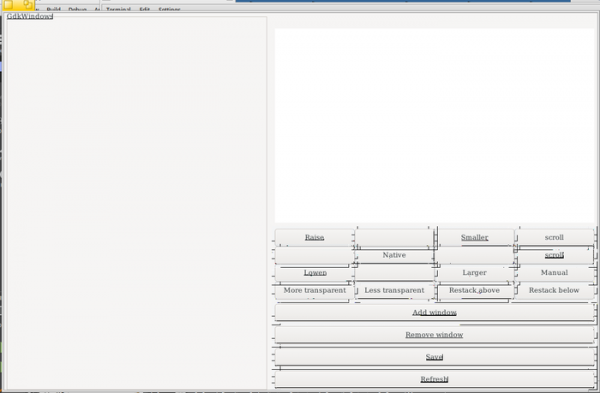
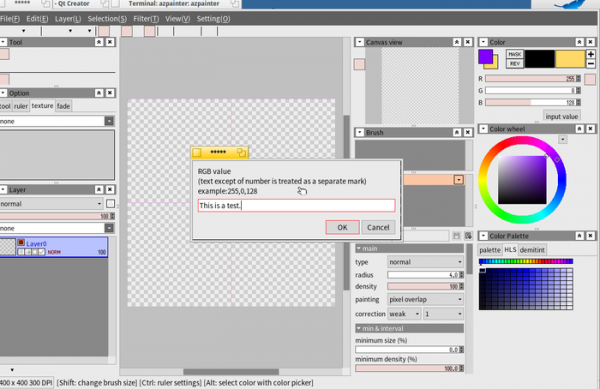
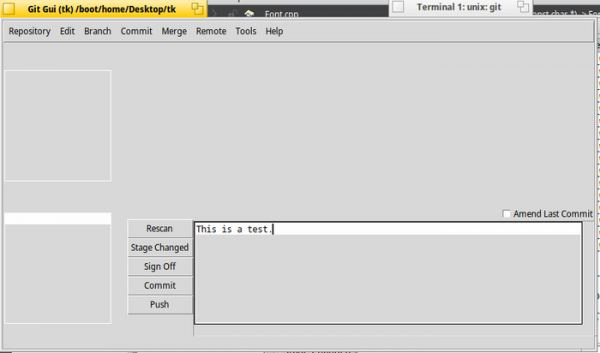
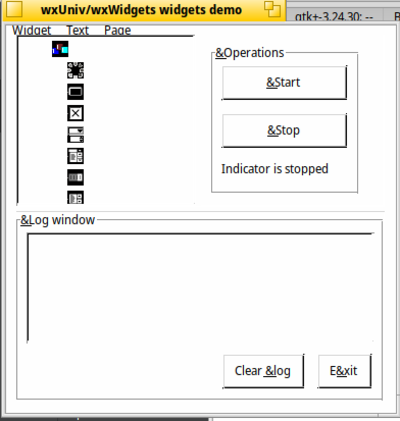
When running simpler applications through the layer, such as those built on Tcl/Tk and wxWidgets, there are still unresolved issues, but the appearance is already much closer to normal:
It should be noted that the Haiku project was created in 2001 in response to the discontinuation of the BeOS operating system development and initially developed under the name OpenBeOS, but was renamed in 2004 due to trademark claims associated with the use of the BeOS name. The system is directly based on BeOS 5 technologies and aims for binary compatibility with applications for this OS. The source code of most of the Haiku OS is distributed under the MIT open-source license, with the exception of some libraries, media codecs, and components borrowed from other projects.
The system targets personal computers, using its own kernel built on a hybrid architecture, optimized for high responsiveness to user actions and efficient execution of multithreaded applications. OpenBFS is used as the file system, supporting extended file attributes, journaling, 64-bit pointers, support for storing meta-tags (attributes can be saved in the form of key=value for each file, making the file system similar to a database), and special indexes to speed up queries. B+ tree structures are used to organize the directory structure. Included in Haiku from the BeOS code are the Tracker file manager and the Deskbar panel, whose source codes were released after the development of BeOS ceased.
Source: opennet.ru
