

Researchers from the University of Waterloo and the U.S. Naval Research Laboratory have presented results from their development of a Tor network simulator, comparable in scale to the main Tor network in terms of nodes and users, allowing for experiments that closely replicate real-world conditions. The tools and methodology prepared for the experiment enabled simulating a network of 6,489 Tor nodes on a computer with 4 TB of RAM, connected to 792,000 virtual users simultaneously.
This is noted as the first large-scale simulation of the Tor network, where the number of nodes corresponds to that of the real network (the operational Tor network consists of about 6,000 nodes and 2 million connected users). A full-fledged simulation of the Tor network is of interest for identifying bottlenecks, modeling behavior under attack scenarios, testing new optimization methods in real conditions, and verifying concepts related to security.
With a fully developed simulator, Tor developers can move away from conducting experiments on the main network or on individual operational nodes, which create additional risks of compromising user confidentiality and do not exclude the possibility of disruptions. For example, in the coming months, the introduction of a new congestion control protocol in Tor is expected, and simulation will allow a comprehensive study of its functionality before deployment in the real network.
In addition to eliminating the impact of experiments on user confidentiality and the reliability of the main Tor network, having separate test networks will allow for rapid testing and debugging of new code during development, implementing changes for all nodes and users without waiting for the completion of lengthy intermediate rollouts, and more efficiently creating and prototyping new ideas.
Work is underway to enhance the tools, which the developers claim will reduce resource consumption by 10 times and allow simulating networks that exceed the real network on the same hardware, which may be necessary for identifying potential scaling issues with Tor. During this work, several new network modeling methods have also been created, enabling the prediction of network state changes over time and using background traffic generators to simulate user activity.
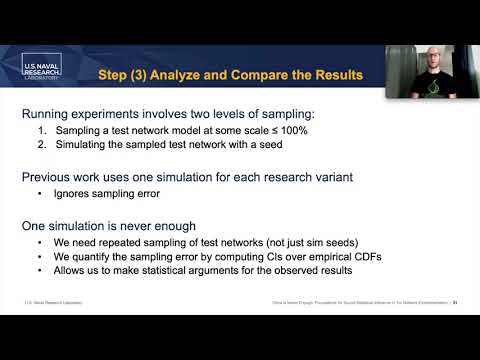
Researchers have also examined the relationship between the size of the simulated network and the accuracy of projecting experimental results onto the real network. During the development of Tor, initial checks of the changes and optimizations are performed in small test networks that contain significantly fewer nodes and users than the real network. It has been found that statistical errors in forecasts obtained from small simulations can be compensated by repeated independent experiments with different sets of initial data, noting that the larger the simulated network, the fewer repetitions are needed to achieve statistically significant conclusions.
For modeling and simulating the Tor network, several open projects distributed under the BSD license are being developed by researchers:
- Shadow — a universal network simulator that allows running real network application code to recreate the operation of distributed systems with thousands of network processes. To simulate systems based on real unmodified applications, Shadow employs a technique for emulating system calls. Network interactions of applications in the simulated environment are carried out through the deployment VPN and use of simulators for standard network protocols (TCP, UDP). Customizable modeling of virtual network characteristics, such as packet loss and delivery delays, is supported. In addition to experiments with Tor, an attempt was made to develop a plugin for Shadow to simulate the Bitcoin network, but this project was not developed further.
- Tornettools — a toolkit for generating realistic Tor network models that can run in a Shadow environment, as well as for launching and configuring the simulation process, accumulating and visualizing results. Metrics reflecting the operation of the real Tor network can be used as templates for network generation.
- TGen — a generator of traffic streams based on user-defined parameters (size, delays, number of streams, etc.). Traffic generation schemes can be specified either based on specific scenarios in GraphML format or using probabilistic Markov models for the distribution of TCP streams and packets.
- OnionTrace — a tool for monitoring performance and events in the simulated Tor network, as well as for recording and replaying information about the formation of Tor node chains and their binding to traffic streams.
Source: opennet.ru
