

The release of the DentOS 2.0 network operating system, based on the Linux kernel and designed for equipping switches, routers, and specialized network equipment, is now available. The development is conducted with the participation of companies such as Amazon, Delta Electronics, Marvell, NVIDIA, Edgecore Networks, and Wistron NeWeb (WNC). The project was initially established by Amazon to equip network equipment in its infrastructure. The DentOS code is written in C and is distributed under the Eclipse Public License.
For managing packet switching in DentOS, the Linux kernel SwitchDev subsystem is used, allowing the creation of drivers for Ethernet switches that can delegate frame forwarding and network packet processing operations to specialized hardware chips. The software stack is based on the standard Linux networking stack, the NetLink subsystem, and tools such as IPRoute2, tc (Traffic Control), brctl (Bridge Control), and FRRouting, as well as protocols such as VRRP (Virtual Router Redundancy Protocol), LLDP (Link Layer Discovery Protocol), and MSTP (Multiple Spanning Tree Protocol).
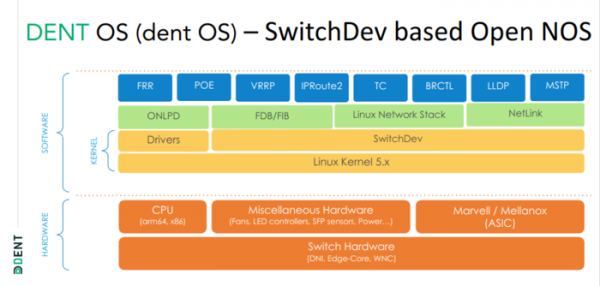
The system environment is based on the ONL (Open Network Linux) distribution, which in turn uses a Debian GNU/Linux package base and provides an installer, settings, and drivers for running on switches. ONL is developed by the Open Compute project and serves as a platform for creating specialized network devices, supporting installation on more than a hundred different switch models. It includes drivers for interaction with indicators, temperature sensors, fans, I2C buses, GPIO, and SFP transceivers used in switches. Management tools such as IpRoute2 and ifupdown2 can be used, as well as gNMI (gRPC Network Management Interface). Data models YANG (Yet Another Next Generation, RFC-6020) are used for configuration.
The system is available for switches based on Marvell and Mellanox ASICs, with up to 48 10-gigabit ports. Support is provided for various ASICs and network data processing chips, including Mellanox Spectrum ASIC chips, Marvell Aldrin 2, and Marvell AC3X with hardware packet forwarding table implementations. Ready-to-install images of DentOS are prepared for ARM64 (257 MB) and AMD64 (523 MB) architectures.
The new release includes the following enhancements:
- Support for NAT-44 and NA(P)T for translating addresses (NAT) from the internal range to public addresses at the level of standard (Layer-3, network layer) and VLAN ports (network bridges) in the switch.
- Capabilities have been provided for configuring 802.1Q (VLAN) network interfaces and routing traffic through them. The IpRoute2 and Ifupdown2 packages are used for configuration.
- Support for PoE (Power over Ethernet) controllers has been added to manage power through Ethernet.
- Changes have been made to enhance the performance and scalability of firewall configurations.
- Improved resource management based on ACL. Support for flags has been added for recognizing local (intranet) traffic. (the key to connect to is specified, and iroh finds the associated host and establishes an encrypted connection using the QUIC protocol). Direct P2P connections are established whenever possible, but if not, it falls back to using relays, which are also employed for host discovery by keys. You can run your own relay or connect to public relays supported by the community..
- The ability to connect custom handlers for port isolation configuration has been provided.
- Based on 'devlink', an API for obtaining information and changing device parameters has implemented support for local trap counters and dropped packets.
Source: opennet.ru
