

The release of Zulip 5 has taken place, a server platform for deploying corporate messengers suitable for facilitating communication among employees and developer groups. The project was initially developed by Zulip and was made open-source after being acquired by Dropbox under the Apache 2.0 license. The server-side code is written in Python using the Django framework. Client software is available for Linux, Windows, macOS, Android, and iOS, with a built-in web interface provided.
The system supports both direct messaging between two individuals and group discussions. Zulip can be compared to the Slack service and can be viewed as an internal corporate equivalent of Twitter, used for communication and discussions on work matters within large employee groups. It provides tools for tracking participation and status across multiple discussions simultaneously, using a threaded message display model, which optimally balances room-specific interactions in Slack with a single public space like Twitter. The simultaneous threaded display of all discussions allows for encompassing all groups in one place while maintaining logical divisions between them.
Among Zulip's features, it also supports sending messages to users in offline mode (messages will be delivered once they come online), preserving the complete history of discussions on server and tools for archive searching, the ability to send files using Drag-and-drop, automatic syntax highlighting for code blocks in messages, a built-in markup language for quickly formatting lists and text, tools for group notifications, the ability to create private groups, integration with Trac, Nagios, Github, Jenkins, Git, Subversion, JIRA, Puppet, RSS, Twitter, and other services, as well as tools for attaching visual tags to messages.
Key innovations:
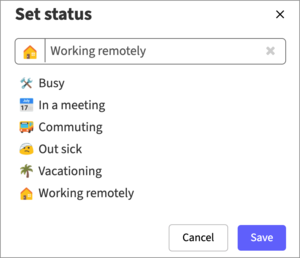
- Users have the option to set statuses in the form of emojis in addition to status messages. Status emojis are displayed in the sidebar, message feed, and message composition field. Emoji animations play only when the mouse pointer hovers over the symbol.

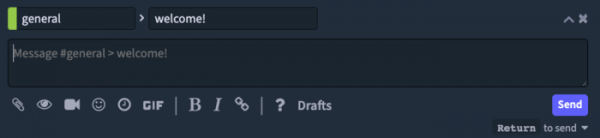
- The message composition field has been redesigned and editing capabilities have been expanded. Formatting buttons have been added for bold or italic text, link insertion, and timestamp addition. For larger messages, the input field can now expand up to full-screen size.

- A feature has been added to mark topics as resolved, making it convenient for visually indicating the completion of various tasks.
- Up to 20 images can now be inserted into a message, which are displayed with grid alignment. The interface for viewing images in full-screen mode has been revamped, improving scaling, panning, and tag display.
- The style of tooltips and dialogs has been changed.
- It is now possible to create contextual links to messages or chats when addressing issues, engaging in forums, working with email, and in any other applications. Persistent links are redirected to the latest message in case the message is moved to a different topic or section. Support for linking to individual messages in a discussion thread has been added.
- A feature has been added to display the contents of publication sections (stream) on the web with the ability to view without creating an account.

- The administrator can now define personal settings that are applied by default for new users. For example, the theme and icon set can be changed, notifications can be enabled, etc.
- Support for sending invitations with a limited validity period has been added. When a user is blocked, all invitations sent by them are automatically revoked.
- The server now supports authentication using the OpenID Connect protocol, in addition to methods such as SAML, LDAP, Google, GitHub, and Azure Active Directory. Support for syncing arbitrary profile fields and automatically creating accounts has been introduced for SAML authentication. Support for the SCIM protocol for synchronizing accounts with an external database has also been added.
- Support for launch has been added server on ARM architecture systems, including Apple computers with M1 chip.
Source: opennet.ru
