

eQualite has released the mobile web browser CENO 1.4.0, aimed at facilitating access to information under conditions of censorship, traffic filtering, or segments of the internet being disconnected from the global network. It is based on Firefox for Android (Mozilla Fennec). The functionality related to building a decentralized network has been moved to a separate library called Ouinet, which can be used to add tools for bypassing censorship to arbitrary applications. The project's developments are distributed under the MIT license. Ready builds are available on Google Play.
The CENO browser and Ouinet library allow access to information in conditions of active proxy server blocking, VPN, gateways, and other centralized mechanisms for bypassing traffic filtering, even in cases of complete internet shutdowns in censored areas (when content is fully blocked, it can be served from cache or local storage). A P2P network is created for data exchange, where users participate in redirecting traffic to external gateways (injectors) that provide access to information circumventing filters.
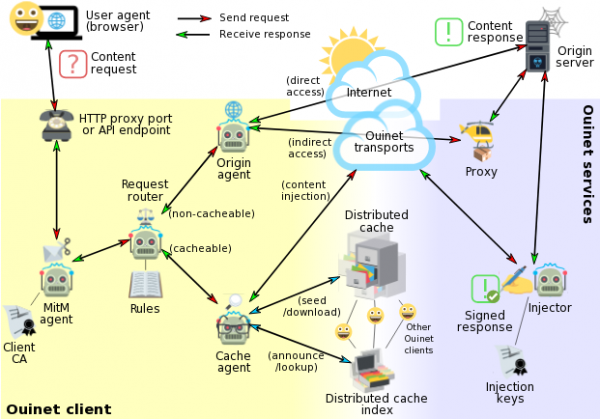
The project also envisions caching content on each user's side while maintaining a decentralized cache of popular content. When a user opens a website, the loaded content is cached in the user's system and becomes available to P2P network participants who cannot access the resource directly or the gateways for bypassing the block. Each device only stores data that is directly requested from that device. The identification of cached pages is done using a hash of the URL, while all additional data related to the page, such as images, scripts, and styles, is grouped and provided together under a single identifier.
To gain access to new content that is blocked from direct access, special proxy gateways (injector) are used, which are placed in external parts of the network that are not subject to censorship. Information between the client and the gateway is encrypted using public key encryption. Digital signatures are used to identify gateways and prevent the introduction of malicious gateways, while the keys of the project-supported gateways are included in the browser distribution.
To access the gateway under conditions of its blocking, a chain connection through other users is supported, who act as proxies to route traffic to the gateway (data is encrypted with the gateway's key, which prevents transit users, through whose systems the request is transmitted, from intercepting the traffic or determining its content). Client systems do not send external requests on behalf of other users, but either return data from the cache or are used as a link to establish a tunnel to the proxy gateway.
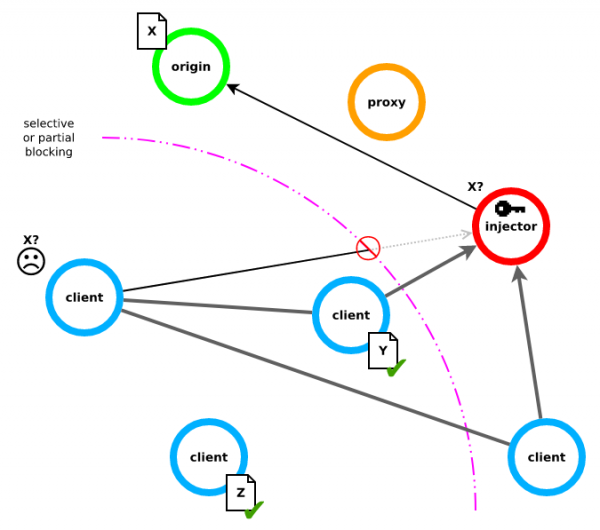
At the same time, CENO does not provide anonymity, and information about sent requests is available for analysis on the participants' devices (an attacker can gain information about data requested or returned from the cache to other users, as well as determine that a user accessed a specific website via the hash). Normal requests are first attempted to be delivered directly by the browser, and if the direct request fails, a search in the distributed cache is performed. If the URL is not in the cache, the information is requested through the connection to the proxy gateway or by referring to the gateway via another user. Confidential data, such as cookies, are not stored in the cache.
For confidential requests, such as those requiring connection to personal accounts in email and social networks, it is recommended to use a separate private tab, where data is requested only directly or through a proxy gateway, but without accessing the cache and without being stored in the cache.
Each system in the P2P network is assigned an internal identifier used for routing within the P2P network, but it is not tied to the user's physical location. The authenticity of the transmitted and cached information is ensured through the application of digital signatures (Ed25519). The transmitted traffic is encrypted using TLS. A distributed hash table (DHT) is used to access information about the network structure, participants, and cached content. If necessary, µTP or Tor can be used as transport in addition to HTTP.
Changes in the new release:
- Access to data stored in the local cache of the current system has been enabled, allowing multiple users in the local network to share previously downloaded content in completely isolated networks without internet access. Data exchange is also possible prior to loading the distributed hash table (DHT).
- An IP address of one of the nodes has been added to the list of nodes used to connect to the network in case of DNS failures.
- Debugging capabilities for failures have been expanded.
- The browser extension 'HTTPS by default' has been included, which by default enables requests over the HTTPS protocol.
- The 'no Wi-Fi' dialogue has been transformed into 'on mobile data' and now appears when operating through a mobile carrier network, regardless of the Wi-Fi state.
- Updated versions of CENO Extension 1.4.2 and Ouinet client 0.18.2.
Source: opennet.ru
