

The developers of the GNUnet framework, designed for building secure decentralized P2P networks without a single point of failure and capable of guaranteeing the privacy of users' information, have released the first version of the libgnunetchat library 0.1.0. This library simplifies the use of GNUnet technologies and the GNUnet Messenger service for creating secure chat applications.
Libgnunetchat provides a separate level of abstraction over GNUnet Messenger, including typical functionality used in messaging applications. Developers can focus on creating the graphical interface using their choice of GUI toolkit while not worrying about components related to chat organization and user interaction. Clients implemented based on libgnunetchat remain compatible with each other and can interact with one another.
To ensure privacy and protection against message interception, the CADET (Confidential Ad-hoc Decentralized End-to-End Transport) protocol is used, allowing for fully decentralized interaction among a group of users with end-to-end encryption of transmitted data. Users can send messages and files. Access to messages in files is granted only to group members. A distributed hash table (DHT) or special entry points can be used to coordinate interaction among decentralized network participants.
In addition to Messenger, libgnunetchat also utilizes the following GNUnet services:
- GNS (GNU Name System, a fully decentralized and censorship-resistant replacement for DNS) for determining published records in public chat pages (lobbies), opening chats, and exchanging credentials.
- ARM (Automatic Restart Manager) for automating the launch of all GNUnet services necessary for operation.
- FS (File Sharing) for secure uploading, sending, and organizing file sharing (all information is transmitted only in encrypted form, and the use of the GAP protocol does not allow tracking who uploaded or downloaded a file).
- IDENTITY for creation, deletion, and management of accounts, as well as for verifying another user's parameters.
- NAMESTORE for local storage of address book and chat information, and for publishing posts on chat pages available through GNS.
- REGEX for publishing participant information, enabling the quick formation of a public group chat on a specific topic.
Key features of the first release of libgnunetchat:
- Account management (creation, viewing, deletion) and the ability to switch between different accounts during operation.
- Ability to rename accounts and update keys.
- Sharing contacts through public chat pages (lobbie). User information can be received as a text link or as a QR code.
- Contacts and groups can be managed separately, allowing different nicknames to be linked to different groups.
- Ability to request and open a direct chat with any participant from the address book.
- Abstraction of user and chat representations to simplify wrapping in the desired interface.
- Support for sending text messages, files, and organizing file sharing.
- Support for sending read receipts and the ability to check the status of message delivery.
- Ability to automatically delete messages after a specified time.
- Flexible file management capabilities in chat, for instance, displaying a preview of the content while keeping the actual content encrypted.
- Ability to connect handlers for tracking all operations (uploading, sending, deleting from indexes).
- Support for receiving invitations to connect to new chats.
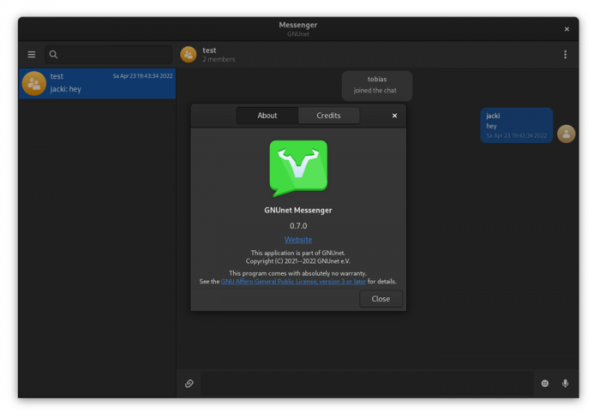
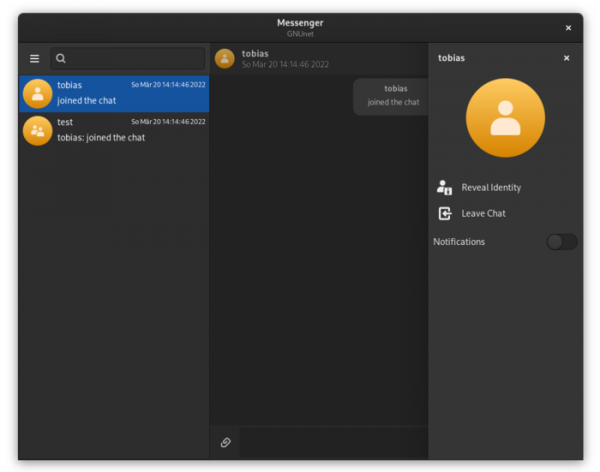
Additionally, it is worth noting the release of the GNUnet Messenger 0.7, which offers a GTK3-based interface. GNUnet Messenger continues the development of the cadet-gtk graphical client, which has been transitioned to the libgnunetchat library (the functionality of cadet-gtk is divided into a universal library and an add-on with a GTK interface). The program supports creating chats and chat groups, managing an address book, sending invitations to join groups, sending text messages and voice recordings, organizing file sharing, and switching between multiple accounts. For console enthusiasts, a console messenger based on libgnunetchat is being developed separately, which is still in the early stages of development.
Source: opennet.ru
