

The creator of the GeckoLinux distribution, based on the openSUSE package base and focusing heavily on desktop optimization and details like quality font rendering, has introduced a new distribution — SpiralLinux, built using packages from Debian GNU/Linux. The distribution offers 7 ready-to-use Live editions, shipped with desktop environments such as Cinnamon, Xfce, GNOME, KDE Plasma, Mate, Budgie, and LXQt, configured to enhance usability.
The GeckoLinux project will continue to be supported, while SpiralLinux is an attempt to maintain a familiar environment in the event that openSUSE ceases to exist or transforms into a fundamentally different product, in line with the upcoming plans for significant revisions of SUSE and openSUSE. Debian has been chosen as a base for its stability, flexible adaptability, and quality support. It is noted, however, that Debian developers are not sufficiently focused on end-user convenience, which is a reason for creating derivative distributions whose authors strive to make the product more user-friendly.
Unlike projects such as Ubuntu and Linux Mint, SpiralLinux does not seek to develop its own infrastructure but aims to stay as close to Debian as possible. SpiralLinux utilizes packages from the main Debian repository and uses the same repositories, but offers different default settings for all major desktop environments available in the Debian repositories. Thus, users are presented with an alternative way to install Debian, which is updated from the official Debian repositories but offers a set of more user-optimized configurations.
Features of SpiralLinux
- Installable Live images for DVD/USB approximately 2 GB in size, configured for popular desktop environments.
- Utilization of Debian Stable packages with pre-installed packages from Debian Backports, ensuring support for newer hardware.
- The ability to update to the Debian Testing or Unstable branches with just a few clicks.
- Optimal Btrfs subvolume layout with transparent Zstd compression and automatic Snapper snapshots, bootable via GRUB for rolling back changes.
- Graphical package manager for Flatpak and a pre-configured theme applied to Flatpak packages.
- Font rendering and color settings optimized for optimal readability.
- Ready-to-use proprietary multimedia codecs and 'non-free' Debian package repositories.
- Extended hardware support with a wide range of pre-installed firmware.
- Enhanced printer support with simplified printer management rights.
- Utilization of the TLP package for power consumption optimization.
- Inclusion into VirtualBox.
- Using swap partition compression with zRAM technology to improve performance on older hardware.
- Allowing regular users to work and administer the system without accessing the terminal.
- Complete binding to the Debian infrastructure, avoiding dependencies on individual developers.
- Support for smooth upgrades of the installed system to future Debian releases while preserving the unique configuration of SpiralLinux.
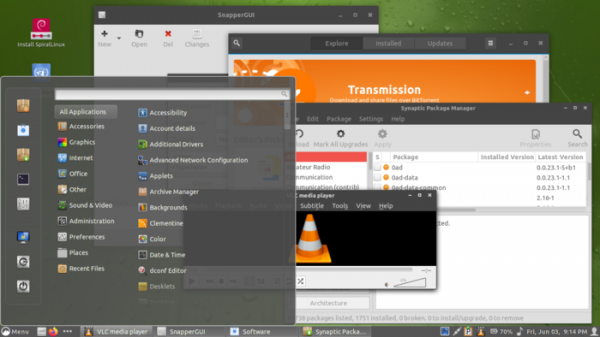
Cinnamon:
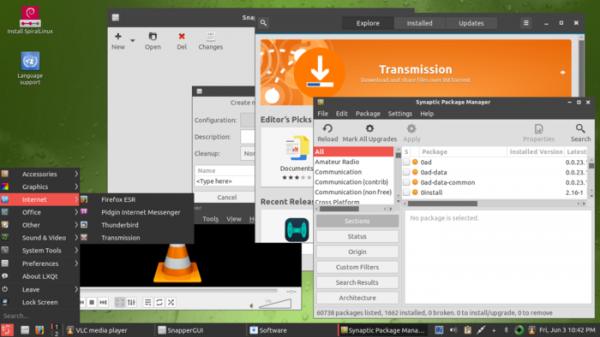
LXQt:
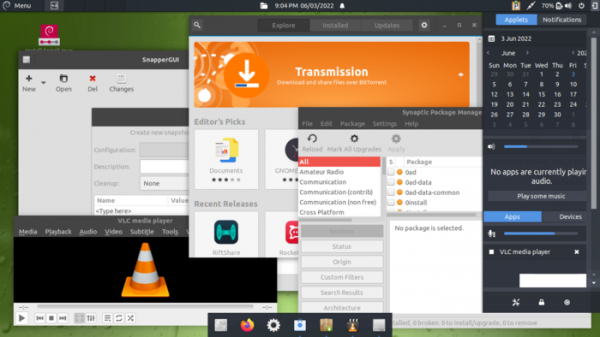
Budgie:
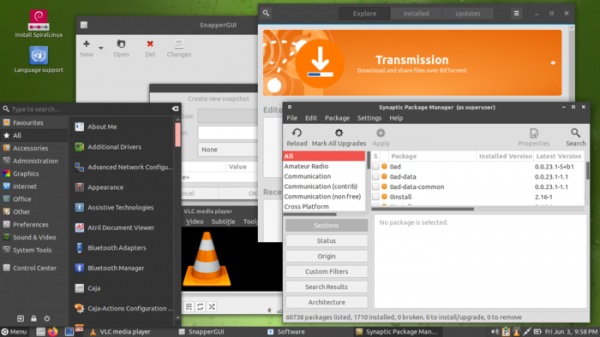
Mate:
KDE:
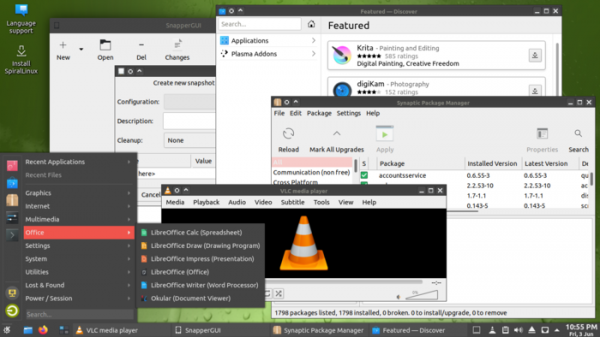
GNOME:
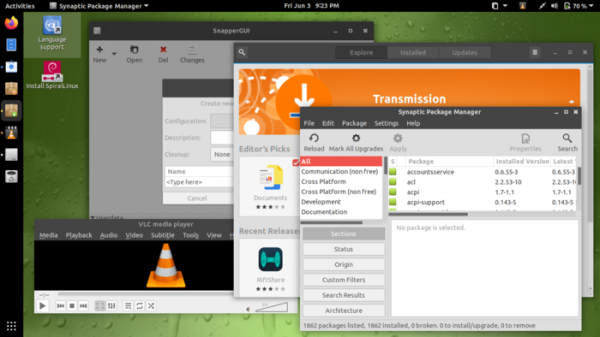
Xfce:
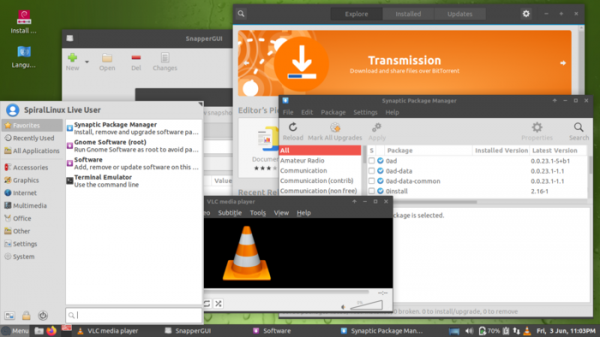
Source: opennet.ru
