

Tim Berners-Lee has announced the decision to grant the specification defining decentralized identifiers for the Web (DID, Decentralized Identifier) the status of a recommended standard. Objections raised by companies like Google and Mozilla have been rejected.
The DID specification introduces a new type of unique global identifiers that are not tied to individual centralized services or organizations, such as domain registrars and certificate authorities. An identifier can be associated with any resource and generated using systems trusted by the resource owner. To verify the authenticity of the identifier, proof of ownership is authenticated based on cryptographic mechanisms, such as digital signatures. The specification allows for various methods of decentralized management and obtaining information about identifiers, including methods based on blockchain.
The format of the new URI is constructed as "did:method:unique_identifier", where "did" defines the new URI scheme, "method" indicates the mechanism for processing the identifier, and "unique_identifier" represents a resource identifier specific to the chosen method, for example, "did:example:123456789abcdefghi". The method field specifies the name of the service used for storing verifiable data that ensures the uniqueness of the identifier, defines its format, and binds the identifier to the resource it is created for. The URI with the identifier is transformed into a JSON document containing metadata that describes the requested object and includes public keys for verifying the owner's identity.
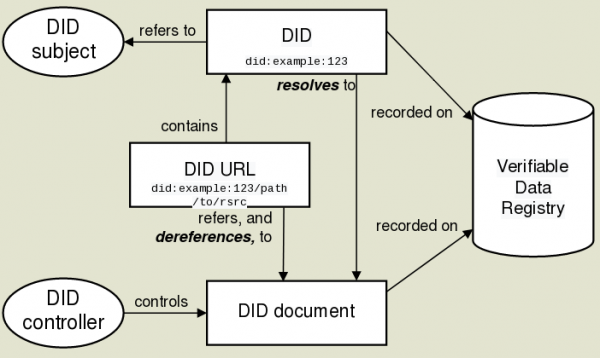
Implementations of methods go beyond the DID standard, defined in their own specifications and supported in a separate registry. Currently, 135 methods based on various blockchains, cryptographic algorithms, distributed technologies, decentralized databases, P2P systems, and identification mechanisms have been proposed. The creation of DID wrappers over centralized systems is also allowed; for instance, the web method enables binding to traditional host names (e.g., "did:web:example.com").
Google's objections relate to separating the specification of the overall decentralized identifier mechanism from the specifications of specific method implementations, which prevents analyzing the correctness of the core specification without examining the method specifications. Publishing the core specification when the method specifications are not ready complicates the review process, and Google has proposed delaying the standardization of the general DID specification until multiple best methods are ready for standardization, as subtle points requiring refinement of the core specification may arise during the standardization of methods.
Mozilla's objections are related to the fact that the specification does not adequately encourage portability, leaving this issue to the method registry. The registry has already proposed over a hundred methods created without regard for compatibility and standardization of typical solutions. In its current form, it encourages the creation of a new method for each task instead of attempting to adapt existing methods to their needs.
The W3C's position is that standardizing the DID specification, which defines a new extensible class of identifiers and its associated syntax, will stimulate the development of methods and achieving consensus regarding the standardization of methods. There is currently sufficient evidence of the applicability of the core specification for addressing issues in demand within the community developing decentralized technologies. Proposed method implementations should not be evaluated by analogy with new URL schemes, and the creation of a large number of methods can be considered as meeting the basic specification needs of developers.
Standardizing specific methods is viewed as a more complex task, in terms of achieving consensus among developers, than standardizing the general class of identifiers. Therefore, the adoption of the general specification before the standardization of methods is seen as a decision that could cause less potential harm to the community implementing decentralized identifiers.
Source: opennet.ru
