

The release of the distributed replicable block device DRBD 9.2.0 has been published, allowing for the implementation of a RAID-1-like array formed from networked multiple disks of different machines (network mirroring). The system is implemented as a module for the Linux kernel and distributed under the GPLv2 license. The drbd 9.2.0 branch can be used as a transparent replacement for drbd 9.x.x and is fully compatible at the protocol level, configuration files, and utilities.
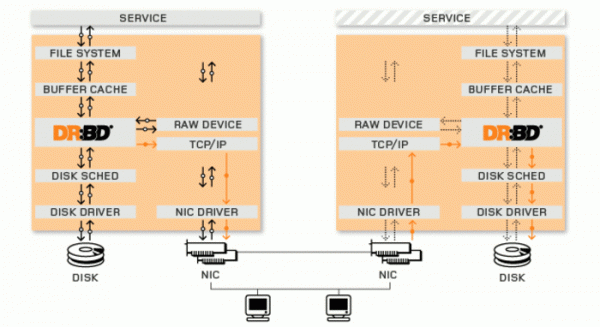
DRBD allows for the integration of cluster node storage into a single fault-tolerant storage system. For applications and the system, this storage appears as a uniform block device for all systems. When using DRBD, all operations on the local disk are sent to other nodes and synchronized with the disks of other machines. In the event of one node failing, the storage will automatically continue to operate using the remaining nodes. When the failed node becomes available again, its state will be automatically updated to the current version.
The cluster that forms the storage can consist of several dozen nodes, located both in a local network and geographically spread across different data centers. Synchronization in such branched storage systems is performed using mesh network technologies (data flows along a chain from node to node). Replication of nodes can occur in both synchronous and asynchronous modes. For example, locally located nodes can use synchronous replication, while for remote locations, asynchronous replication can be applied with additional traffic compression and encryption.
In the new release:
- Reduced latency for mirrored write requests. A closer integration with the network stack has allowed for a decrease in the number of context switches by the scheduler.
- Reduced competition between application I/O and resynchronization I/O due to optimized locking during extent resynchronization.
- Significantly improved resynchronization performance on backends using dynamic storage space allocation (‘thin provisioning’). Performance was enhanced by combining trim/discard operations, which take significantly longer than standard write operations.
- Support for network namespaces has been added, allowing for integration with Kubernetes for transmitting replication network traffic over a network dedicated to containers, instead of the host environment network.
- The transport_rdma module has been added for use as an Infiniband/RoCE transport instead of TCP/IP over Ethernet. The use of the new transport reduces latency, decreases CPU load, and ensures data retrieval without unnecessary copy operations (zero-copy).
Source: opennet.ru
