

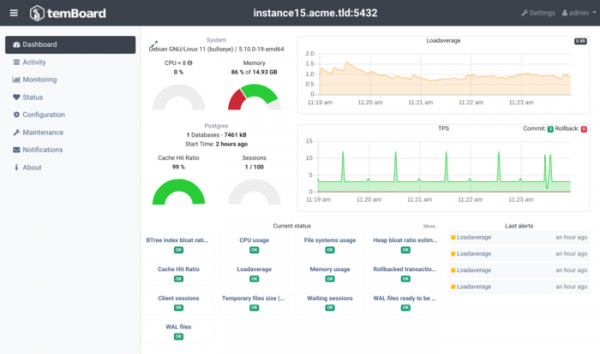
The release of project temBoard 8.0 has been announced, which develops a web interface for remote management, monitoring, configuration, and optimization of PostgreSQL databases. The product includes a lightweight agent installed on each server with PostgreSQL, and a server component that centrally manages the agents and collects statistics for monitoring. The code is written in Python and distributed under the PostgreSQL License.
Key features of temBoard:
- The ability to manage hundreds of PostgreSQL database instances through a single centralized web interface.
- Information screens to assess both the overall status of all databases and a more detailed evaluation of each instance.

- Monitoring the state of databases using various metrics.
- Support for managing active database sessions.
- Tracking vacuum operations on tables and indexes.
- Monitoring slow database queries.
- Interface for optimizing PostgreSQL settings.
In the new version:
- Authentication and channel organization between the management interface and agents have been reworked. The changes have simplified agent deployment and enhanced the security of the communication channel with them. All requests to agents are now further authenticated with a digital signature using asymmetric encryption based on public keys, and the interface serves as an identification provider for the agents. Password authentication, jointly defined on the agent and interface sides, is no longer applied. Now, passwords are only used to establish user connections to the interface.
- A new command-line interface has been proposed. The separate utilities temboard-migratedb and temboard-agent-register have been replaced with built-in commands invoked via executable files temboard and temboard-agent. Built-in commands have been added for performing typical administration and monitoring operations from the command line.
- Support for PostgreSQL 15, RHEL 9, and Debian 12 has been added. Support for PostgreSQL 9.4 and 9.5, as well as Python 2.7 and 3.5 has been discontinued.
- In temboard, the 'register-instance' command has been added for registering agents, which, unlike the 'temboard-agent register' command, is executed on the side server and does not require network availability of the agent, meaning it can be used to add new instances in offline mode.
- The agent's load on the system has been reduced — the number of transactions performed has decreased by 25%, implementing caching for typical values and task multiplexing.
- The default size of stored monitoring data has been reduced to 2 years.
- The ability to upload inventory data in CSV format has been added.
- Automatic restart of background processes for the interface and agent after a crash has been ensured.
Additionally, the release of the Pyrseas 0.10.0 toolkit is noteworthy, designed for supporting PostgreSQL databases and automating data structure update operations. Pyrseas converts the standard schema with database structure and accompanying metadata into YAML or JSON format, more suitable for use in version control systems. By using the YAML format, Pyrseas allows the generation of SQL to synchronize the structure of one database with another (i.e., changes in the structure can be easily made and propagated to other databases). The project code is written in Python and is distributed under the BSD license.
The new release of Pyrseas is notable for switching to Psycopg 3, a completely redesigned branch of the module for working with PostgreSQL from Python programs, supporting asynchronous interaction with the database and providing interfaces based on DBAPI and asyncio. The new version also drops support for Python 2.x and removes pgdbconn from dependencies. Support for PostgreSQL versions 10 through 15 has been ensured.
Source: opennet.ru
