

After almost a year of development, the new release of OpenRGB 0.8 has been published, an open-source toolkit for managing RGB lighting of peripheral devices. The package supports motherboards from ASUS, Gigabyte, ASRock, and MSI with RGB subsystems for case lighting, RAM modules with lighting from ASUS, Patriot, Corsair, and HyperX, graphics cards from ASUS Aura/ROG, MSI GeForce, Sapphire Nitro, and Gigabyte Aorus, various LED strip controllers (ThermalTake, Corsair, NZXT Hue+), glowing coolers, mice, keyboards, headphones, and Razer accessories with lighting. Information about the device interaction protocol is primarily obtained through reverse-engineering proprietary drivers and applications. The code is written in C/C++ and is distributed under the GPLv2 license. Ready builds are created for Linux (deb, rpm, appimage), macOS, and Windows. As before, all builds created after the release will have version number 0.81.
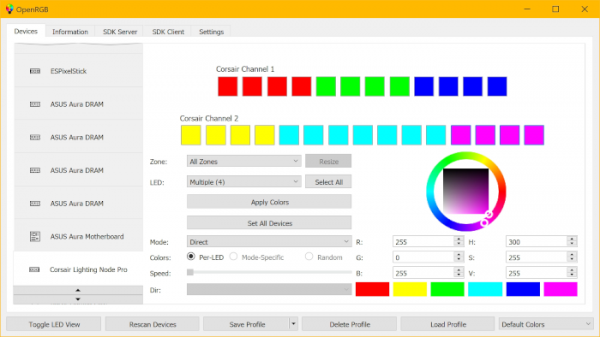
The new release features a partially redesigned and optimized interface, added program localization including a Russian language translation (except for some functionality added during the release stabilization stage).
Among the changes:
- udev rules are now generated automatically.
- The inpout32 library, which caused issues when running alongside certain antivirus and anti-cheat programs (Vanguard), has been replaced with WinRing0.
- For proper operation alongside official SMBus device software on Windows, a system mutex is now used, solving most issues.
- The list of supported devices has been expanded to include a large number of graphics cards from ASUS, Gigabyte, EVGA, MSI, Gainward, and Palit. Additionally, support for NVIDIA Illumination graphics cards has been added; however, at this time, like older NVIDIA graphics cards, it works only on Windows due to issues with i2c through the proprietary NVIDIA driver (the problem is resolved by installing the beta version of the driver). The famous issue with MSI MysticLight motherboards has been resolved, and they are now supported again, expanding the list of supported boards.
- In addition to a large number of 'classic' peripheral devices whose support has been added, the list also includes NanoLeaf modular lights; SRGBMods Raspberry Pi Pico can now be used for DIY devices, and Arduino can now be connected via i2c.
Among known issues:
- The path for settings still should not contain non-ASCII characters. A fix was prepared but did not make it into the release to maintain compatibility with existing plugins; however, it will be included in current builds after the release.
- It has come to light that the manufacturer of Sinowealth keyboards reused the VID/PID values from Redragon keyboards using a different protocol. To avoid potential issues (up to bricking), the code supporting Sinowealth keyboards has now been disabled and is unsupported.
- The 'wave' effect does not work on the Redragon M711.
- Some Corsair mice have unmarked LEDs.
- The layout list is incomplete on some Razer keyboards.
- The number of Asus Addressable channels may be inaccurate.
- As usual, after an update, it is recommended to recreate existing device profiles; old ones may not work or may function incorrectly, and when updating from versions before 0.6, the plugin folder should be cleared as there was no versioning system for plugin APIs before 0.6.
Source: opennet.ru
