

The Blender Foundation has released the free 3D modeling package Blender 3.4, suitable for various tasks related to 3D modeling, 3D graphics, game development, simulation, rendering, compositing, motion tracking, sculpting, animation creation, and video editing. The code is distributed under the GPL license. Precompiled builds are available for Linux, Windows, and macOS. Additionally, a corrective release of Blender 3.3.2 has been made in the long-term support (LTS) branch, with updates planned until September 2024.
Among the enhancements added in Blender 3.4:
- Support for the Wayland protocol has been implemented, allowing Blender to run directly in Wayland-based environments without the need for the XWayland layer, improving performance in Linux distributions that use Wayland by default. To operate in Wayland-based environments, the libdecor library must be present for client-side window decoration.
- The ability to build Blender as a module for the Python language has been added, enabling the creation of wrappers and services for data visualization, animation creation, image processing, video editing, 3D format conversion, and automation of various tasks in Blender. The 'bpy' package is offered for accessing Blender functionality from Python code.
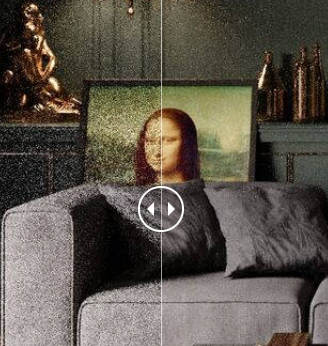
- The Cycles rendering system has introduced support for the 'Path Guiding' method, which allows achieving higher quality in scenes with reflected lighting while consuming the same CPU resources compared to traditional path tracing. Specifically, this method reduces noise levels in scenes where path tracing struggles to track the path to the light source, such as when a room is illuminated through a small door crack. The method is implemented through the integration of the OpenPG (Open Path Guiding) library, developed by Intel.

- Sculpting mode simplifies access to automatic masking settings, which are now available in the 3D viewport header. Features for automatic masking have been added based on irregularities, viewpoint, and selected areas. To convert the automatic mask into a regular mask attribute that can be edited and visualized, use the "Create Mask" button.
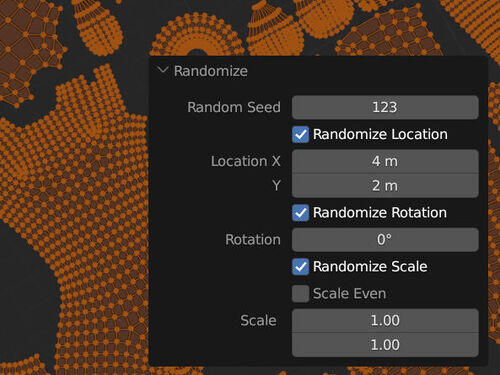
- The UV Editor introduces a new Relax brush for geometry smoothing, enhancing UV unwrapping quality by achieving better correspondence with the 3D geometry when calculating texture overlay parameters on the 3D object. It also adds support for uneven meshes, pixel spacing, upper mesh constraints, UV unwrapping rotation aligned to a selected edge, and quick setting of random scaling, rotation, or offset parameters for selected UV islands.

- Viewport Overlay has been provided to display geometry nodes, which can be used for previewing, debugging, or testing attribute changes in the node tree.
- Eight new nodes have been added for extracting data from meshes and curves (e.g., determining edge seams, vertex angles, setting curve normals, and checking control points). A node for sampling UV surfaces has been included, allowing the attribute value to be determined based on UV unwrap coordinates. The Add menu now displays the resources of the node group.
- The capabilities of the Grease Pencil 2D drawing and animation system have been expanded, allowing sketches in 2D to be created and then used in a 3D environment as three-dimensional objects (a 3D model is formed based on several flat sketches from different angles). A contour modifier has been added to generate outlines based on the camera view. The option to import multiple SVG files at once has been introduced. The fill tool has significantly improved. A new fill method has been proposed, using a circle radius to determine the proximity of line endpoints during filling.
- Support for extensions for physically based rendering (PBR) has been implemented in .mtl files.
- Font handling has been improved.
- Added the ability to extract frames from videos in WebM format and implemented support for encoding videos in AV1 format using FFmpeg.
- The Eevee engine and viewport on the Linux platform now support rendering in headless mode.
- Improved performance of the Subdivision Surface Modifier, object creation in batch mode, calculations of disabled modifiers, and thumbnail creation in WebP format. Enhanced sculpting performance when masks and sets of faces are not used.
Source: opennet.ru
