

After six years of development, the release of the free Computer-Aided Design system LibreCAD 2.2 is now available. The system is aimed at 2D design tasks, such as creating engineering and construction drawings, diagrams, and plans. It supports importing drawings in DXF and DWG formats, and exporting to DXF, PNG, PDF, and SVG formats. The LibreCAD project was created in 2010 as a fork of the CAD system QCAD. The project code is written in C++ using the Qt framework and is distributed under the GPLv2 license. Ready-made builds are prepared for Linux (AppImage), Windows, and macOS.
The engineer is provided with several dozen tools for creating and modifying objects, working with layers and blocks (groups of objects). The system supports extending functionality through plugins and provides means for creating extension scripts. There is a library of elements featuring layouts for several thousand standard parts. The LibreCAD interface is notable for providing extensive customization options—menu and panel content, as well as style and widgets, can be freely changed according to user preferences.
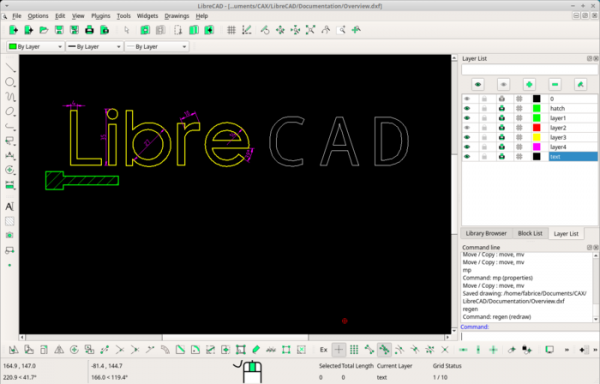
Key Changes:
- Support for the Qt4 library has been discontinued, and the interface has been completely migrated to Qt 5 (Qt 5.2.1+).
- The undo/redo engine has been completely redesigned.
- The command line interface capabilities have been enhanced concerning multi-line command processing, as well as command file recording and opening.
- The interface for print preview has been improved, with added settings for document headers and line width management.
- The ability to select multiple areas simultaneously and batch perform operations on lists of blocks and layers has been added.
- In the project-developed library libdxfrw, support for the DWG format has been improved, and performance optimization has been conducted for panning and zooming large files.
- Accumulated bugs have been fixed, some of which caused crashes.
- Support for new compiler versions has been added.
In the parallel development branch of LibreCAD 3, work is underway to transition to a modular architecture, which separates the interface from the core CAD engine. This allows for the creation of interfaces based on various toolkits, without being tied to Qt. An API has been added for plugin and widget development in Lua.
Source: opennet.ru
