

After a year and a half of development, the fourth beta release of the Haiku R1 operating system has been published. The project was initially created in response to the closure of the BeOS OS and developed under the name OpenBeOS, but it was renamed in 2004 due to trademark claims regarding the use of the BeOS name. Several bootable Live images (x86, x86-64) have been prepared to evaluate the performance of the new release. The source code for most of the Haiku OS is distributed under the MIT open source license, with some libraries, media codecs, and components borrowed from other projects being exceptions.
The Haiku OS is focused on personal computers, utilizing its own kernel built on a modular architecture optimized for high responsiveness to user actions and effective execution of multithreaded applications. It offers an object-oriented API for developers. The system is directly based on BeOS 5 technologies and aims for binary compatibility with applications designed for that OS. The minimum hardware requirement is a Pentium II CPU with 384 MB of RAM (recommended: Intel Core i3 and 2 GB of RAM).
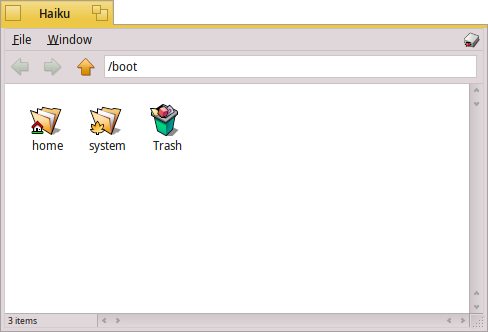
The file system used is OpenBFS, which supports extended file attributes, journaling, 64-bit pointers, support for storing meta-tags (attributes can be saved for each file in a key=value form, making the file system similar to a database), and special indexes to speed up data retrieval. Directory structures utilize 'B+ tree' structures. The file manager Tracker and the Deskbar panel from BeOS have been included in Haiku, with their source codes released after BeOS exited the scene.
Key innovations:
- The performance on high pixel density (HiDPI) screens has been improved. Correct interface scaling has been implemented, which goes beyond just changing font sizes. Upon first boot, Haiku now attempts to automatically detect the presence of a HiDPI screen and select the appropriate scaling sizes. The selected settings can be changed in the preferences, but applying them currently requires a reboot. Scaling parameters are supported in most native applications and in some ported ones, but not all.
- The option to use a flat appearance with flat window decorators and button styling, instead of a style that heavily utilizes gradients, has been provided. The flat design is included in the Haiku Extras package and can be enabled in the appearance settings.

- A layer has been added to ensure compatibility with the Xlib library, allowing X11 applications to run on Haiku without starting an X server. This layer is implemented by emulating Xlib functions through translating calls to Haiku's high-level graphical API.
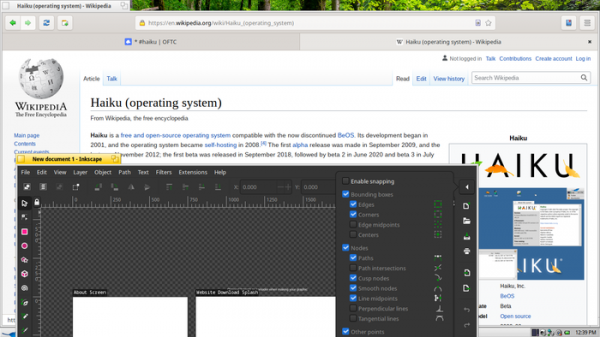
- A layer has been prepared to ensure compatibility with Wayland, allowing toolkits and applications that use this protocol to run, including those based on the GTK library. The layer provides the libwayland-client.so library, based on the libwayland code and compatible at the API and ABI level, which allows Wayland applications to run without changes. Unlike typical composite Wayland implementations, this layer does not run as a separate server process; instead, it is loaded as a plugin to client processes. Instead of sockets in servers Wayland does not start as a separate server process but is loaded as a plugin to client processes. Instead of sockets in server For testing, precompiled packages with GTK3, GIMP, Inkscape, Epiphany (GNOME Web), Claws Mail, AbiWord, and HandBrake can be found in the haikuware repository.
- Thanks to the compatibility layers for X11 and Wayland, a working port of the GTK3 library has been prepared. Applications that can be launched using this port include GIMP, Inkscape, Epiphany (GNOME Web), Claws-mail, AbiWord, and HandBrake.

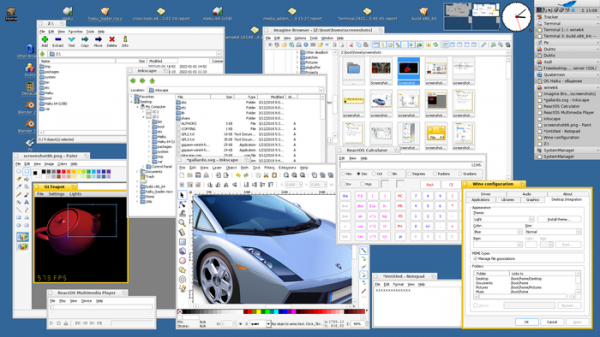
- A working port with Wine has been added, which can be used to run Windows applications on Haiku. The limitations include the ability to run only on 64-bit builds of Haiku and the capability to execute only 64-bit Windows applications.
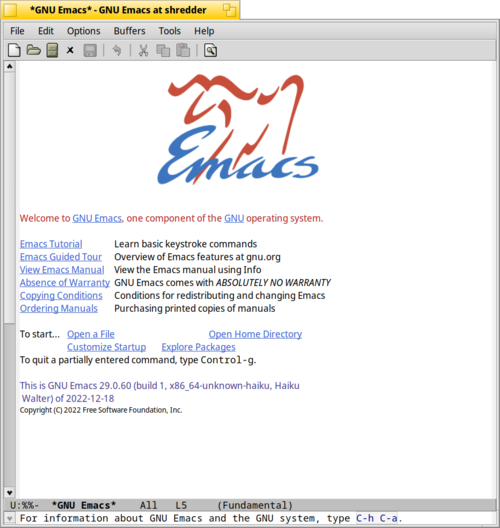
- A port of the GNU Emacs text editor operating in graphical mode has been added. The packages are available in the HaikuDepot repository.

- Support for generating and displaying image thumbnails has been added to the Tracker file manager. Thumbnails are stored in the extended attributes of files.

- A layer for compatibility with FreeBSD drivers has been implemented. Drivers have been ported from FreeBSD to support wireless USB adapters with Realtek (RTL) and Ralink (RA) chips. A limitation is that the device needs to be connected before booting (it is not recognized after booting).
- The 802.11 wireless stack has been ported from OpenBSD with support for 802.11ac and the iwm and iwx drivers for Intel "Dual Band" and "AX" wireless adapters.
- A USB-RNDIS driver has been added, enabling the setup of an access point via USB (USB tethering) for use as a virtual network card.
- A new NTFS driver based on the library from the NTFS-3G project has been added. The new implementation is more stable, supports integration with the file caching layer, and provides good performance.
- A translator for reading and writing images in the AVIF format has been added.
- The HaikuWebKit browser engine has been synchronized with the latest version of WebKit and transitioned to a network backend based on the cURL library.
- Support for 32-bit systems with EFI has been added to the bootloader, allowing the installation of a 64-bit Haiku environment from a 32-bit EFI bootloader.
- Compatibility with POSIX standards has been improved. The process of replacing calls to the standard C library, previously ported from glibc, with versions from musl has been continued. Support for C11 threads and locale_t methods has been added.
- The driver for NVMe drives has been improved, adding support for the TRIM operation to inform the drive about freed blocks.
- Support has been added for building the kernel and drivers with new versions of GCC (including GCC 11). However, due to dependencies on old code for compatibility with BeOS, GCC 2.95 is still required for building the system.
- Overall work has been done to improve the stability of the entire system.
Source: opennet.ru
