

After 11 months of development, the release of the Sway 1.8 compositing manager has been published, built using the Wayland protocol and fully compatible with the tiling window manager i3 and the i3bar panel. The project code is written in C and distributed under the MIT license. The project is aimed at use in Linux and FreeBSD.
Compatibility with i3 is provided at the level of commands, configuration files, and IPC, allowing Sway to be used as a transparent replacement for i3, utilizing Wayland instead of X11. Sway allows windows to be organized on the screen logically rather than spatially. Windows are arranged in a grid that makes optimal use of screen space and allows for quick manipulation of windows using only the keyboard.
To create a complete user environment, the following components are offered: swayidle (background process implementing the KDE idle protocol), swaylock (screen locker), mako (notification manager), grim (screenshot creation), slurp (screen area selection), wf-recorder (video capture), waybar (application bar), virtboard (on-screen keyboard), wl-clipboard (clipboard management), wallutils (desktop wallpaper management).
Sway evolves as a modular project built on top of the wlroots library, which abstracts all basic primitives for organizing the operation of the compositing manager. Wlroots includes backends for abstracting access to the screen, input devices, rendering without direct access to OpenGL, interaction with KMS/DRM, libinput, Wayland, and X11 (providing a layer to run X11 applications on Xwayland). In addition to Sway, the wlroots library is actively used in other projects, including Librem5 and Cage. In addition to C/C++, bindings have been developed for Scheme, Common Lisp, Go, Haskell, OCaml, Python, and Rust.
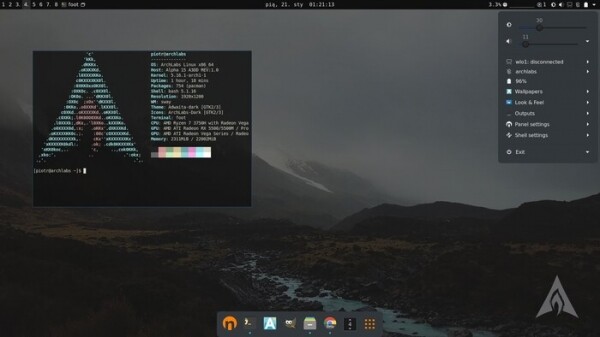
In the new release:
- A new command 'bindgesture' has been implemented to attach actions to gestures on the touchpad.
- The screen locking process (swaylock) has been transitioned to use the Wayland protocol ext-session-lock-v1, which has increased the reliability and security of session locking.
- A new command 'output unplug' has been added to remove virtual output devices.
- Support for high-resolution mouse wheel scroll events has been added.
- Support for the 'disable while trackpointing' setting in the libinput library is provided to manage the disabling of the touchpad while using the trackpoint joystick (trackpoint on Thinkpad laptops).
- To enhance the reliability of workspace detection when launching new client applications, the xdg-activation-v1 protocol has been employed.
- The rendering system implementation in the wlroots library has been improved using the Vulkan graphics API.
- To optimize the task scheduling process on the Linux platform, the capability to set CAP_SYS_NICE privileges has been implemented.
- Support for operation with the SUID root flag has been discontinued.
- The command 'output dpms' has been declared deprecated, and the 'output power' command is now used instead.
- For working with regular expressions, the pcre2 library is now used instead of pcre.
Source: opennet.ru
