

Barry Kauler, the founder of the Puppy Linux project, has released an experimental distribution EasyOS 5.0, combining Puppy Linux technologies with container isolation for running system components. The distribution is managed through a set of graphical configurators developed by the project. The size of the boot image is 825 MB.
The new release includes updated versions of applications. Virtually all packages have been rebuilt from source code, using metadata from the OpenEmbedded 4.0 project. Support for language packages 'langpack' and builds specific to certain languages has been discontinued. Translations related to the selected language have been moved to separately downloadable files. Language selection for the interface now occurs after the first boot. The MoManager application, used for translating user elements into different languages, has been rewritten.
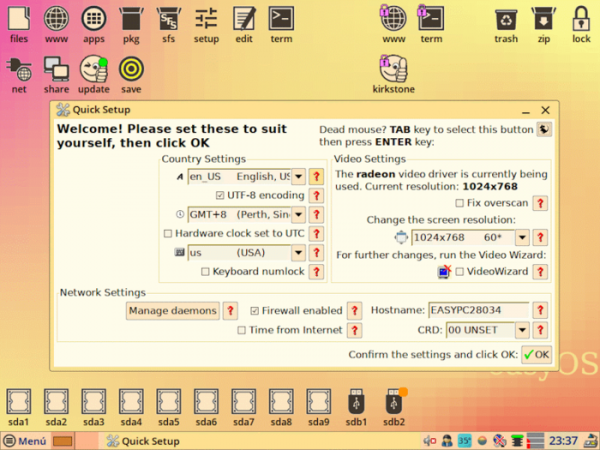
Features of the distribution:
- Each application, as well as the desktop itself, can be launched in separate containers using the Easy Containers mechanism for isolation.
- Operation by default with root privileges, dropping privileges at the start of each application, as EasyOS is positioned as a live one-user system.
- The distribution installs in a separate subdirectory and can coexist with other data on the storage device (the system is installed in /releases/easy-5.0, user data is saved in the /home directory, and additional containers with applications are located in the /containers directory).
- Encryption of individual subdirectories (for example, /home) is supported.
- Meta-packages in SFS format can be installed, which are mountable images with Squashfs that combine several regular packages and are similar to appimages, snaps, and flatpak formats.
- The system updates in an atomic mode (the new version is copied to another directory, and the active directory is switched with the system) and supports reverting changes in case of issues after the update.
- There is a mode for running from RAM, in which the system is copied to memory at boot and operates without accessing disks.
- The distribution is built using the WoofQ toolkit and source texts of packages from the OpenEmbedded project.
- The desktop is based on the JWM window manager and ROX file manager.
- The base package includes applications such as Firefox, LibreOffice, Scribus, Inkscape, GIMP, mtPaint, Dia, Gpicview, the Geany text editor, Fagaros password manager, HomeBank personal finance management system, DidiWiki personal wiki, Osmo organizer, Planner project manager, Notecase notes system, Pidgin, Audacious music player, Celluloid, VLC and MPV media players, LiVES video editor, and OBS Studio streaming system.
- To simplify file sharing and organize printer access, there is a proprietary application called EasyShare.
Source: opennet.ru
