

The release of the free boot firmware Libreboot 20230319 has been announced. The project builds upon the existing coreboot implementation, providing a replacement for proprietary UEFI and BIOS firmware responsible for initializing the CPU, memory, peripherals, and other hardware components, while minimizing binary blobs.
Libreboot aims to create a system environment that completely avoids proprietary software, not just at the operating system level but also in the firmware responsible for booting. Libreboot not only cleans coreboot of non-free components but also enhances it with tools that simplify usage for end-users, forming a distribution that anyone without special skills can use.
Among the hardware supported by Libreboot:
- Desktop systems include Gigabyte GA-G41M-ES2L, Intel D510MO, Intel D410PT, Intel D945GCLF, and Apple iMac 5,2.
- Laptops: ThinkPad X60 / X60S / X60 Tablet, ThinkPad T60, Lenovo ThinkPad X200 / X200S / X200 Tablet / X220 / X230, Lenovo ThinkPad R400, Lenovo ThinkPad T400 / T400S / T420 / T440, Lenovo ThinkPad T500 / T530, Lenovo ThinkPad W500 / W530, Lenovo ThinkPad R500, Apple MacBook1 and MacBook2, as well as various Chromebook devices from companies ASUS, Samsung, Acer, and HP.
In the new release:
- Support has been added for Lenovo ThinkPad W530 and T530 laptops. The next version is expected to support HP EliteBook 8560w, Lenovo G505S, and Dell Latitude E6400.
- Support for Asus p2b_ls and p3b_f motherboards has been discontinued.
- The code for memory initialization (raminit) has been adapted for boards with processors based on the Haswell microarchitecture. Operation has been verified on ThinkPad T440p and ThinkPad W541 laptops.
- Issues with entering sleep mode (S3) on ThinkPad T440p and ThinkPad W541 laptops have been resolved.
- In GRUB, forced console output mode (GRUB_TERMINAL=console) has been enabled without changing the video mode, which improved the display of boot menus for installation media of some Linux distributions.
- For most x86 boards, synchronization with the CoreBoot codebase as of February 2023 has been completed, including improvements for devices with chips based on the Haswell microarchitecture (ThinkPad T440p/W541).
- Changes have been ported from the current codebases of GRUB and SeaBIOS.
- The wait time in grub.cfg has been reduced from 10 to 5 seconds.
- For ThinkPad laptops GM45, the default video memory allocation size has been reduced from 352MB to 256MB.
- The nvmutil codebase has been reworked.
In addition, the author of Libreboot has begun developing a new minimalist Live distribution for system recovery after failures. Similar to the Heads distribution, this project is developing a Flash-based trimmed-down system environment that can be booted from LibreBoot, CoreBoot, or LinuxBoot. However, instead of building it as a bootable 'payload,' the new project plans to prepare a separate system image that can be loaded into CBFS and invoked from intermediate payloads with GRUB or SeaBIOS, capable of executing files stored on Flash.
The project is interesting in that it plans to combine the Linux kernel, the standard C library Musl, and tools from the basic environment of OpenBSD. To realize this idea, the development of the lobase project, which was working on porting OpenBSD utilities to Linux but was abandoned five years ago, has continued (the author of Libreboot created a fork of lobase, updated to OpenBSD 7.2, and ported for Musl). For package management and the installation of additional programs, the plan is to use the apk-tools from Alpine Linux, and for building images, the abuild and aports toolset. After the fork of the OpenBSD user environment is ready, it is planned to hand it over to the Alpine project to be used as an alternative to the BusyBox package.
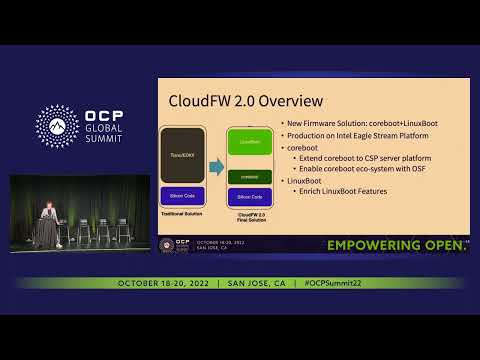
Additionally, the announcement of the CloudFW 2.0 project can be noted, which implements firmware based on Coreboot and LinuxBoot to replace UEFI, providing a complete open firmware stack for x86.serversDevelopment is being carried out by the Chinese company Bytedance (owner of TikTok), which uses CloudFW on the hardware in its infrastructure.
Source: opennet.ru
