

The Sculpt 23.04 release is presented, within which a general-purpose operating system is being developed based on the Genode OS Framework technologies, aimed at regular users for performing everyday tasks. The project's source texts are distributed under the AGPLv3 license. A 28 MB LiveUSB image is available for download. It supports operation on systems with Intel processors and graphics subsystems with VT-d and VT-x extensions enabled, as well as on ARM systems with VMM extensions.
Key innovations:
- Support for the PinePhone smartphone has been implemented, and an interface optimized for mobile devices has been proposed. ARM architecture support has been improved.
- The ability to update the boot image in live mode has been added. The user interface has implemented a feature to switch between Sculpt OS versions, leading to the loading of the necessary system image, installation of the image onto the boot medium, and reboot of the device.
- The menu now supports presets, allowing the application launch scenarios to be changed with a single click of the mouse. For example, a preset has been added for launching a simple nano3d desktop with the Falkon browser.
- Sleep mode transition support has been expanded.
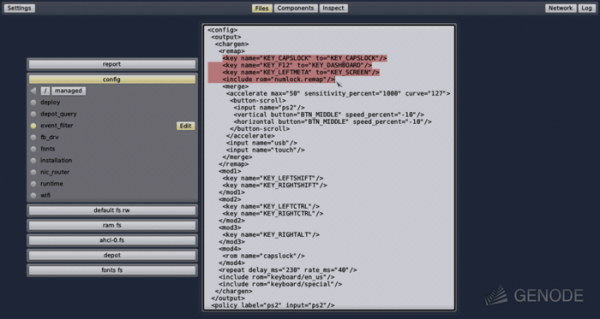
The system comes with the Leitzentrale graphical interface, allowing typical system administration tasks to be performed. In the top left corner of the graphical interface, a menu with tools for managing users, connecting storage devices, and configuring network connections is displayed. In the center, there is a configurator for assembling the system's components, providing a graph-like interface that defines the relationships between system components. Users can interactively remove or add components to define the system environment's composition. of virtual machines.
At any time, the user can switch to the console management mode, which offers greater flexibility in management. A traditional desktop can be obtained by launching the TinyCore Linux distribution. virtual machine with Linux. In this environment, the Firefox and Aurora browsers, a Qt-based text editor, and various applications are available. Command line utilities are provided in a noux environment.
Genode provides a unified infrastructure for creating custom applications that run on top of the Linux kernel (32 and 64 bit) or the NOVA microkernel (x86 with virtualization), seL4 (x86_32, x86_64, ARM), Muen (x86_64), Fiasco.OC (x86_32, x86_64, ARM), L4ka::Pistachio (IA32, PowerPC), OKL4, L4/Fiasco (IA32, AMD64, ARM), and a direct-running kernel for ARM and RISC-V platforms. The paravirtualized Linux kernel L4Linux, running on top of the Fiasco.OC microkernel, enables the execution of standard Linux programs within Genode. The L4Linux kernel does not interact directly with hardware but uses Genode services via a set of virtual drivers.
Various Linux and BSD components have been ported to Genode, ensuring support for Gallium3D, integrating Qt, GCC, and WebKit, and enabling the organization of hybrid Linux/Genode software environments. A port of VirtualBox has been prepared, which operates on top of the NOVA microkernel. A large number of applications have been adapted to run directly atop the microkernel and the Noux environment, which provides OS-level virtualization. For unported programs, there is a mechanism for creating application-level virtual environments that allows programs to run in a virtual Linux environment using paravirtualization.
Source: opennet.ru
