

The release of the Wolvic web browser 1.4 has been published, designed for use in augmented and virtual reality systems. The project continues the development of the Firefox Reality browser, which was previously developed by Mozilla. Following the stagnation of the Firefox Reality codebase, the development has been continued by Igalia, known for its contributions to free projects like GNOME, GTK, WebKitGTK, Epiphany, GStreamer, Wine, Mesa, and freedesktop.org. The Wolvic code is written in Java and C++ and is distributed under the MPLv2 license. Pre-compiled builds are available for the Android platform. It supports compatibility with 3D headsets including Oculus, Huawei VR Glass, Lenovo VRX, Lenovo A3, HTC Vive Focus, Pico Neo, Pico4, Pico4E, Meta Quest Pro, and Lynx (with ongoing porting for Qualcomm devices).
The browser uses the GeckoView web engine—a version of the Mozilla Gecko engine packaged as a separate library that can be updated independently. Control is achieved through a fundamentally different three-dimensional user interface that allows navigation of websites within the virtual world or in augmented reality systems. In addition to the interface designed for control via a 3D headset that permits viewing traditional two-dimensional pages, web developers can utilize the WebXR, WebAR, and WebVR APIs to create specialized three-dimensional web applications, with interactions taking place in virtual space. It also supports viewing spatial videos shot in 360 degrees in a 3D headset.
VR controllers are used for navigation, while data entry in web forms can be done using a virtual or physical keyboard. Additionally, a voice input system is offered for user interaction, enabling form filling and search queries using the speech recognition engine developed by Mozilla. The browser's start page provides an interface for accessing favorite content and navigating through a collection of games, web applications, 3D models, and spatial videos adapted for 3D headsets.
In the new version:
- Support has been added for the Lenovo VRX 3D headset, as well as experimental support for Lenovo A3 and Lynx-R1 headsets.
- Realistic three-dimensional models have been implemented for visual tracking of hand movements. The processing of control gestures has been improved, addressing issues with false gesture recognition for tapping and scaling.
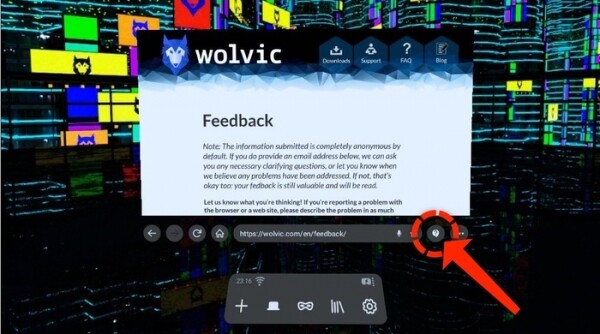
- A button has been added for submitting your feedback or reporting an issue.

- The ability to stream images from external cameras to a virtual screen has been added, allowing users to see in real-time what is happening around them while wearing a virtual reality headset. Windows, models, and arbitrary 3D objects can be overlaid on the streamed image, creating an augmented reality effect. Several image output strategies are supported: overlay mode based on OpenXR, turning off the background image (skybox), and engaging an additional composite manager.
- The Android app is now recognized by the platform as a web browser.
- Support for video from the Japanese streaming service U-NEXT has been added.
- An initial implementation of a Chromium-based backend has been proposed with a simple interface for navigation through the address bar. The backend supports the WebContents and WebXR APIs.
Source: opennet.ru
