

A group of researchers from several universities in the USA has developed a new side-channel attack technique that allows the recreation of visual information processed in GPUs. Using the proposed method, called GPU.zip, an attacker can determine the information displayed on the screen. Among other things, the attack can be carried out through a web browser; for example, it has been demonstrated that a malicious webpage opened in Chrome can extract pixel information rendered from another webpage opened in the same browser.
The source of the information leak is the optimization used in modern GPUs that provides graphics data compression. The problem manifests when using compression on all tested integrated GPUs (AMD, Apple, ARM, Intel, Qualcomm) and discrete NVIDIA graphics cards. Researchers found that Intel and AMD integrated GPUs always enable graphics data compression, even when an application does not specifically request such optimization. The use of compression leads to traffic in DRAM and cache load correlating with the nature of the processed data, which can be reconstructed pixel by pixel through side-channel analysis.
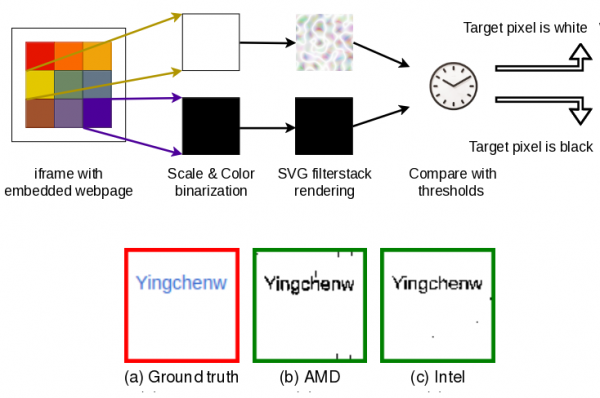
The method is quite slow; for example, on a system with an integrated AMD Ryzen 7 4800U GPU, the attack to determine the name under which the user logged into Wikipedia in another tab took 30 minutes and allowed for the determination of pixel content with 97% accuracy. On systems with an integrated Intel i7-8700 GPU, a similar attack took 215 minutes with 98% accuracy.
When conducting an attack through a browser, the target site is cyclically opened in an iframe to initiate rendering. To determine the displayed information, the output of the iframe is converted to a black-and-white representation, to which an SVG filter is applied that sequentially overlays masks, introducing and not introducing significant redundancy during compression. Based on the evaluation of changes in the rendering time of reference samples, the presence of dark or light pixels at a specific position is highlighted. The overall image is reconstructed through sequential pixel-by-pixel verification using similar masks.
GPU and browser manufacturers were notified of the issue in March, but no supplier has prepared a fix yet, as performing an attack under practical conditions is questionable and the issue is of more theoretical interest. Google has not yet decided on the feasibility of blocking the attack at the browser level in Chrome. Chrome is vulnerable because it allows iframe loading from another site without clearing cookies, enables the application of SVG filters to the iframe, and delegates the GPU rendering process. Firefox and Safari are not susceptible to this vulnerability as they do not meet these criteria. The attack is also not applicable to websites that prohibit embedding via iframe on other sites (for example, by setting the HTTP header X-Frame-Options to 'SAMEORIGIN' or 'DENY', as well as through access settings via the Content-Security-Policy header).
Source: opennet.ru
