

The release of Chrome OS 118, based on the Linux kernel, upstart system manager, ebuild/portage build tools, open components, and Chrome 118 web browser, is now available. The user environment of Chrome OS is limited to the web browser, utilizing web applications instead of standard programs; however, Chrome OS includes a full multi-window interface, desktop, and taskbar. The source code is distributed under the Apache 2.0 open license. The Chrome OS 118 build is available for most current Chromebook models. For use on conventional computers, the Chrome OS Flex edition is offered.
Key changes in Chrome OS 118:
- The ability to recover forgotten passwords and regain access to data associated with accounts has been provided.
- A mode for displaying standalone web applications (PWA, Progressive Web Apps) in the form of tabs has been added, allowing users to work with multiple documents in a single window simultaneously. In this mode, the application developer can also define a home tab, where the document selection interface and settings can be placed, for instance.
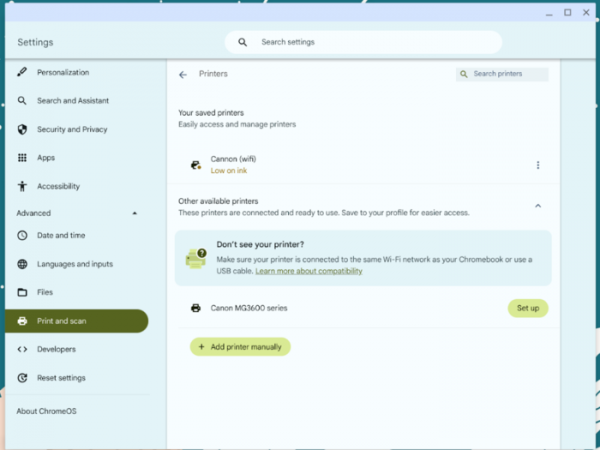
- The print output setup has been simplified. Contextual help for printer usage has been included, saving of selected printers has been simplified, and setup instructions have been provided. The settings page now includes information about the printer's status. A set of options for managing the printer in case of printing issues has been offered.

- Integration with the Imprivata OneSign service has been ensured.
- The interface for text editing on touch screens has been redesigned. More intuitive gesture controls have been proposed. A new zoom mode has been added, which automatically shows the exact position of the cursor.
- A new Bluetooth stack has been proposed, based on the Fluoride stack migrated from the Android platform and continuing the development of Broadcom's BlueDroid stack. A setting 'chrome://flags/#bluetooth-use-floss' has been added to manage the activation of the new stack.
- Six vulnerabilities have been fixed in the virglrenderer component, which allows the use of virtio-gpu (the Virgil3D virtual GPU) for 3D acceleration in virtual environments without the need for exclusive GPU passthrough to the guest system. Three vulnerabilities lead to buffer overflows, and one allows access to freed memory. Additionally, a use-after-free vulnerability (CVE-2023-4921) has been patched in the Linux kernel's net/sched subsystem, enabling privilege escalation in the system.
Source: opennet.ru
