

Canonical has announced the availability of the MicroCloud toolkit, which enables the rapid deployment of computing clusters and cloud systems with a shared distributed data storage and a secure virtual network on its equipment. The toolkit is packaged as a snap package, including components necessary for managing the operation of cluster nodes. Commercial technical support for solutions based on MicroCloud is provided as part of the Ubuntu Pro service, but those who can do without support can use the toolkit without restrictions. The project's developments are written in Go and distributed under the AGPL 3.0 license.
MicroClouds by default employs tools for ensuring fault tolerance, allowing to create clusters with at least three nodes (the upper limit mentions clusters that include up to 50 nodes). The software stack used for cluster management is based on utilizing the centralized management system for containers and virtual machines LXD, the platform for building virtual networks OVN (Open Virtual Network), and the distributed fault-tolerant storage Ceph. MicroClouds provides tools for automatic configuration of LXD, Ceph, and OVN across all cluster nodes.
To determine new servers the nodes that can connect to the cluster, mDNS is used, which allows the entire cluster to be configured by running just one command, 'microcloud init', on one of the nodes after installing the snap packages lxd, microceph, microcloud, and microovn. Ubuntu Server is regarded as the primary platform, but the toolkit is not tied to Ubuntu and can be used with any distributions that support the installation of snap tools (Arch, CentOS, Fedora, Debian, openSUSE, RHEL, etc.). Clusters can also be created based on systems using the atomically updated operating system Ubuntu Core.
After running the command 'microcloud init', the toolkit will detect any other servers in the local network, request to add disks to the shared Ceph storage, and suggest setting up virtual network parameters. To be included in the cluster, the aforementioned snap packages must be installed on the servers in advance. The cluster configuration can be saved in YAML format for subsequent deployment of similar systems. To add additional nodes after initialization, the command 'microcloud add' can be used.
The general file storage is created with replication and fault tolerance enabled, allowing data not to be lost in case of failure of individual nodes by storing multiple data instances on different nodes. To deploy storage based on Ceph in the cluster, in addition to local disks, at least three separate disks dedicated to distributed data storage must be present on three different computers.
Once the cluster is ready, users are given the opportunity to run their applications using system containers or virtual machines, as well as access to the shared Ceph storage and centralized management tools based on LXD. The Kubernetes platform (Microk8s edition) can be launched on top of the cluster to manage the container infrastructure. For user authentication of virtual machines or container authentication in the cluster, OpenID Connect (OIDC) and authorization based on OpenFGA can be used.
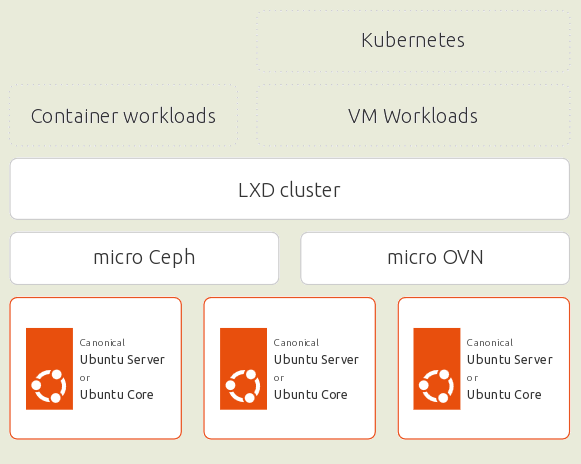
Flexible management of provided resources like CPU, memory, and I/O is possible, with USB device pass-through, GPU, and storage devices. Isolated and virtual environments can be moved between nodes in live migration mode and saved using snapshots. Metrics on cluster performance and event logs can be exported for monitoring using Prometheus and Grafana.
In addition to creating working clusters and private cloud systems, the toolkit is also suitable for quickly conducting experiments on developer systems. For example, MicroCloud can be used to simulate a cluster on a developer's laptop, test cloud applications being developed, experiment with new technologies, or simulate complex infrastructures.
Source: opennet.ru
