

After five months of development, the release of the free game engine Godot 4.2 has been published, suitable for creating 2D and 3D games. The engine supports an easy-to-learn scripting language for game logic, a graphical environment for game design, a one-click game deployment system, extensive animation capabilities, and physics simulation, along with a built-in debugger and performance bottleneck detection system. The code for the game engine, game design environment, and associated development tools (physics engine, sound server, 2D/3D rendering backends, etc.) is distributed under the MIT license.
The source code of the engine was opened in 2014 by OKAM studio after ten years of developing a professional-grade proprietary product that was used to create and publish many games for PC, gaming consoles, and mobile devices. The engine supports all popular desktop and mobile platforms (Linux, Windows, macOS, Wii, Nintendo 3DS, PlayStation 3, PS Vita, Android, iOS, BBX), as well as web game development. Ready-to-run binary builds have been created for Linux, Android, Windows, and macOS.
Key Changes:
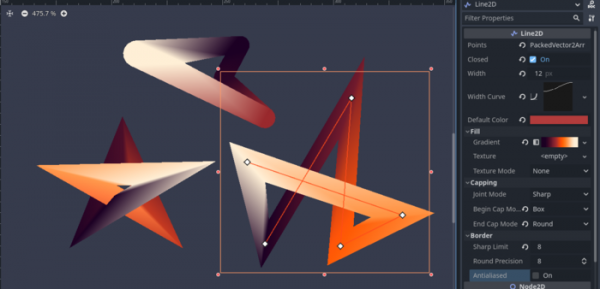
- For 2D game developers, forced integer scaling support has been added, allowing the use of a square pixel grid regardless of the actual aspect ratio. It is now possible to obtain barycentric coordinates of normals from intersection points of an object with a ray. The methods Rotate_toward and Angle_difference have been added for correct handling of rotation and angles. Line2D nodes have a 'closed' property for creating closed lines with continuous filling.

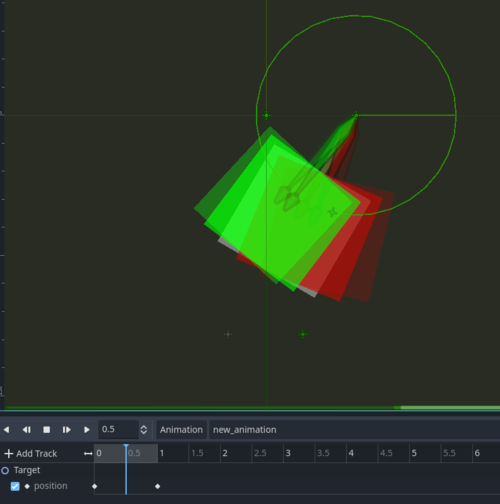
- Efforts have been made to enhance the reliability of the animation system. The AnimationPlayer and AnimationTree nodes have been redesigned and unified, with common components extracted into an intermediate class called AnimationMixer. An option for deterministic blending has been added. An onion skinning mode has been introduced in the animation preview, including the display of translucent overlays with past and future frames of the animation.

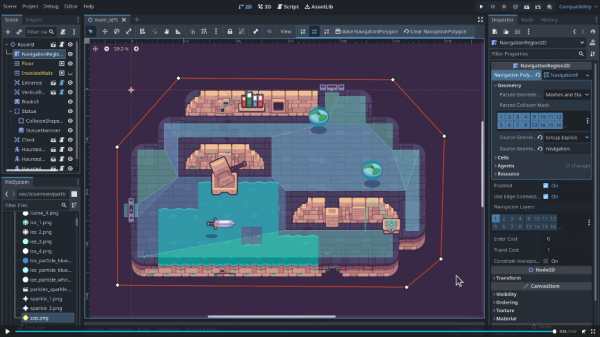
- The capabilities of navigation mesh baking (transforming into a static form) for 2D have been brought closer to the functionalities previously available in 3D navigation. For example, support for working with physical bodies, instances of polygonal meshes, simple polygons, and tilemaps is now implemented for 2D meshes. servers Support for multithreaded mesh baking has been added to 2D and 3D navigation.

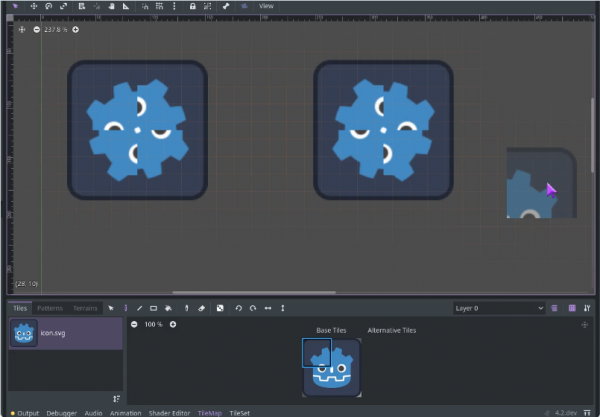
- The code has been refactored for working with tiles and tile maps. Optimizations have been made for block grouping operations and sorting along the Y-axis, significantly reducing tile update times. Efforts have been made to enhance the ease of creating and using tile maps. A tool has been added for flipping and rotating tiles during placement. The tools for editing polygons and tile scenes have been improved.

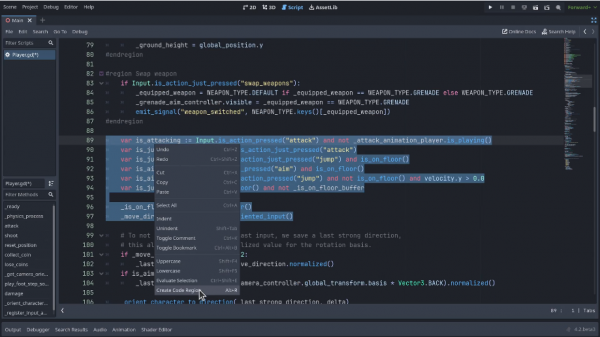
- The GDScript script editor now allows the creation of named code areas for folding blocks during editing, simplifying navigation. The script debugger has added full support for multithreaded code, call stack, and breakpoints. Support for platforms Android (requires .NET 7.0+) and iOS (requires .NET 8.0) has been implemented in C#/.NET scripts. In GDScript scripts, support for statically typed code has been expanded, with the addition of raw string (r-string) support and enhanced match operator capabilities.
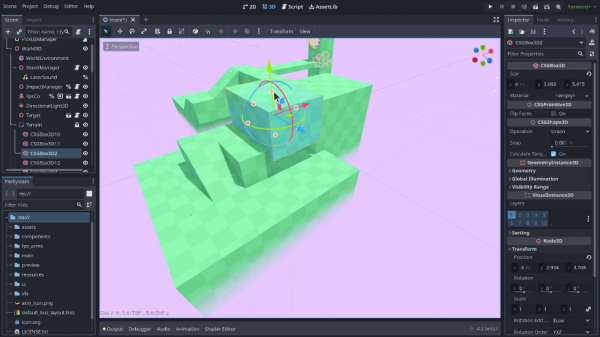
- In the 3D viewport, support for transformation control in the style of Blender has been improved, using the mouse and hotkeys. Extended visual information in the 3D viewport is now displayed only for selected objects. Additional indicators have been added for elements such as decals and volume fog. Work with the gizmo has been enhanced—any side of volumetric shapes can now be expanded separately in the viewport.
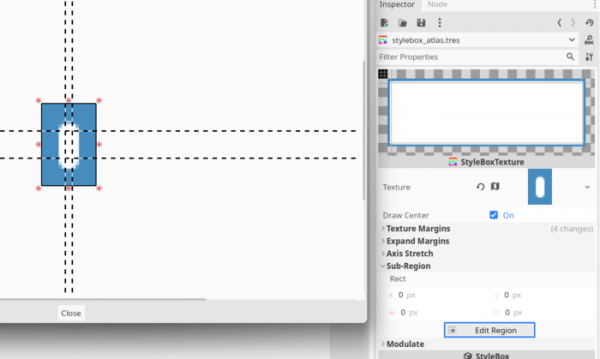
- The context menus and tooltips in the 'Inspection' and 'Signals' panels have been improved. The theme editor now includes tooltips describing properties. In the file system panel, visual highlighting of directories has been enabled by assigning them different colors. The gradient resource editor interface has been revamped. The texture region editor has unified the workflow with all supported resources, including styles and atlases.

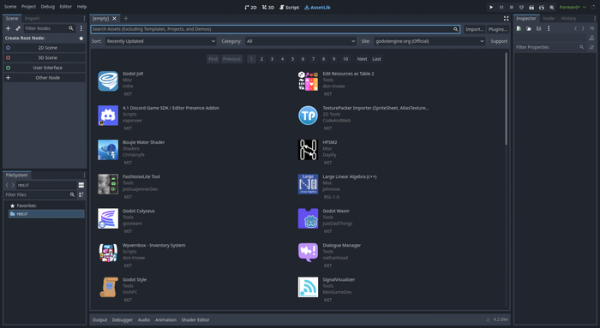
- The asset library has improved search result output and added the option to choose a different directory for installing addons or resources.

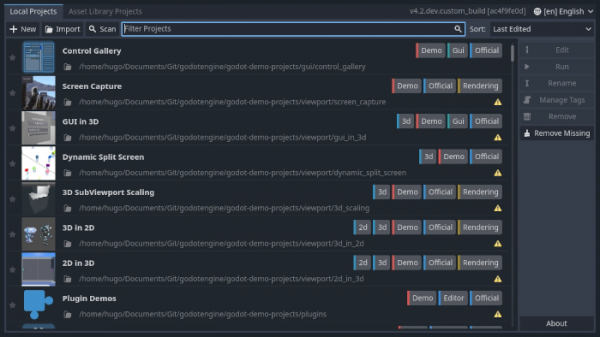
- In the project manager, the layout of the main control elements has been redesigned, and the project import interface has been modernized.
- The plugin development capabilities for the editor have been expanded. Access to all editor functionalities is provided through the EditorInterface class. Convenient methods for direct access to the 2D and 3D viewports have been implemented. A dialog warning about unsaved changes has been added.
- The development of the experimental GDExtension system continues, allowing low-level languages like C++ to be used as scripting languages for games without the need to rebuild the engine or modify the code. Support for using GDExtensions during export to the Web has been added.
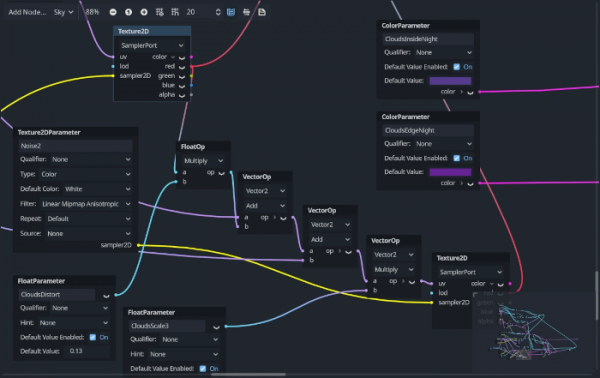
- User interface focus management has been modified. It is now possible to shift focus to individual tabs in the tab panel, including when navigating using the keyboard. A method has been added to the Control nodes for finding the next focusable neighboring element. The graph building nodes (GraphEdit and GraphNode) have been significantly overhauled. The capabilities for customizing the toolbar of the main GraphEdit node have been expanded.

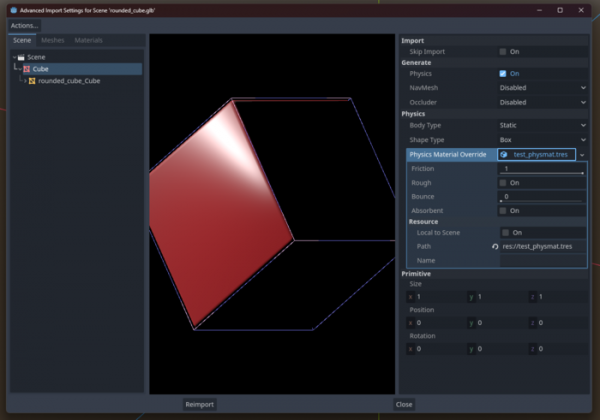
- The ability to change asset import types on the fly with automatic scene and resource updates without requiring a restart of the editor has been added. Available import options have been expanded, allowing modifications to the physical properties of imported objects, as well as shadow and visibility parameters. A preview of animations in the import dialog has been added. Support for importing assets from Blender in the GLTF format has been expanded. Support for importing images in the KTX format has been added.

- Optimizations aimed at improving rendering performance have been implemented. To enhance performance on mobile devices, raster barriers have been split into vertex and fragment components. The generation of noise textures has been accelerated. A preliminary pass for depth computation has been added. Load and compile times for shaders have been reduced. Polygonal mesh storage in memory has been optimized. Support for compressing polygonal meshes to reduce bandwidth during transmission has been added.
- The ability to create custom texture objects has been added (e.g., using compute shaders to create a texture with a water effect).
- An API has been added for calling code in the rendering thread, which may be needed, for example, when synchronizing a compute shader with rendering.
- Support for version 2.2 of AMD FSR (FidelityFX Super Resolution) super sampling technology has been added, utilizing spatial scaling and detail reconstruction algorithms to reduce image quality loss when upscaling and converting to higher resolutions.
- A new noise suppressor JNLM has been proposed, utilizing lightmapper maps and compute shaders. JNLM is significantly faster than the previously used noise reduction library OIDN (Open Image Denoise), though it may compromise on quality in some situations.
- The Forward+ and Mobile rendering methods now support 2D rendering in extended high dynamic range (HDR), allowing for the implementation of some 3D effects, such as glow, in 2D games. The Compatibility rendering method has been updated to support three-dimensional shadows.
- A new OpenGL rendering driver has been proposed for macOS and Windows, using the ANGLE layer to translate OpenGL calls to Direct3D 11 and Metal APIs.
- The particle simulation system has been redesigned to simplify maintenance and expand particle movement controls. For instance, it is now possible to animate and inherit movement speed, as well as change the number of emitted particles. A tool has been added to convert CPU-based particle generation code to equivalent GPU-based code.
- Support has been added for native file selection dialogs for Linux, macOS, and Windows, as well as the ability to copy and paste images via the clipboard.
- The architecture of Godot for the Android platform has been reworked to eliminate the binding to the Android Fragment component, reducing application and game startup times and enabling multi-window functionality.
- Official Linux builds of the Godot editor for 32- and 64-bit ARM platforms have been established.
Source: opennet.ru
