

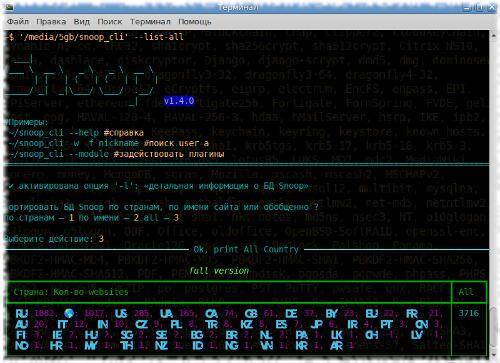
The main functionality of Snoop Project is to track 'username' in public data, along with various OSINT plugins.
Snoop Project is listed in the register of domestic software in Russia under the code 26.30.11.16: Software that ensures the execution of established actions during operational search activities: No. 7012 order 07.10.2020 No. 515.
Snoop Project is developed based on research in the field of scraping public data (own database). Currently, Snoop tracks nickname across 3.7K internet resources (in the full version) and the most popular resources (in the demo version).
Ready builds for OS GNU/Linux and Windows are available, and it can also be built from source in Termux (Android). https://github.com/snooppr/snoop/releases
Change log:
The search web base of Snoop has been expanded to over 3700 sites.
Search speed in Snoop for GNU/Linux has been accelerated by ~140%, almost 2.5 times! (with an internet speed of at least 12 Mbps, searching for 'username' using the Snoop full version database in quick mode ‘–quick/-q’ takes less than 1 minute).
The startup of the Snoop Project build version has been accelerated on old PCs with Windows/HDD.
A new and smart auto-detection algorithm for unspecified/problematic/misidentified site encodings has been added, for searches in various modes.
More informative CLI output has been added when searching through a reduced database, using filter options: ‘–site/–exclude/–include’ (the number of websites when narrowing the search is displayed in brackets to the right of the total number of sites in the database).
Alert threshold for Bad_raw has been changed: increased from 2% to 2.5%.
Formatting. The styling of info lines in the CLI on small/compressed terminals has been improved, for example, in the CLI Termux on Android (auto indentation has been added considering the user's CLI environment). The appearance of premium offers has been redesigned, applicable to all users of the Snoop full version.
The HTML report has been updated:
- button styles have been changed;
- highlighting has been added, and the line from the websites list is increased on hover, making it less likely to miss when selecting a resource from the list;
- a duplicate line/tautology about how many resources have found 'username' has been removed;
- the Snoop demo version has included a couple of mentions about using demo versions/a request for donations for the project's development/full;
- the visual component of grouping country flags has been enhanced;
- Added the display of title(s) of soundtracks when hovering over them.
Fixed the network autotesting in verbose mode ‘–verbose/-v’ in cases where tests sometimes failed due to some. servers accept the connection through an unsecured channel.
Sound notifications for errors and search completion have been removed from the CLI in all versions of Snoop.
Light builds have been added to the Snoop full version, allowing software to launch almost instantly.
Android. Search in verbose mode has been slightly accelerated.
Android. If the user prefers to open HTML reports manually from their GUI FM, all styles are now pulled in.
Plugins ‘GEO_IP/domain’ and ‘ReverseVgeocoder’ have been updated to new versions. Data visualization in HTML reports in full versions of Snoop has been expanded, specifically added:
- a checkbox for filtering data by countries;
- charts with statistics for countries, regions, objects, providers;
- a new layer — topographic maps, changed by click/swipe;
- full-screen toggle mode;
- auto-display of coordinates at any point on the map;
- scale ruler;
- a reminder displaying statistics on InvalidData;
- copyright;
- search;
- In the ‘ReverseVgeocoder’ plugin, the coverage/accuracy scale has been increased by 10-100 times for districts/objects in RU; EU and CIS locations.
Attention! To take advantage of all updates, if the user has previously used old builds of Snoop, it is necessary to clear the cache (one-time operation):
snoop_cli —autoclean
If the user preferred to use Snoop in its original form, update the libraries:
cd ~/snoop && python3 -m pip install -r requirements_android.txt #Android;
cd ~/snoop && python3 -m pip install -r requirements.txt #Desktop
Source: linux.org.ru
