

Red Hat has launched the Red Hat Enterprise Linux AI (RHEL AI) distribution, specifically tailored for machine learning tasks and designed to simplify the creation of server solutions utilizing large dialog models. It includes a collection of tools and frameworks for machine learning, as well as drivers for various hardware accelerators from AMD, Intel, and NVIDIA, along with components to leverage the capabilities of Dell, Cisco, HPE, Lenovo, and SuperMicro servers optimized for AI systems.
RHEL AI is intended for the development, testing, and execution of machine learning systems based on the Granite large language model, which was open-sourced by IBM under the Apache 2.0 license. This model can consider up to 4,000 tokens in text generation and encompasses 7 billion parameters. The distribution integrates the open toolkit InstructLab, which supports the LAB (Large-scale Alignment for chatBots) methodology for customizing and optimizing models to meet specific needs, as well as for adding additional knowledge and implementing new skills in pre-trained models.
The platform can be used to develop AI applications for corporate needs and to implement services for content generation, creating dialog systems, and integrating into virtual assistant applications that support capabilities such as answering questions in natural language, solving mathematical problems, generating meaningful text on specified topics, summarizing content, correcting errors in text, performing rewriting with different wording, assisting in code writing in various programming languages, and generating letters and documents based on templates.
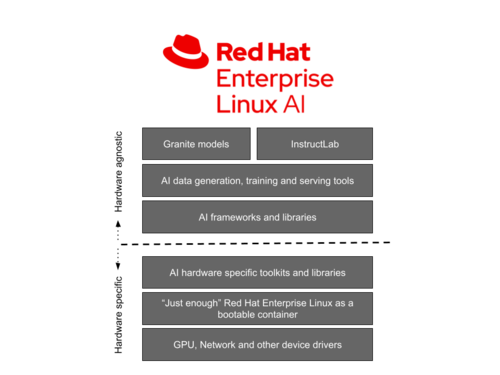
In addition, Red Hat has introduced a new mode for creating and managing system images based on Red Hat Enterprise Linux — the 'image mode,' which allows the use of tools and technologies employed for deploying the operating system as utilized for creating and running application containers. This new mode manipulates monolithic system images formed using the rpm-ostree tooling and updated atomically without breaking into individual packages.
Images can be created in formats OCI (like in Docker), ISO, QCOW2, AMI, VMI, and VMDK. The contents of the image are selected by editing the Containerfile. Standard container management tools such as Podman and OpenShift Container Platform can be used to create and manage images. Both the standard Anaconda installer and the bootc-image-builder toolkit, which allows converting a container image into a bootable disk image, can be used to install images. The bootable container images that come with the Linux kernel and can boot similarly to regular system builds are updated using the bootc tool.
Source: opennet.ru
