

The June update for the Bliss OS project, which continues the development of Android-x86, a port of the Android platform for the x86 architecture (most of the developers from Android-x86 have transitioned to the Bliss OS project), is now available. Bliss OS offers ready-to-use builds with a customized environment based on Android, optimized for use on PCs, tablets, and laptops. Bliss OS can also be used as a replacement for Chrome OS on Chromebooks. The project's developments are distributed under the Apache 2.0 license.
The project supports several branches: stable branches Bliss OS 14 and Bliss OS 15 based on Android 11 and 12, beta branch Bliss OS 16 based on Android 13, and Bliss OS Zenith branch on Android 13 with the latest changes from the Bliss OS project and the latest version of the Linux kernel. Builds are prepared in versions with Google services (GApps) and open alternatives (F-Droid, Aurora, and microG).
The system environment is designed as a monolithic image, mounted in read-only mode and updated atomically with updates delivered over-the-air (OTA) — two system partitions are used, one of which is active, while the update is copied to the second, passive one. There is an option to install Magisk modules without writing data to the system partition.
Components from the Android platform are maintained by the Bliss OS developers as part of the related Android Generic project, which provides a set of scripts and patches for quick prototype builds of firmware based on code from the AOSP (Android Open Source Project) repository. A Native-Bridge translation layer is provided to run Android applications built for ARM/ARM64 architectures on x86 systems.
The package includes KernelSU, which allows users to gain root rights in the system and delegate them to selected applications. Bliss OS fully supports systems based on Intel and AMD processors with integrated GPUs, as well as most configurations with AMD graphics cards (support for NVIDIA GPUs leaves much to be desired).
The graphics stack is based on the standard drivers from the Linux kernel and the Mesa project. The user environment is similar to traditional desktop environments — featuring the Blissified application panel, the 'Bliss' application menu, and a multi-window interface. In addition to the desktop mode, optimized for keyboard and mouse management, Bliss OS also supports switching to a tablet mode designed for touch screen control (for example, this mode can be used on tablets or convertible laptops with touch screens).
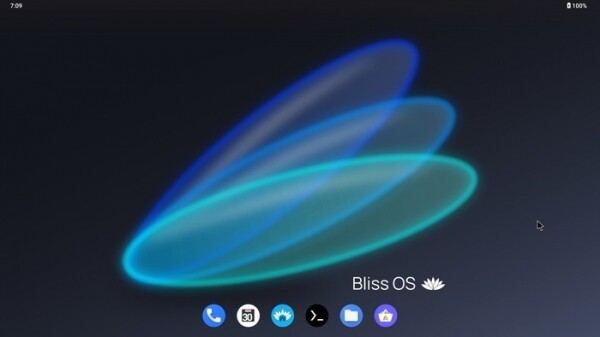
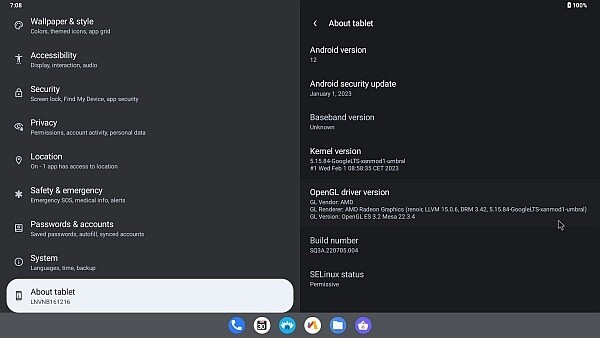
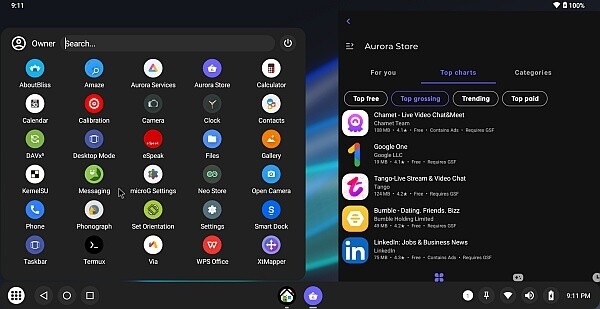
Changes in the new builds BlissOS 14.10.2, 15.9.1, and 16.9.6 include:
- Updated versions of Mesa 24.0.8, Libva 2.21.0, and LLVM 17.0.6 (necessary for building the radeonsi driver).
- Changes have been ported from the main branches of the minigbm projects (Mini Graphics Buffer Manager, responsible for buffer management during rendering) and drm_hwcomposer (which provides the graphical subsystem of the Android platform on top of the standard Linux kernel graphics stack).
- Recent security-related fixes from Android and LineageOS have been incorporated.
- The initialization process of sound devices has been completely redesigned. The sof-firmware (Sound Open Firmware) set has been updated to version 202403. Many sound issues have been resolved.
- Added the option FORCE_TSCAL=1 to use the TSCalibration touch screen calibration application during boot.
- In the stable branches, the Linux kernel has been updated to version 6.1.84, while the Bliss OS Zenith branch is updated to version 6.9.3 with patches from the Android-x86, xanmod, and Nobara Linux projects.
Source: opennet.ru
