

The developers of the openSUSE project have released version 9 of the Agama installer, designed to replace the classic installation interface of SUSE and openSUSE, notable for separating the user interface from the internal components of YaST. Agama allows the use of various front-ends, such as a front-end for managing installations through a web interface. Live builds for testing the new installer have been created for x86_64, ppc64le, s390x, and ARM64 architectures, supporting the installation of openSUSE Leap, the continuously updated openSUSE Tumbleweed build, as well as several editions of SUSE ALP based on isolated containers.
The installer provides the necessary capabilities to address tasks such as selecting an initial set of applications, configuring network connections, language, keyboard, time zone, and localization options, preparing storage devices and partitioning, and adding users to the system. Among Agama's main development goals is the elimination of existing graphical interface limitations, expanding the functionality of YaST for use in other applications, moving away from a single programming language, and encouraging the creation of alternative configurations by community representatives.
To install packages, check hardware, partition disks, and perform other necessary installation functions, Agama continues to use YaST libraries, on top of which layer services abstract access to the libraries via a unified communication protocol based on HTTP. The installer employs a multi-process architecture, ensuring that the user interaction interface remains responsive while other tasks are being executed. The basic interface for managing the installation is built using web technologies. The web interface is written in JavaScript using the React framework and PatternFly components. The messaging service and the built-in HTTP server are written in Ruby.
In the new version:
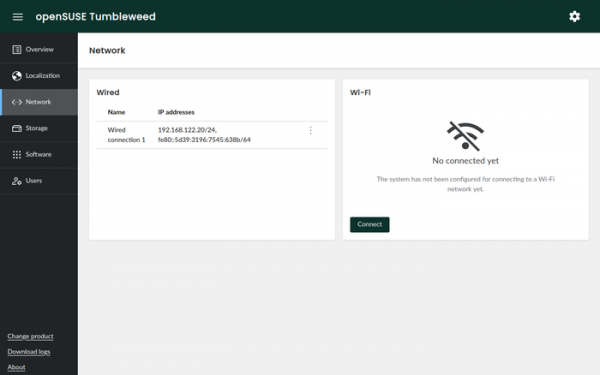
- A new implementation of the web interface has been proposed, featuring a classic layout and an added sidebar for navigation through all installation stages. Issues with the scalability of the web interface when new functionalities were added have been resolved. Various sections in the interface have been significantly altered, with the network configuration setup page being notably redesigned.

- Capabilities for automated installation, conducted without human intervention, have been expanded. More information about the hardware is now provided when executing profiles in the configuration definition language jsonnet. A new section 'legacy-autoyast-storage' has been implemented, allowing the use of the contents of sections from AutoYaST. The command-line interface has been updated, adding support for editing configurations in an external editor.
- Partial compatibility has been ensured with automated installation profiles created for AutoYaST, which can be imported into Agama and converted into the native format. Due to differences in functionality, not all elements of the AutoYaST configuration are available, but developers plan to support the most significant sections.
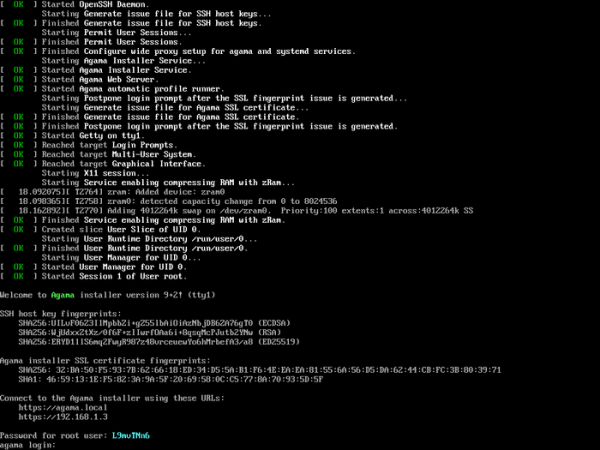
These include sections such as 'partitioning', 'networking', 'software', and 'scripts'. Rules, classes, Ruby code embedding, and the definition of scripts to be executed before applying changes are supported. - The installation media (Live ISO) has been modernized. Support for installing additional packages in the Live environment has been added (the database containing information about packages is no longer blocked, allowing for the installation and updating of any packages after booting into Live mode). Instead of a fixed password 'linux' for gaining root rights in the system environment of the boot media, the option to set a custom password or generate a random password has been provided, which will be displayed after booting in the local console along with the generated SSH keys. for TLS certificates.

Source: opennet.ru
