

The first official release of the new integrated development environment Theia IDE has taken place, developed by the Eclipse Foundation based on the Theia code editor and its plugins. The project code is written in TypeScript and distributed under the EPLv2 (Eclipse Public License). The Theia IDE product is delivered as a standalone desktop application intended for installation on local systems, as well as in an online version for browser use (a ready-made Docker image is provided for deploying the online version on your server).
The project is developed with the participation of companies such as IBM, Red Hat, Google, ARM, Broadcom, Huawei, Samsung, Ericsson, SAP, and Arduino on a neutral platform supported by the Eclipse Foundation, independent of specific manufacturers. Initially, the development environment was developed under the name Theia Blueprint and used as a set of examples and templates for building custom solutions based on the Theia platform, and has now been transformed into a standalone product notable for its modular organization and flexible environment customization options.
The Theia platform is built on a front-end/back-end architecture, involving the launch of two processes, one responsible for rendering the interface and the other for internal logic. The processes interact using HTTP via JSON-RPC over WebSockets or REST API. This separation allows for operation through the Web, whereby the back-end, utilizing the Node.js platform, runs on an external server, server, while the front-end with the interface loads in the browser. In the Theia IDE application, both processes run locally, and the Electron platform is used to create a self-sufficient application.
The Theia IDE offers features such as a customizable dynamic toolbar, detachable code editing panels in separate windows, a tab system, remote work organization capabilities, and a collaborative editing and project management mode currently under development. The project is declared to be privacy-conscious and does not include telemetry transmission by default.
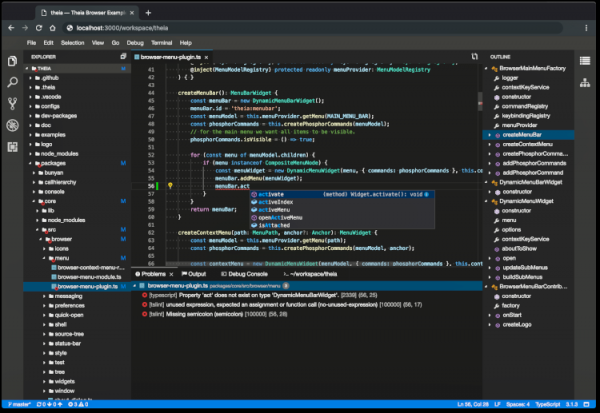
The environment provides development tools for Python, Java, JavaScript, C++, and any other languages supported through integration. servers LSP (Language Server Protocol) defines the logic for syntax parsing, autocompletion, code navigation, error diagnostics, and refactoring. For integration with external debuggers, the DAP (Debug Adapter Protocol) is supported. The plugin system for Theia IDE is compatible with extensions developed for the VS Code editor, allowing the use of over 3600 existing extensions available in the Open VSX catalog.
Source: opennet.ru
