

The lineup of AMD hybrid processors designed for the desktop platform Socket AM5 includes a total of four models. We previously discussed the two higher models — the eight-core with Radeon 780M graphics and the six-core with Radeon 760M graphics. These hybrid processors, based on Zen 4 cores and RDNA 3 graphics architecture, offer unique capabilities — they deliver gaming performance comparable to that of GeForce GTX 1650 graphics cards, solely with their integrated graphics core. Because of this feature, both Ryzen 7 8700G and Ryzen 5 8600G are quite suitable for building relatively inexpensive gaming systems, allowing users to forego purchasing a discrete graphics card altogether.
However, there is a serious issue: for those computers where it would make sense to install them, they are still too expensive. For the amount you would need to spend on a platform with one of these processors featuring powerful integrated graphics, you could easily purchase a system with a last-gen six-core processor and a significantly more powerful graphics card (like the Radeon RX 6600). Thus, there is currently no clear economic justification for choosing the higher-end APU models for the Socket AM5 platform.
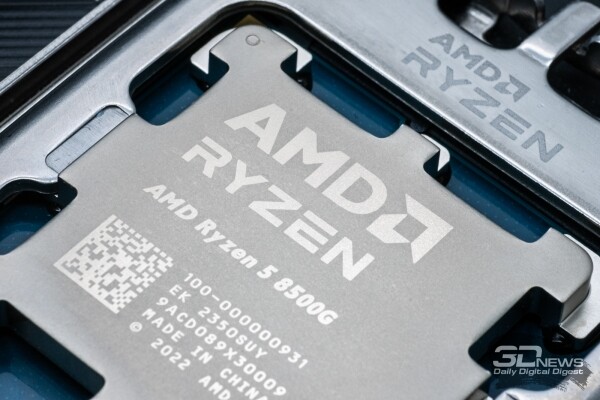
But that does not mean that all representatives of the Ryzen 8000G series are of no interest. Besides Ryzen 7 8700G and Ryzen 5 8600G, it includes two more processors. One of them, the four-core Ryzen 3 8300G, is intended for distribution through OEM channels and is unlikely to become widely available, making it less interesting. On the other hand, the six-core Ryzen 5 8500G looks much better: just look at its specifications.
| Ryzen 7 8700G | Ryzen 5 8600G | Ryzen 5 8500G | Ryzen 3 8300G | |
|---|---|---|---|---|
| Design | Phoenix | Phoenix | Phoenix 2 | Phoenix 2 |
| Cores | 8 × Zen 4 | 6 × Zen 4 | 2 × Zen 4 + 4 × Zen 4c | 1 × Zen 4 + 3 × Zen 4c |
| Threads | 16 | 12 | 12 | 8 |
| L3 Cache, MB | 16 | 16 | 16 | 8 |
| Base frequency, GHz | 4,2 | 4,3 | 4,1 / 3,2 | 4,0 / 3,2 |
| Max. Frequency, GHz | 5,1 | 5,0 | 5,0 / 3,7 | 4,9 / 3,6 |
| NPU | There is | There is | No | No |
| GPU | Radeon 780M (12 CU) | Radeon 760M (8 CU) | Radeon 740M (4 CU) | Radeon 740M (4 CU) |
| GPU Frequency, GHz | 2,9 | 2,8 | 2,8 | 2,6 |
| TDP, W | 65 | 65 | 65 | 65 |
| Price | $329 | $229 | $179 | N/A |
On one hand, Ryzen 5 8500G is more than 20% cheaper than its neighboring six-core model, Ryzen 5 8600G. On the other hand, the specifications of Ryzen 5 8600G and Ryzen 5 8500G are quite similar, leading us to think that the true successor to the extremely popular Ryzen 5 5600G should not be the overrated Ryzen 5 8600G, but rather the more affordable Ryzen 5 8500G.
This is why we decided to dedicate a separate review to the Ryzen 5 8500G. In it, we will evaluate this processor as a modern alternative to the Ryzen 5 5600G and answer the questions that arise in this context. Can it boast the same revolutionary progress in graphics performance as its Ryzen 8000G counterparts, and can the Ryzen 5 8500G be considered a more budget-friendly version of the Ryzen 5 8600G?
Moreover, the Ryzen 5 8500G is intriguing not only because it has the potential to become a versatile processor for budget gaming systems. It deserves attention also because it is based on the Phoenix 2 semiconductor chip. This means that the Ryzen 5 8500G is one of the first desktop processors from AMD featuring compute cores of different types: powerful Zen 4 and efficient Zen 4c.
What are Zen 4c cores and what do they do in the Ryzen 5 8500G?
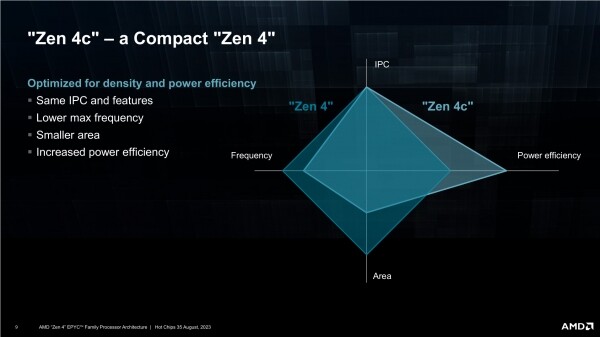
The topic of efficient Zen 4c cores originated in the server segment. The primary goal for their creation was to minimize the area occupied by each core on the processor semiconductor chip to produce as many cores as possible. In the end, AMD achieved its aim: it was the Zen 4c cores that became the foundation of the 128-core Epyc Genoa. After that, AMD introduced such cores into the mobile segment, where they enabled processors to be not only cheaper but also more energy-efficient. And now, Zen 4c cores have made their way to desktop PCs. Here, they perform a similar role as in mobile processors: reducing the cost of lower-end APU variants.
Essentially, the Ryzen 5 8500G can be considered an equivalent to the mobile Ryzen 5 7545U: it is the same six-core processor based on the Phoenix 2 design, which simultaneously uses compute cores of two types: Zen 4 and Zen 4c. However, AMD's hybrid approach implemented in Phoenix 2 differs significantly from Intel's approach. The performance and efficient cores in the Ryzen 5 8500G do not differ in base architecture or size of Level 2 cache memory, thus yielding equal performance at the same clock frequency. The difference lies in the area occupied by Zen 4 and Zen 4c on the semiconductor chip. The efficient cores are physically smaller, not due to simplification, but because of the increased transistor density.
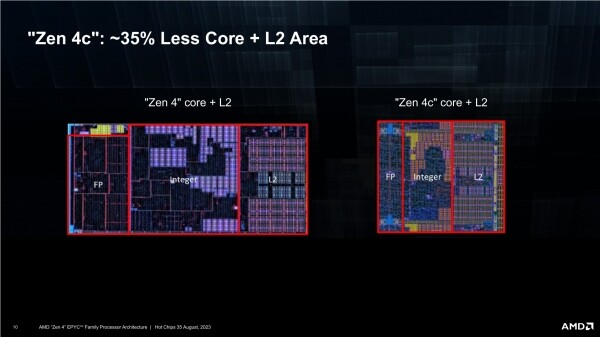
The area of a single Zen 4 core is 3.84 mm². The Zen 4c core is 35% smaller, occupying 2.48 mm² on the die. Both types of cores are produced using the same 4nm process, but the implementation of Zen 4c in silicon uses different libraries with a higher transistor density per unit area of the die. This has consequences: the denser Zen 4c cores cannot operate at the same high frequencies as the regular Zen 4. This difference is quite significant. While the maximum frequency of Zen 4 cores exceeds 5 GHz (in some cases even by several hundred megahertz), the frequency of Zen 4c is limited to 3.7 GHz. Hence, the efficiency of Zen 4c arises: the reduced frequency allows for lower operating voltage, which in turn leads to decreased power consumption.
The Phoenix 2 die used by AMD in the Ryzen 5 8500G differs fundamentally from the base Phoenix die found in the higher-end APU models of the same series (Ryzen 7 8700G and Ryzen 5 8600G). This is initially a six-core rather than an eight-core silicon, with only two cores belonging to the Zen 4 class, while the other four are 'condensed' Zen 4c. As a result, the total area of the Phoenix 2 die is only 137 mm², while the area of Phoenix is 178 mm².
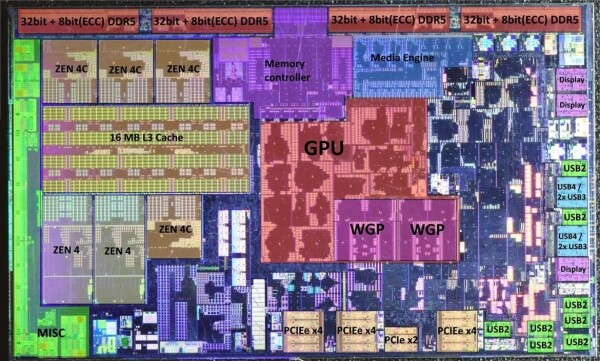
However, the silicon savings in Phoenix 2 are not solely due to the transition from an eight-core to a six-core design and the use of Zen 4c instead of Zen 4. The capabilities of Phoenix 2 are also significantly reduced in terms of integrated graphics: the number of CU blocks is reduced from 12 to 4. Additionally, this version of the die lacks the Ryzen AI coprocessor.
Detailed specifications of the Ryzen 5 8500G
The Ryzen 5 8500G is a processor that fully utilizes all the capabilities built into the Phoenix 2 die. It is a six-core processor whose maximum frequency for Zen 4 cores reaches 5 GHz, while Zen 4c cores reach up to 3.7 GHz; the L3 cache size is 16 MB, and the integrated Radeon 740M graphics uses all 4 available CUs with RDNA 3 architecture and operates at a frequency of up to 2.8 GHz.
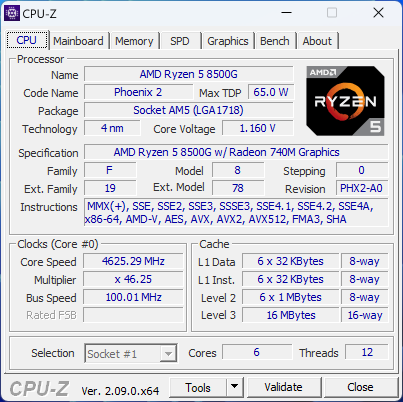
Thus, when comparing two related six-core APUs based on the Phoenix and Phoenix 2 die — the Ryzen 5 8600G and Ryzen 5 8500G — it becomes clear that the processor with the higher model number excels primarily in the power of its GPU, which has twice as many CUs. Additionally, the Ryzen 5 8600G benefits from all its cores operating at a boost frequency of 4.6 GHz under multithreaded load. In the same situation, only two cores of the Ryzen 5 8500G, belonging to the Zen 4 class, will operate at 4.6 GHz, while the others will run at just 3.7 GHz.
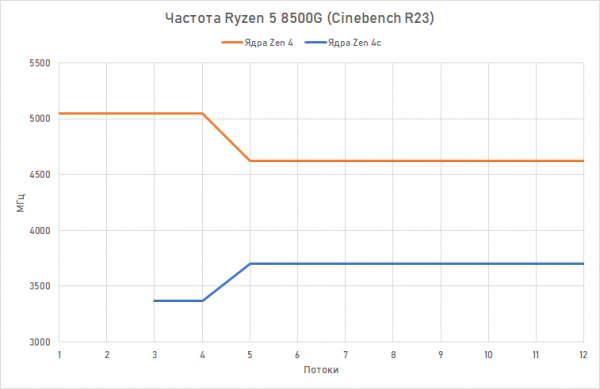
Overall, the frequency formula of the Ryzen 5 8500G is quite peculiar. Its Zen 4 portion can reach 5.05 GHz only when one, two, three, or four cores are under load. If five or six cores are engaged, the maximum frequency of the Zen 4 cores is strictly limited to 4.6 GHz. Meanwhile, Zen 4c cores determine their frequency based on the current frequency of the Zen 4 cores. If they are operating at 5.05 GHz, then the frequency for the Zen 4c cores will be set at 3.4 GHz, and if at 4.6 GHz — then 3.7 GHz.
As a result, in the case of the Ryzen 5 8500G, there might be a scenario where, as the load intensity increases, the frequency of the Zen 4 cores decreases while that of the Zen 4c cores increases. For example, this flip occurs when transitioning from a four-threaded to a five-threaded workload, as shown in the graph below that we created while monitoring the frequencies of the Ryzen 5 8500G during rendering in Cinebench R23 with varying numbers of active threads. Under a four-threaded load, two Zen 4 cores run at 5.05 GHz, while two Zen 4c cores run at 3.4 GHz. When another thread is introduced and a third Zen 4c core is engaged, the frequency of the Zen 4 cores decreases by 450 MHz, while that of the Zen 4c cores increases by 300 MHz.
Fortunately, this illogical frequency formula does not cause any issues, as the processors with the Phoenix 2 design lack their own mechanisms for thread distribution like Intel's Thread Director. Threads are directed to cores by the standard Windows task scheduler, which follows a very simple principle: first, the load is directed to the cores with the higher clock speed, and then to those with the lower speed. As for the virtual cores generated by SMT technology, they are loaded last.
Thus, the effective cores in the Ryzen 5 8500G are not oriented towards background task management, and the Windows scheduler does not take their energy efficiency into account when distributing workload. Even minor loads are always directed primarily to the Zen 4 cores, making the Ryzen 5 8500G a less economical processor than it could have been with better collaboration between AMD and Microsoft.
However, it is difficult to raise any complaints about the energy efficiency of the Ryzen 5 8500G. According to official specifications, it, like the Ryzen 5 8600G, is classified as a processor with a thermal package of 65W. Moreover, in practice, its maximum consumption during multi-threaded rendering in Cinebench R23 is around 42W.
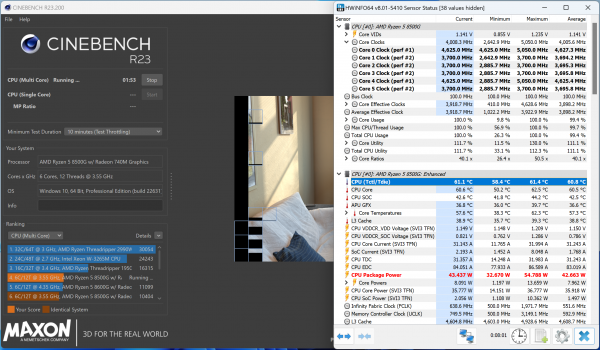
The similar Ryzen 5 8600G based on the Phoenix design, in the same situation, consumes significantly more — about 72W. However, one must understand that the energy efficiency of the Ryzen 5 8500G in this comparison is due to the frequency of the Zen 4c cores, which is lower than the frequency of the Zen 4 cores by almost a full gigahertz.
As a result, the main power consumer in the Ryzen 5 8500G is not the computing cores, but the graphics. For example, under high graphical load in the Furmark test, the APU's consumption reaches up to 55W.
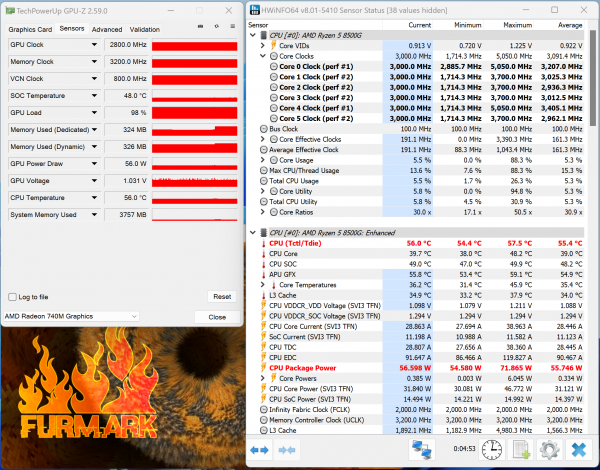
Consequently, under full and simultaneous load on the graphics and CPU cores, the Ryzen 5 8500G still hits its consumption limit set at 88W. However, this has little effect on the processor's operating frequencies. The computational cores continue to operate at peak frequencies, while the limitation only affects the GPU frequency, which drops from a maximum of 2.8 to 2.6-2.7 GHz.
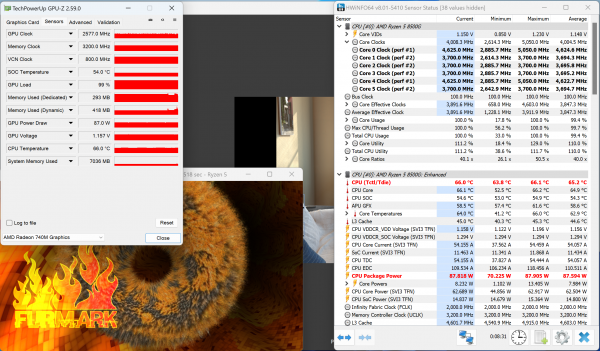
However, the situation in the screenshot above is artificially created by running the most power-hungry applications in their classes — Cinebench R23 and FurMark. In real games, nothing similar is observed, of course. In them, the maximum consumption of the Ryzen 5 8500G (when using the integrated graphics core) is around 50-60W. For example, the following graphs show the measured consumption of the Ryzen 5 8500G in Counter Strike 2 and Cyberpunk 2027.
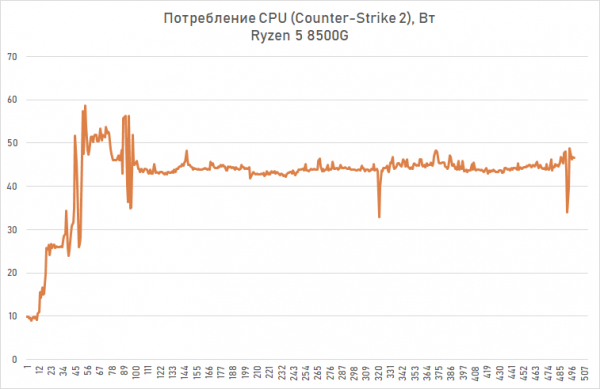
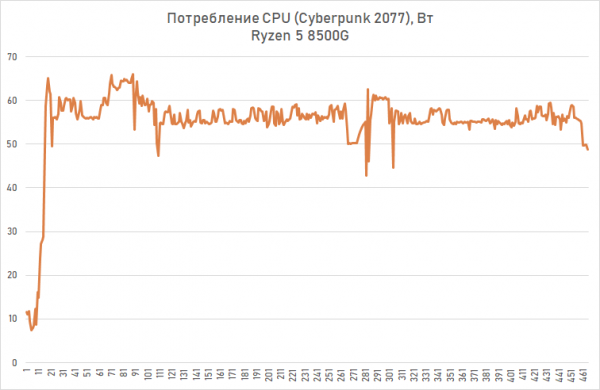
From the results of such measurements, it follows that the Ryzen 5 8500G has not become a more economical APU compared to the Ryzen 5 5600G, at least when it comes to gaming. The six-core representative of the Cezanne family consumes 5-10 watts less under similar conditions. However, this is not surprising. Although the Ryzen 5 8500G is manufactured using a more modern 4nm process, its Radeon 740M graphics core is significantly more powerful, even if it may not seem so at first glance. But let's dig deeper.
Radeon 740M Graphics: Gaming or Office Use?
On one hand, the graphics of the Ryzen 5 8500G do not appear powerful: it is based on 4 CUs and has 256 shader pipelines, 16 texture mapping units, and 8 raster operating units. For example, the six-core APU of the previous generation, the Ryzen 5 5600G, has a far richer arsenal of resources: its GPU consists of 7 CUs and offers 448 shader pipelines, 28 texture units, and 8 raster operating units. On the other hand, all this is offset by architectural differences — the graphics of the Ryzen 5 8500G is based on RDNA 3 architecture and even supports hardware ray tracing, while the previous generation APU used the GCN 5th generation (Vega) graphics architecture that is seven years old. Additionally, the graphics core of the Ryzen 5 8500G has a substantially higher clock speed — 2.8 GHz compared to 1.9 GHz. As a result, in terms of theoretical performance, the graphics of the Ryzen 5 8500G represents a significant step forward. The performance of the Radeon 740M is estimated at 2.7 teraflops, while the theoretical performance of the graphics of the Ryzen 5 5600G is around 1.7 teraflops.
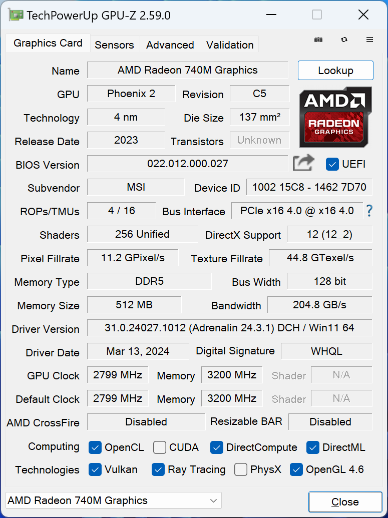
Furthermore, this must be supplemented by a significant increase in memory bus bandwidth, which greatly affects the performance of integrated GPUs. Platforms with the Ryzen 5 5600G are equipped with dual-channel DDR4 SDRAM, providing a bandwidth of 51.2 GB/s (when operating in DDR4-3200 mode). At the same time, the Ryzen 5 8500G, paired with at least dual-channel DDR5-5200, can provide its graphics core access to memory with a bandwidth of 83.2 GB/s.
Thus, the Ryzen 5 8500G, like its older siblings the Ryzen 5 8600G and Ryzen 7 8700G, has a good chance of making its way into entry-level gaming systems, even though it is based on the Phoenix 2 chip with a reduced GPU. This is compensated by its price: the Ryzen 5 8500G currently costs around 17-18 thousand rubles, while a similar six-core Ryzen 5 8600G on the Phoenix chip is sold for no less than 24 thousand rubles.
However, one must recognize that the Radeon 740M is, in some sense, a compromise solution. Against the backdrop of the Radeon 780M and Radeon 760M, its specifications are hardly impressive.
| Radeon 780M | Radeon 760M | Radeon 740M | |
|---|---|---|---|
| Architecture | RDNA 3 | RDNA 3 | RDNA 3 |
| CU | 12 | 8 | 4 |
| Stream processors | 768 | 512 | 256 |
| Texture units | 48 | 32 | 16 |
| Rasterization units | 24 | 16 | 8 |
| RT units | 12 | 8 | 4 |
| Frequency, GHz | 2,9 | 2,8 | 2,8 |
| L0 cache, KB | 192 | 128 | 64 |
| L1 cache, KB | 1536 | 1024 | 512 |
| L2 cache, MB | 2 | 2 | 2 |
| Filling rate, GTexels/s | 139,2 | 89,6 | 44,8 |
| Filling rate, Gpixels/s | 69,6 | 44,8 | 22,4 |
| FP32 performance, TFLOPS | 8,91 | 5,73 | 2,87 |
But in real performance, the gap between the Radeon 780M, Radeon 760M, and Radeon 740M is not that drastic. All three accelerators use the same memory bus, which smooths out the differences. For example, according to the synthetic benchmark 3DMark Steel Nomad Light, the integrated graphics of the Radeon 780M outperforms the Radeon 740M by 80%, although in terms of specifications, the superiority should be threefold.
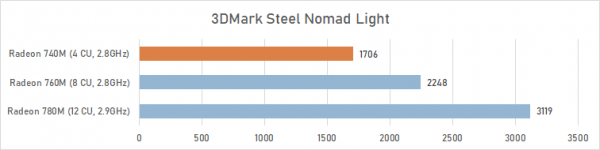
As for the performance ratio of the integrated accelerators Radeon 760M and Radeon 740M, the graphics of the Ryzen 5 8600G is practically only 32% faster according to 3DMark Steel Nomad Light. But for now, this is a preliminary estimate; detailed tests in real games are yet to come.
Disadvantages of the Ryzen 5 8500G: overclocking and PCIe
However, even if we don't nitpick the graphical performance, it cannot be said that the Ryzen 5 8500G can become a full-fledged successor to the Ryzen 5 5600G. It's not just that the six-core APU of the previous generation currently costs about 40% less in stores. Much worse is that the new generation processor has unpleasant limitations that will make it seem worse to many than the six-core APU for the Socket AM4 platform.
The first problem with the Ryzen 5 8500G is overclocking. In this processor, it is almost completely locked. It is not possible to increase the frequency of the integrated cores or overclock the graphics core. In the Ryzen 5 8500G, only memory and Infinity Fabric bus frequencies can be changed. In addition, the Ryzen 5 8500G still has access to the Curve Optimizer function, but in this case, it is of little use.
The second, and more serious problem is the PCI Express bus controller. The Phoenix 2 chip, which forms the basis of the Ryzen 5 8500G, was primarily developed with mobile PCs in mind. Therefore, its capabilities for connecting various peripherals are significantly limited, even more so than in processors built on Phoenix chips. It lacks support for PCI Express 5.0 entirely, and the number of PCI Express 4.0 lanes has been reduced to 14 (compared to 20 in Phoenix and 28 in standard Ryzen 7000). Out of these 14 lanes, 4 lanes are used for connection to the chipset, while the remaining 10 are split between the external graphics card and NVMe drives.
As a result, when installing a discrete graphics accelerator in a system with Ryzen 5 8500G, it will only be able to utilize the PCIe 4.0 x4 interface. The first SSD will also get the same interface, while the second drive will have to make do with two PCIe 4.0 lanes. This not only limits the potential use of systems based on Ryzen 5 8500G with fast SSDs, but also raises questions about the feasibility of their subsequent upgrades with discrete graphics cards. However, for now, this doesn’t seem so dire: as tests show, currently available graphics cards lose no more than 10% of their performance when using PCIe 4.0 x4 instead of PCIe 4.0 x16.
Description of the test systems
So, in terms of graphical capabilities, the Ryzen 5 8500G is significantly cut down compared to the Ryzen 5 8600G. Nevertheless, it remains a next-generation hybrid processor with modern architectures for computing cores and graphics. Therefore, it is quite relevant to check how applicable it is in full-fledged entry-level gaming systems.
The main competitors of the Ryzen 5 8500G in this study will logically be its higher siblings (Ryzen 7 8700G and Ryzen 5 8600G), as well as AMD's previous generation hybrid processors (Ryzen 7 5700G and Ryzen 5 5600G). In fact, this set of processors covers the entire range of options available for building a gaming system without a discrete graphics card. Here, two main questions arise, to which we will provide answers later: how much slower is the six-core Ryzen 5 8500G with the Phoenix 2 design compared to the six-core Ryzen 5 8600G with the Phoenix design? And is it truly faster than the tried-and-true six-core Ryzen 5 5600G for the older Socket AM4 platform?
In addition, we will focus on how the Ryzen 5 8500G performs in regular applications as well as in games after installing a discrete graphics card. The aim of this part of the testing is to determine how viable the idea of enhancing it with an additional graphics card is.
As a result, the configuration of the test systems included a quite extensive list of components.
- Processors:
- AMD Ryzen 7 8700G (Phoenix, 8 cores, 4.2-5.1 GHz, 16 MB L3);
- AMD Ryzen 5 7600X (Raphael, 6 cores, 4.7-5.3 GHz, 32 MB L3);
- AMD Ryzen 5 7500F (Raphael, 6 cores, 3.7-5.0 GHz, 32 MB L3);
- AMD Ryzen 7 5700G (Cezanne, 8 cores, 3.8-4.6 GHz, 16 MB L3);
- AMD Ryzen 5 8600G (Phoenix, 6 cores, 4.3-5.0 GHz, 16 MB L3);
- AMD Ryzen 5 8500G (Phoenix 2, 6 cores, 3.2-5.0 GHz, 16 MB L3);
- AMD Ryzen 5 7600X (Raphael, 6 cores, 4.7-5.3 GHz, 32 MB L3);
- AMD Ryzen 5 7500F (Raphael, 6 cores, 3.7-5.0 GHz, 32 MB L3);
- AMD Ryzen 5 5600G (Cezanne, 6 cores, 3.9-4.4 GHz, 16 MB L3);
- AMD Ryzen 5 5600X (Vermeer, 6 cores, 3.7-4.6 GHz, 32 MB L3);
- Intel Core i5-14400 (Raptor Lake, 6P+4E cores, 2.5-4.7/1.8-3.5 GHz, 20 MB L3);
- Intel Core i5-12400 (Alder Lake, 6P cores, 2.5-4.4 GHz, 18 MB L3).
- CPU cooler: custom liquid cooling solution made from EKWB components.
- Motherboards:
- ASUS ROG Maximus Z790 Apex (LGA1700, Intel Z790);
- ASUS ROG Strix X570-E Gaming WiFi (Socket AM4, AMD X570);
- MSI MPG X670E Carbon WiFi (Socket AM5, AMD X670E).
- Memory:
- 2 × 16 GB DDR5-6400 SDRAM (G.Skill Ripjaws S5 F5-6400J3239G16GX2-RS5K);
- 2 × 16 GB DDR4-3600 SDRAM (Crucial Ballistix RGB BL2K16G36C16U4BL).
- Graphics Cards:
- ASUS Dual GeForce GTX 1650 OC (1515/1755 MHz, 4 GB GDDR5 8 Gbps);
- GIGABYTE GeForce RTX 4090 Gaming OC (AD102 2235/2535 MHz, 24 GB GDDR6X 21 Gbps).
- Storage Subsystem: Intel SSD 760p 2 TB (SSDPEKKW020T8X1).
- Power Supply: ASUS ROG-THOR-1200P (80 Plus Titanium, 1200 W).
Memory subsystem configuration on the Socket AM5 and LGA1700 platforms was generally executed according to the XMP (EXPO) profile – DDR5-6400 with timings of 32-39-39-102. On the Socket AM4 platform, memory was similarly configured via XMP with timings of 16-18-18-38.
Processors were tested with power consumption limits corresponding to official specifications. An exception was made for the Core i5-14400 and Core i4-12400, for which the PL1 limit was relaxed to the PL2 level of 154 or 117 W respectively (this is how most LGA1700 motherboards configure these CPUs). Testing was performed in the Microsoft Windows 11 Pro (23H2) Build 22631.3086 operating system using the following set of drivers:
- AMD Chipset Driver 6.02.07.2300;
- AMD Software Adrenalin Edition 24.3.1.0;
- Intel Chipset Driver 10.1.19600.8418;
- NVIDIA GeForce 552.22 Driver.
Integrated Graphics Performance
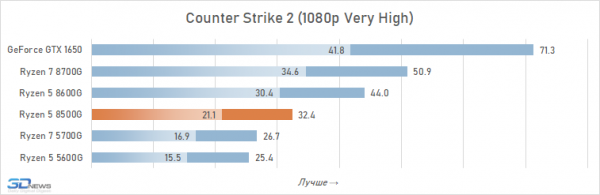
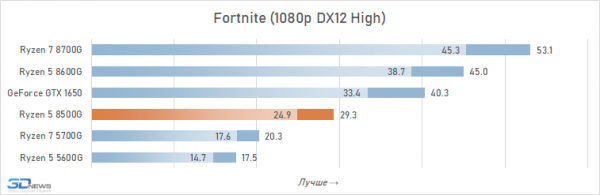
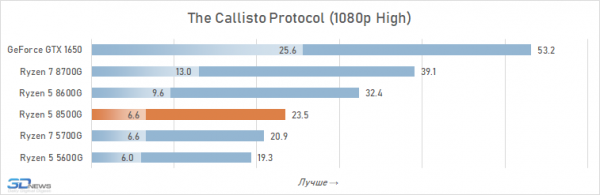
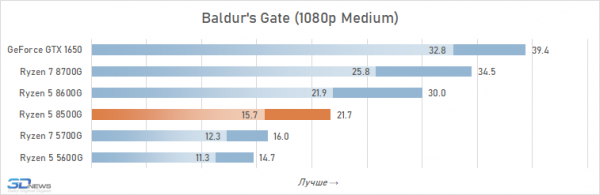
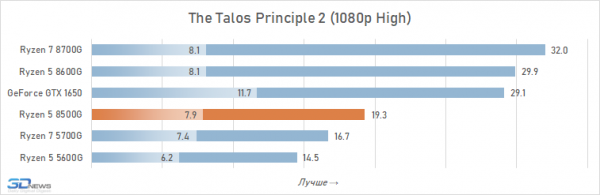
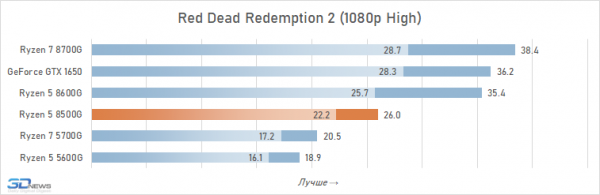
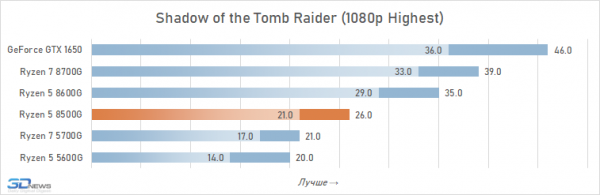
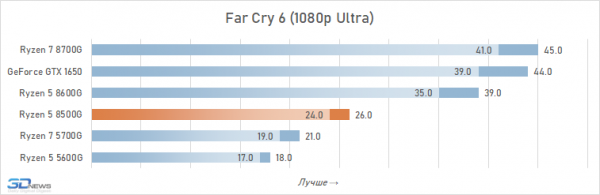
Let's start with the main point, which is evaluating the performance of the integrated Radeon 740M graphics core in the Ryzen 5 8500G. The tests, the results of which are presented below, were conducted at a resolution of 1080p (with FSR scaling off) in ten games with the following settings:
- Baldur’s Gate 3. Resolution 1920 × 1080, quality settings profile Medium.
- Cyberpunk 2077. Resolution 1920 × 1080, quality settings profile High.
- Counter-Strike 2. Resolution 1920 × 1080, quality settings profile Very High.
- Far Cry 6. Resolution 1920 × 1080, quality settings profile Ultra, without HD textures.
- Fortnite. Resolution 1920 × 1080, quality settings profile High.
- Red Dead Redemption 2. Resolution 1920 × 1080, quality settings profile High.
- Returnal. Resolution 1920 × 1080, quality settings profile Medium.
- Shadow of the Tomb Raider. Resolution 1920 × 1080, quality settings profile Highest.
- The Callisto Protocol. Resolution 1920 × 1080, quality settings profile High.
- The Talos Principle 2. Resolution 1920 × 1080, quality settings profile High.
The FPS metrics obtained in this test suite are not surprising. The Radeon 740M graphics performed significantly slower than the Radeon 760M and Radeon 780M. It lags approximately 30% behind the Radeon 760M, which has double the number of CUs, and its performance is over 40% behind the Radeon 780M, which has three times the number of CUs. In other words, in terms of the power of the GPU integrated into the Ryzen 5 8600G and Ryzen 7 8700G processors, based on the Phoenix architecture, they outperform the Ryzen 5 8500G significantly.
However, this is not a reason to dismiss the six-core Phoenix 2. Regardless, the Ryzen 5 8500G, which has only four CUs, easily outperforms last generation solutions, not only the Ryzen 5 5600G but also the Ryzen 7 5700G, which has 8 CUs based on the GCN 5 architecture. When comparing processors of the same class — the Ryzen 5 8500G and Ryzen 5 5600G — the newer APU can be expected to deliver an average of 37% higher frame rates in games.
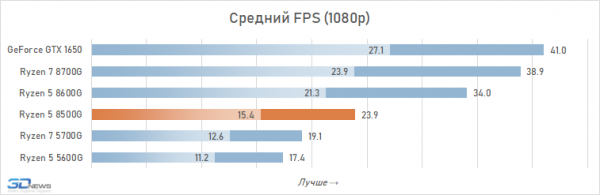
When discussing the Ryzen 7 8700G and Ryzen 5 8600G, we mentioned that the integrated graphics of these APU can replace entry-level graphics cards and deliver quite acceptable performance in modern games at high or medium quality settings at 1080p resolution. However, the same cannot be said for the Ryzen 5 8500G. Those choosing this processor for a gaming build will likely need to reduce the image quality a notch. While this isn't catastrophic, it's important to understand that the performance here is no longer comparable to that of a GeForce GTX 1650. Additionally, there is little room for improving gaming performance with the Ryzen 5 8500G. Its GPU, like the compute component, does not allow for any overclocking. As a result, even in lightweight graphics games like Counter Strike 2 or Fortnite, users with Ryzen 5 8500G systems will likely have to sacrifice quality for sufficient FPS.
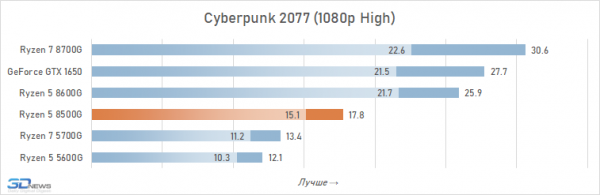
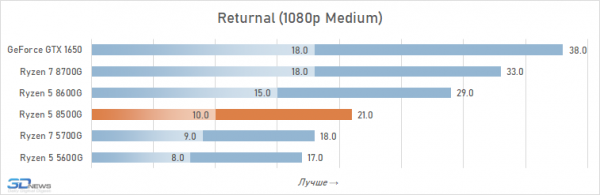
However, it should not be forgotten that the Ryzen 5 8500G features a decent software solution for addressing low frame rates. This is the Hyper-RX technology, which combines several performance-enhancing tools, including the Radeon Super Resolution scaling technology based on FSR 1 algorithms, Anti-Lag+, and Radeon Boost, as well as AMD Fluid Motion Frames for generating additional intermediate frames. This tool is available at the driver level of AMD Adrenalin and is applicable to any game—it allows for reducing the game rendering resolution (with the final output at 1080p) without significant loss of image quality.
Performance in applications
Processor performance tests for the Ryzen 5 8500G were conducted with a discrete graphics card, the GeForce RTX 4090, installed in the system. The following benchmarks and applications were used:
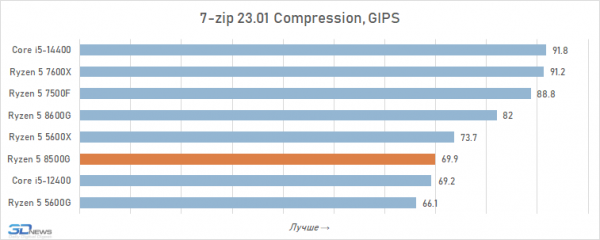
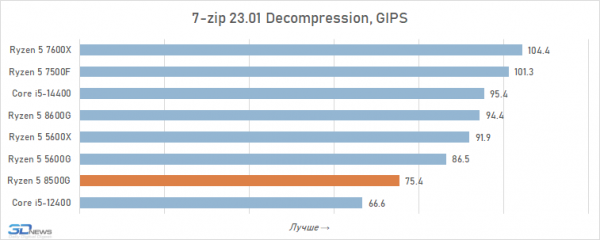
- 7-zip 23.01 — testing compression and decompression speed. An integrated benchmark is used with a dictionary size of up to 64 MB.
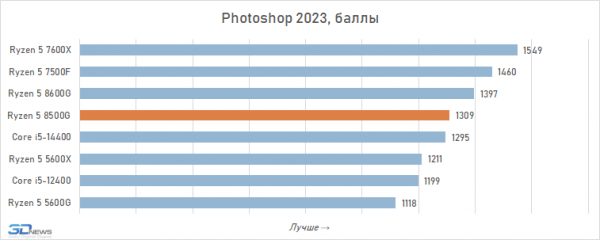
- Adobe Photoshop 2023 24.7.1 — testing performance in processing graphic images. A test script, PugetBench for Photoshop V0.93.7, is used, simulating basic operations and working with filters such as Camera Raw Filter, Lens Correction, Reduce Noise, Smart Sharpen, Field Blur, Tilt-Shift Blur, Iris Blur, Adaptive Wide Angle, and Liquify.
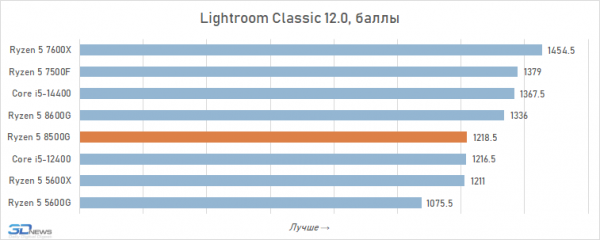
- Adobe Photoshop Lightroom Classic 12.5 — performance testing for batch processing of a series of images in RAW format. The test script PugetBench for Lightroom Classic V0.95 is used, simulating basic library work and editing, as well as import/export, Smart Preview, and the creation of panoramas and HDR images.
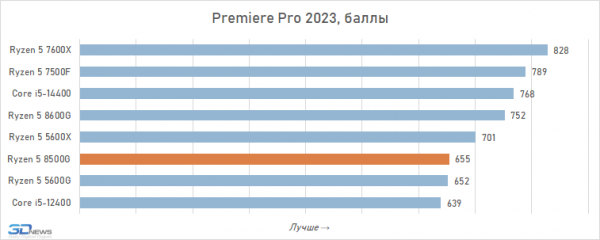
- Adobe Premiere Pro 2023 23.6.0 — performance testing for video editing. The test script PugetBench for Premiere Pro V0.98 is used, simulating the editing of 4K videos in various formats, applying different effects and final rendering for YouTube.
- Blender 4.0 — testing the speed of final rendering on CPU. The standard Blender Benchmark is used.
- Corona 10 — testing the speed of final rendering on CPU. The standard Corona Benchmark is used.
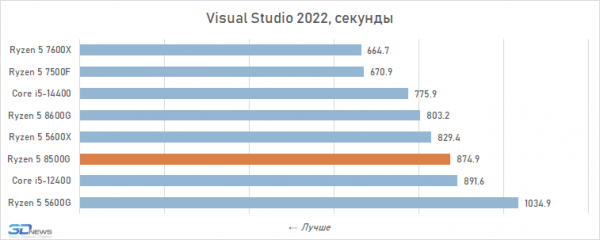
- Microsoft Visual Studio 2022 (17.8.0) — measuring the compilation time of a large MSVC project — Blender version 4.0.
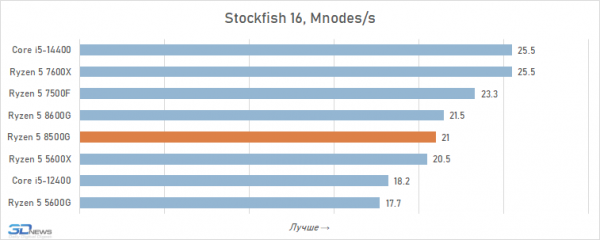
- Stockfish 16.0 — testing the speed of the popular chess engine. A standard benchmark with a 30 half-move depth of analysis is used.
- SVT-AV1 1.7 — testing the speed of video transcoding to AV1 format. The source is 4K@24FPS video with 10-bit color and a bitrate of 51 Mbps.
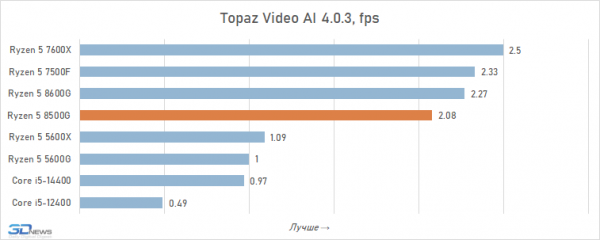
- Topaz Video AI v4.0.3 — performance testing for video quality enhancement using AI algorithms executed on CPU. The source video 640×360@30FPS is upscaled using the Artemis model to a resolution of 1280×720, while the FPS is increased to 60 using the Apollo model.
- X264 164 r3107 — testing the speed of video transcoding to H.264/AVC format. The source is 4K@24FPS video with 10-bit color and a bitrate of 51 Mbps.
- X265 r12776 — testing the speed of video transcoding to H.265/HEVC format. The source is 4K@24FPS video with 10-bit color and a bitrate of 51 Mbps.
- V-Ray 5.00 — testing the speed of final rendering on CPU. The standard V-Ray 5 Benchmark is used.
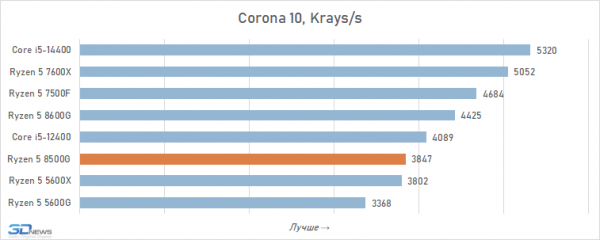
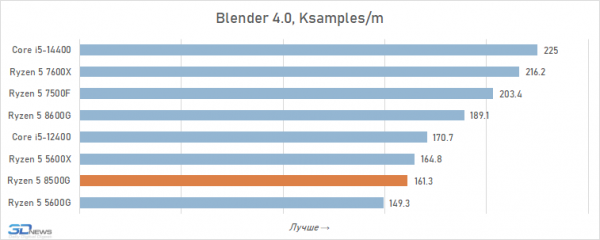
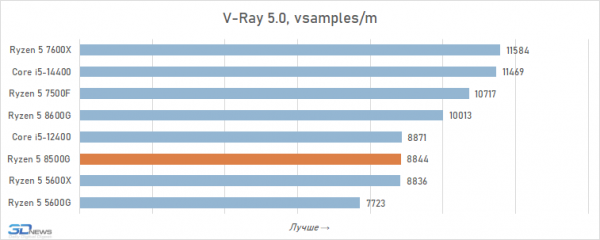
The Ryzen 5 8500G's CPU part is similar to that of the Ryzen 5 8600G — it is an equivalent six-core processor based on the Zen 4 architecture with a reduced L3 cache of 16 MB. However, despite this, the advantage of the Ryzen 5 8600G in resource-intensive applications cannot be considered insignificant, as these two CPUs significantly differ in their frequency formula. The Ryzen 5 8500G has only two fast cores, operating at the typical Zen 4 frequencies of 4.6-5 GHz, while the other cores belong to the Zen 4c class and function at best at 3.7 GHz. As a result, the average frequency of the Ryzen 5 8500G under multi-threaded loads can be described as around 4 GHz, whereas the frequency of the Ryzen 5 8600G under the same conditions is 4.6 GHz. Therefore, the observed performance advantage of 12% for the Ryzen 5 8600G should not come as a surprise.
However, in low-thread workloads, this gap is much smaller, as the Ryzen 5 8500G has two fast cores that operate at the same frequencies as the cores of the Ryzen 5 8600G. This is good news for those who do not plan to use systems based on the Ryzen 5 8500G for creating or processing digital content. For typical office and home needs, the Ryzen 5 8500G and Ryzen 5 8600G are similarly suitable.
Nevertheless, any of the APUs fall short in performance compared to the "full" Ryzen 7000 series, which not only have higher frequencies but also boast twice the L3 cache capacity. Even the budget six-core Ryzen 5 7500F can provide a 20% performance advantage, not to mention the Ryzen 5 7600X, which outperforms the Ryzen 5 8500G by 25-30% in resource-intensive tasks.
In terms of computational performance, the Ryzen 5 8500G can be matched only with the Ryzen 5 5600X or Core i5-12400 — six-core processors that hit the market three to four years ago. This can be considered a trade-off for hybridization, which leaves little space for the implementation of a classic CPU part in the Phoenix 2 chip.
Rendering:
Video Encoding:
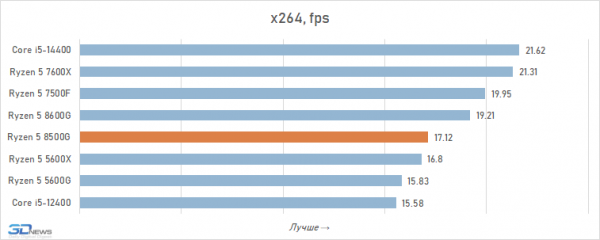
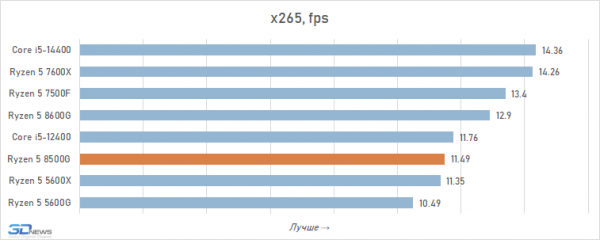
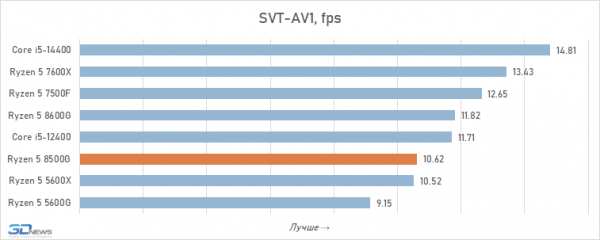
Photo processing:
Video editing:
Compilation:
Archiving:
Chess:
Gaming performance with discrete graphics
AMD hybrid processors are often purchased with the intent of later upgrading the system by installing a discrete graphics card. That’s why it makes sense to pay special attention to how the Ryzen 5 8500G performs with a powerful external GPU. Moreover, this processor raises significant concerns. It allocates only four PCIe 4.0 lanes to the first PCIe x16 slot on the motherboard, which may potentially be insufficient to ensure adequate performance.
For practical testing, we used the GeForce RTX 4090 graphics card and the following set of games:
- Baldur’s Gate 3. Graphics settings: Vulkan, Overall Preset = Ultra.
- Cities: Skylines II. Graphics settings: Global Graphics Quality = High, Anti-aliasing Quality = Low SMAA, Volumetrics Quality Settings = Disabled, Depth of Field Quality = Disabled, Level of Detail = Low.
- Cyberpunk 2077 2.01. Graphics settings: Quick Preset = Ray Tracing: Medium.
- Dying Light 2. Graphics settings: Quality = High Quality Ray Tracing.
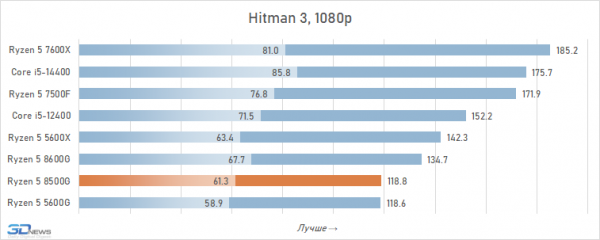
- Hitman 3. Graphics settings: Super Sampling = 1.0, Level of Detail = Ultra, Texture Quality = High, Texture Filter = Anisotropic 16x, SSAO = Ultra, Shadow Quality = Ultra, Mirrors Reflection Quality = High, SSR Quality = High, Variable Rate Shading = Quality.
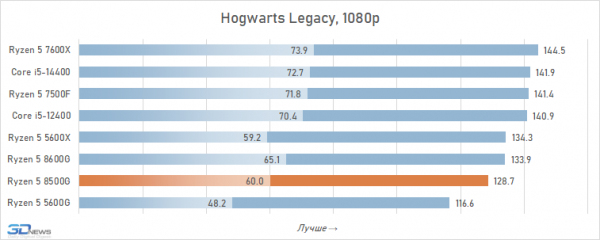
- Hogwarts Legacy. Graphics settings: Global Quality Preset = Ultra, Ray Tracing Quality = Low, Anti-Aliasing Mode = TAA High.
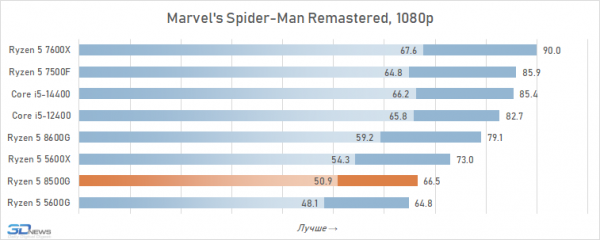
- Marvel’s Spider-Man Remastered. Graphics settings: Preset = Very High, Ray-Traced Reflection = On, Reflection Resolution = Very High, Geometry Detail = Very High, Object Range = 10, Anti-Aliasing = TAA.
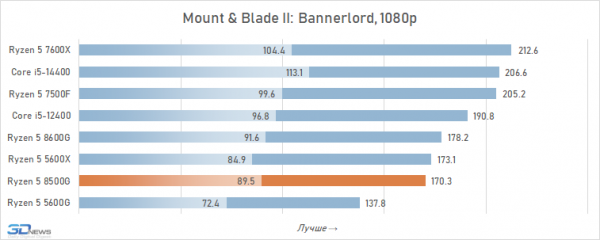
- Mount & Blade II: Bannerlord. Graphics settings: Overall Preset = Very High.
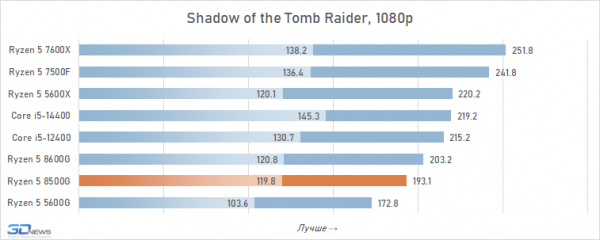
- Shadow of the Tomb Raider. Graphics settings: DirectX12, Preset = Highest, Anti-Aliasing = TAA, Ray Traced Shadow Quality = Ultra.
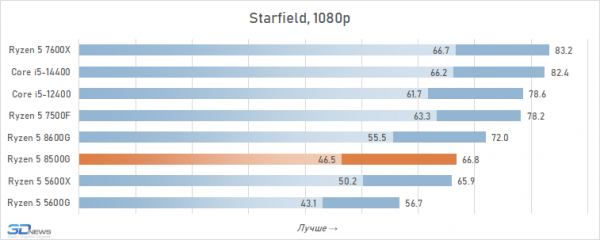
- Starfield. Graphics settings: Graphics Preset = Ultra, Upscaling = Off.
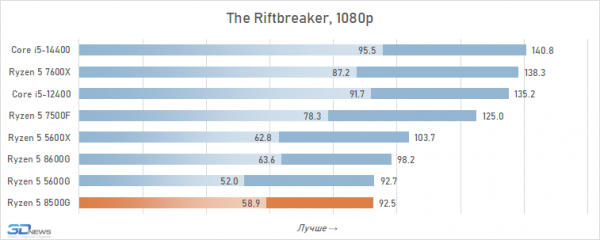
- The Riftbreaker. Graphics settings: DirectX12, Texture Quality = High, Ray Traced Soft Shadows = On, Ray Traced Shadow Quality = Ultra, Ray Traced Ambient Occlusion = On.
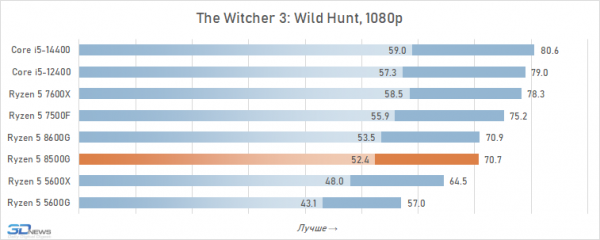
- The Witcher 3: Wild Hunt 4.04. Graphics settings: Graphics Preset = RT Ultra.
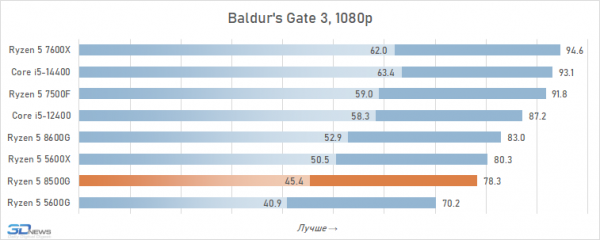
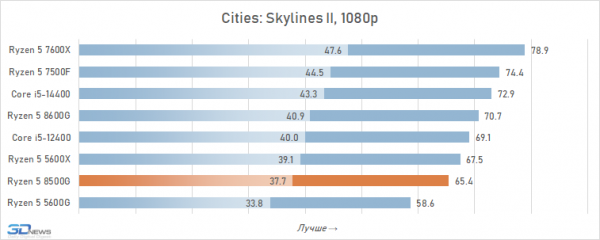
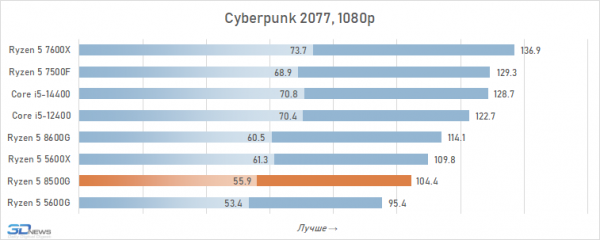
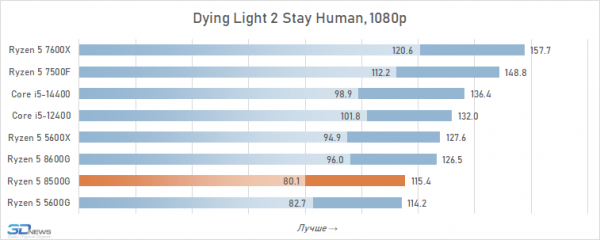
According to the results at 1080p resolution, there’s not much to worry about. The gaming performance of the Ryzen 5 8500G and the Ryzen 5 8600G paired with the flagship GeForce RTX 4090 graphics card does not differ noticeably. The average frame rate lag for the Ryzen 5 8500G is about 7%.
However, it is important to understand that six-core APU and six-core CPU implementations by AMD are not the same at all. Processors like the Ryzen 5 8500G, with reduced cache memory, are significantly weaker than their relatives from the Ryzen 7000 series, even though both utilize the Zen 4 architecture. For instance, in tests with discrete graphics, the Ryzen 5 7500F outperforms the Ryzen 5 8500G by a substantial 22%. The six-core Core i5-12400 also proves faster than the Ryzen 5 8500G, although in this case, the advantage is smaller but still represents a double-digit percentage.
In other words, if you are planning for a future upgrade, it is better to focus on combinations of traditional processors and inexpensive graphics cards rather than hybrid options. The most convincing illustration of this thesis is that after pairing the Ryzen 5 8500G with discrete graphics, it fails to reach the performance level of even the Ryzen 5 5600X, which means it lags behind AMD's complete solutions by more than one generation.
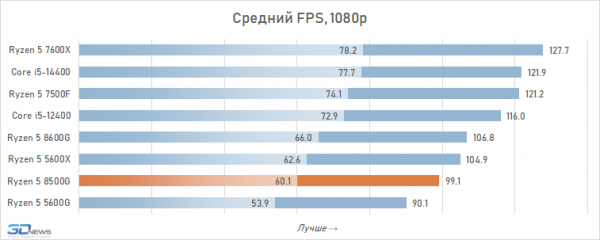
The results in individual games only confirm this. The Ryzen 5 8500G loses to the Ryzen 5 5600X in 10 out of 12 games in our test suite. The Core i5-12400 outperforms the main subject of this review in all 12 games, with its superiority exceeding 25% in some cases.
Source: 3dnews.ru
