

The Raspberry Pi project has unveiled the new Raspberry Pi Pico 2 board, which continues the development of the mini boards Pico and Pico W, equipped with a custom-designed microcontroller. The board is produced at the Sony factory and is available for $5. Like previous Pico boards, the new model is primarily aimed at collaboration with Raspberry Pi computers, embedded system development, and control systems for various devices. An additional model, the Pico 2 W, is planned for release by the end of the year, featuring support for Bluetooth and Wi-Fi (2.4GHz 802.11n), based on the Infineon CYW43439 chip.
The Pico 2 board is notable for employing the new RP2350 microcontroller, which, compared to the RP2040 used in previous models, includes a more powerful dual-core ARM Cortex-M33 processor with DSP and a floating-point computation block, operating at 150MHz (previously, an ARM Cortex-M0+ at 133 MHz was used). Furthermore, it includes two optional Hazard3 cores with a RISC-V instruction set architecture, which can be toggled during boot for use instead of the ARM Cortex-M33 cores.
The chip is equipped with 520 KB of built-in RAM (previously 264 KB), allows connection of external QSPI PSRAM memory modules, and provides enhanced security features. The Pico 2 board comes with 4MB of QSPI Flash, which is double that of the previous model. Additionally, the board is fully compatible with past models at the hardware interface and software levels used for application development.
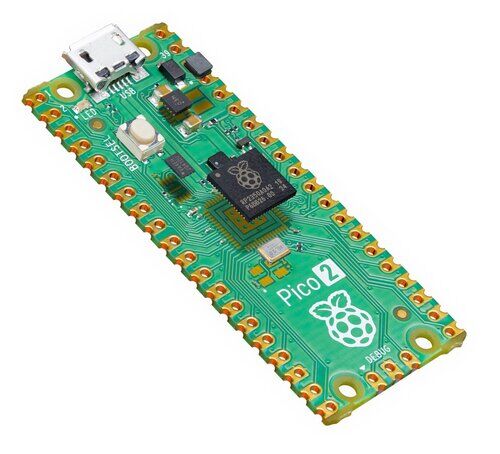
The RP2350 chip contains built-in hardware to protect against Fault Injection attacks and supports Arm TrustZone technology, which can be used to verify boot through digital signatures, provides instructions to accelerate SHA-256 hash computations, and generates reliable random numbers (TRNG, True Random Number Generator). Additionally, it includes 8 KB of one-time programmable memory, allowing data to be written that cannot be altered or deleted afterward.
C, C++, MicroPython, or CircuitPython can be used to create applications. Development in C/C++ can be done in the Visual Studio Code editor, for which a special extension is available. The chip has enough capabilities to run applications for machine learning tasks, for which there is a port of the TensorFlow Lite framework. For network access, it is suggested to use the lwIP network stack, which is included in the Pico SDK for C language application development, as well as in the firmware with MicroPython.
There has been a partnership announced with companies such as 4D Systems, Adafruit, Bus Pirate, Cytron, Hellbender, Ignys, Invector Labs, Melopero, NewAE, Pimoroni, Seeed, Solder Party, SparkFun, Switch Science, ThisisNotRocketScience, Tiny Circuits, and Wiznet, which have prepared their own versions of boards and devices based on the RP2350 microcontroller. Among the products being developed are the gen4-RP2530 screens, Arduino-compatible Adafruit Feather RP2350 board, Bus Pirate 5XL and Bus Pirate 6 debugging boards, Cytron IRIV I/O industrial input/output controller, MOTION 2350 Pro robot controller, Hellbender RP2350 and Ignys RP2350 developer boards, Challenger+ RP2350 BConnect board, Melopero Perpetuo LoRa and NewAE RP2350, Pimoroni Tiny 2350, Plasma 2350, PGA2350, Seeed XIAO RP2350, Solder Party RP2350 Stamp, SparkFun Pro Micro, and Switch Science Picossci2, as well as the ThisIsNotRocketScience Bopp & Steve sound effects synthesizer and Tiny Circuits Thumby Color gaming console.
Source: opennet.ru
