

After eight months of development, the release of the free game engine Godot 4.3 has been published, suitable for creating 2D and 3D games. The engine supports an easy-to-learn scripting language for game logic, a graphical environment for game design, one-click game deployment, extensive animation and physics simulation capabilities, a built-in debugger, and a performance bottleneck detection system. The source code for the game engine, game design environment, and associated development tools (physics engine, audio server, 2D/3D rendering backends, etc.) is distributed under the MIT license.
The source code of the engine was opened in 2014 by OKAM studio after ten years of developing a professional-grade proprietary product that was used to create and publish many games for PC, gaming consoles, and mobile devices. The engine supports all popular desktop and mobile platforms (Linux, Windows, macOS, Wii, Nintendo 3DS, PlayStation 3, PS Vita, Android, iOS, BBX), as well as web game development. Ready-to-run binary builds have been created for Linux, Android, Windows, and macOS.
Key Changes:
- Experimental built-in support for the Wayland protocol has been added on Linux and BSD systems.
- New resources AudioStreamInteractive, AudioStreamPlaylist, and AudioStreamSynchronized have been added, allowing for dynamic musical accompaniment that changes depending on the context in the game.
- Interpolation has been added for simulating physical processes in two-dimensional space, creating additional frames for rendering intermediate states between the current and next positions of an object, making the output smoother on high-refresh-rate screens and low-power devices.
- The visual shader editor has been completely redesigned, now better suited for handling large and complex shader graphs. To enhance visual clarity, nodes are now color-coded based on categories, and more noticeable colors are used for node connections. Two new node types, 'reroute' and 'frame', have been added to simplify node movement and visual highlighting.
- The flexibility of working with layers has been increased. A new TileMapLayer node has been added to simplify layer addition. Previously created TileMap nodes can be transformed into TileMapLayer nodes with a single click in the editor.
- Support for exporting applications for the Web, running in single-threaded mode, has been restored. Single-threaded applications are more compatible with browsers and do not require complex server support.
- Performance optimization in multithreading has been implemented. Changes have been made to reduce the likelihood of deadlocks. The reliability of multithreaded resource loading has been increased.
- A new SkeletonModifier3D node has been added to the skeletal animation tools, simplifying the organization of joint movements using scripts. New options for importing skeletal animations in fbx format have been added. The animation control interface now supports selection, copying, pasting, and duplicating keyframes.
- The ability to automatically split navigation grids into separate parts has been added, simplifying work on projects that contain large game worlds while reducing memory consumption and increasing performance. The splitting can be configured through boundary and size definitions using new properties in NavigationPolygon (2D) and NavigationMesh (3D) resources.
- The editor has been enhanced with built-in support for importing fbx files, eliminating the need for third-party converters. There is now an option to move the file system access panel to the bottom of the screen, allowing for more free space to view files.
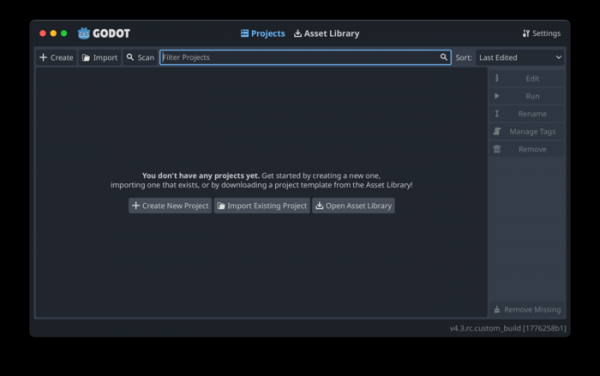
- The project manager interface has been redesigned to provide direct access to editor settings such as language, theme, scaling level, and networking mode. A component for checking for updates has been added.

- A new Parallax2D node has been added, simplifying the creation of a depth illusion in 2D games through the movement of background elements at different speeds.
- Preliminary support for alpha channel blending in 3D shaders has been added to the rendering system, allowing for the creation of more realistic flames and fireworks. An API for managing effects during compositing has been introduced, enabling the integration of custom code to change rendering logic (for example, it can be used to create motion blur effects). The fog generation capabilities have been expanded, allowing for the determination of where fog begins and when it becomes fully opaque. The 'Compatibility' rendering backend has been significantly improved.
- The architecture of the RenderingDevice object has been updated, and support for directed acyclic rendering graphs has been added, allowing for optimized command transmission to the graphics API, which demonstrates a 5-15% increase in frame rates without modifying the 3D scene.
- A new rendering driver utilizing Direct3D 12 has been added.
- In GDScript, the ability to reduce code size during export through cleaning, packing, and obfuscation has been provided. A new operator 'is not' has been added (e.g., 'if my_node is not Node3D:'). The code autocompletion features in the editor have been expanded.
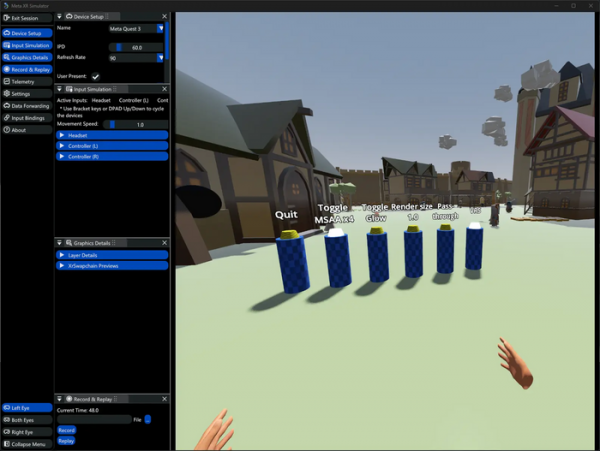
- Enhanced capabilities for creating games for virtual reality headsets using OpenXR and WebXR have been introduced. Support for the Meta XR Simulator has been added.

- Web games have improved audio quality and the ability to display a splash screen.
Source: opennet.ru
