

After nearly two years of development, the release of the Redox OS 0.9 has been published, created using the Rust language and the microkernel concept. The project's developments are distributed under the MIT open-source license. For testing Redox OS, bootable live environments for real hardware and system images for virtual machines (512 MB and 1.5 GB) have been prepared for the x86_64 and i686 architectures.
The demo image includes the DOSBox emulator, a selection of games (DOOM, Neverball, Neverputt, sopwith, syobonaction), educational programs, the music player rodioplay supporting FLAC and WAV formats, the Netsurf web browser, an image viewer, the Sodium console text editor, a file manager, a terminal emulator, and a text editor from the COSMIC project. The user environment is built on their own graphical shell Orbital and the OrbTk toolkit, providing an API similar to Flutter, React, and Redux. There is support for the GUI libraries Slint, Iced, and winit.
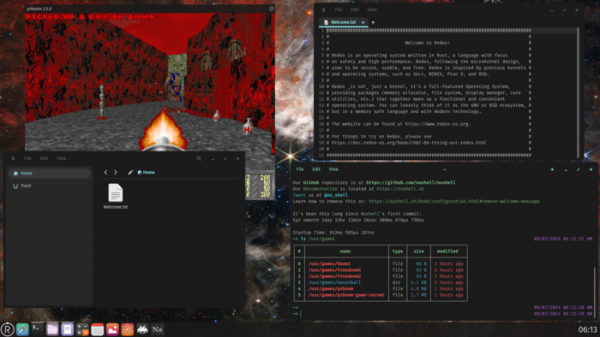
The operating system evolves in accordance with Unix philosophy and borrows some ideas from SeL4, Minix, and Plan 9. Redox employs a microkernel concept, where the kernel level provides only process interaction and resource management, while all other functionality is implemented in libraries that can be used by both the kernel and user applications. All drivers run in user space within isolated sandbox environments. To ensure compatibility with existing applications, a special POSIX layer is provided, allowing many programs to run without porting.
The project is developing its own package manager, a set of standard utilities (binutils, coreutils, netutils, extrautils), the ion shell, the standard C library relibc, a vim-like text editor sodium, a networking stack, and a filesystem. Configuration is defined using the Toml language.
Supported hardware includes input devices with USB interfaces (keyboards, mice, trackpads), graphics output through the VESA BIOS API or UEFI GOP (drivers for GPUs are not supported), AC'97 and Intel HD Audio sound chips, SATA (AHCI, IDE), and NVMe. Support for Wi-Fi and USB storage devices is still under development. The graphical environment has been tested on Lenovo IdeaPad Y510P, System76 Galago Pro, and System76 Lemur Pro laptops. With some limitations, support is provided for Dell XPS 13, HP Dev One, ASUS X554L, ASUS ROG g55vw, Toshiba Satellite L500, and ASUS Eee PC 900 laptops. From ARM systems, the Raspberry Pi 3 Model B+ is supported.
Key Changes:
- Significantly expanded capabilities related to process, thread, memory, and signal management, resulting in improved performance for many applications. For example, the system has reached a level that allows compiling simple programs with the GCC and Rust compilers, although support for self-compilation has not yet been achieved.
- From the COSMIC user environment, the file manager, text editor, and terminal emulator have been transferred to Redox, all functioning in graphical mode.
- Improved compatibility with applications from Linux and BSD systems. The total number of application ports has been increased to around 1700. Significant achievements include the porting of the Apache HTTP server, Simple HTTP Server, RustPython, GNU Make, Lua, Perl 5, and text editors GNU Nano and Helix.
- Various performance optimizations have been made, and many issues affecting stability have been addressed. The performance of the RedoxFS file system, memory management, system calls, and context switching has been enhanced significantly. Performance in has been greatly accelerated. virtual machines.
- In display server Orbital has added support for the GUI libraries Slint, Iced, and winit. Through winit in Orbital, the ability to decorate client-side windows, create hidden windows, and deploy windows to full screen has been implemented. Music and video playback from GUI applications through double-clicking has been added. The design of the Orbital desktop environment has been improved.

- Instead of addressing via URL (for example, for logging one could use the URL "log://", and for network interactions "tcp://"), a traditional Unix file path format has been utilized, which positively impacted compatibility with POSIX/Linux programs and libraries.
- The implementation of the standard C library Relibc has been improved, which, in addition to libm, is now fully written in Rust. Support for POSIX functions has been expanded. Initiatives have been proposed to provide a stable ABI for user space. All system components have been ported from redox_syscall to libredox.
- The bootloader for UEFI has been improved.
- Support for the ARM64 (Aarch64) architecture has been significantly enhanced, providing partial compatibility with the Raspberry Pi 3B+ board.
- The capabilities of the Contain driver for isolated application execution have been expanded. A demonstration of using the Contain driver (desktop-contain.toml) has been added.
- Drivers for PCI and PCIe have been improved. VirtIO drivers have been added.
- The build system capabilities have been expanded.
Source: opennet.ru
