

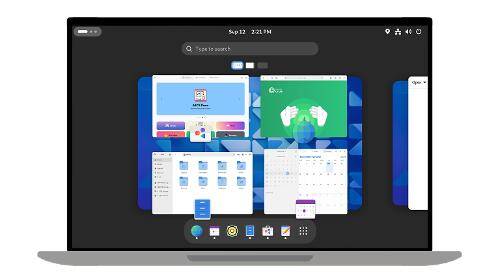
After six months of development introduced Desktop environment release GNOME 47. For a quick evaluation of GNOME 47 capabilities are offered specialized Live builds based on The release of SEMMi Analytics 2.0 and installation image, prepared as part of the GNOME OS initiative. GNOME 47 is also included in the experimental builds of Ubuntu 24.10 and Fedora 41.
In the new release:
- support for configuring accent colors has been added, used to highlight active elements. Previously, the GNOME theme provided a single blue accent color, but now the appearance configurator offers a choice from several options;
- the performance on low-resolution screen systems has been improved, optimizing the rendering process of icons and interface elements. Issues with the display of overly small icons have been resolved — GNOME now automatically selects the icon scaling level to ensure an adequate size for low resolutions;
- on systems with Intel and AMD GPUs, support for utilizing hardware acceleration for video encoding during screencasting has been added, which reduces the load on the system and mitigates the impact of high-resolution screencasting on the responsiveness of the interface and applications;
- the GTK library version has been updated to version 4.16, which by default employs the Vulkan rendering engine in environments based on the Wayland protocol, directly utilizing the Vulkan graphics API. The quality and performance of rendering on older hardware and mobile devices has been significantly improved;
- when remotely connecting to the desktop, session saving support has been implemented — in case of accidental disconnection from the remote desktop, it is now possible to return to the interrupted session without losing its state (the session will resume exactly as it was before disconnecting);
- a new style for dialog windows used in the system and applications has been proposed. The changes aim to enhance usability regardless of screen resolutions and device types;
- The file opening and saving dialogs have been significantly redesigned; they are now integrated and based on the standard file manager code, resembling it in appearance and behavior. The new dialogs include features such as zooming, icon sorting mode selection, built-in functions for renaming directories and files, file previews, on-demand thumbnail generation, and advanced search capabilities.
- The interface of the dialogs in the Nautilus file manager (GNOME Files) for creating new directories and compressing files has been updated. The search panel now provides contextual information related to performance and its impact on search results, such as the absence of the selected file path in the search index or attempts to search on parts of the file system mounted from a remote server.
- The file manager's sidebar capabilities have been expanded. A list of internal drives has been consolidated in one place. The ability to remove various entry points (Places) has been added, including elements to navigate to documents, downloads, music, and videos. A new 'Network' section has been introduced, featuring a list of network storage solutions that includes sections for connected, previously used, and available storage options.
- In the configurator (GNOME Settings), the input device settings section now allows for a visual preview of keyboard layouts prior to selection. A hover-to-activate window mode has been added for accessibility settings. In the power management section for mobile devices, dedicated options for delays before entering sleep mode have been proposed. New interface elements from GNOME have been implemented across various configurators.
- The calibration options for graphic tablets have been enhanced, notably adding the ability for calibration in cases of manual rather than automatic matching with the monitor. Non-libwacom supported tablets are now displayed in the GNOME configurator. Such tablets are now treated and displayed as standard tablets with common basic settings. The naming of displays has been unified in the configurator and in the tablet-to-monitor mapping settings.
- The management tools for external accounts (GNOME Online Accounts) now feature automatic filling of connection details for IMAP/SMTP based on the provided email address. Integration of email, calendar, and address book with Microsoft 365 accounts is ensured. When setting up WebDAV, the available servers are automatically detected.
- In the Epiphany web browser (GNOME Web), a new feature for automatically filling web forms based on previously provided data has been introduced. The settings allow you to choose the information available for auto-completion, such as name, address, and contact details. A new bookmarks panel has been added to simplify navigation and search for bookmarks. A privacy report reflecting the number of scripts blocked by the browser for tracking purposes has been included. Due to changes in the authentication process, support for the Firefox Sync service is temporarily disabled.
- The calendar planner has revamped the pop-up window with detailed information about events. Event handling in read-only mode has been improved. The appearance has been upgraded, and spacing between elements has been modified. In the import and event editing dialogs, the handling of hidden calendars and read-only calendars has been correctly addressed.
- New applications have been added to the GNOME Circle collection: Binary, Biblioteca, Hieroglyphic, Resources, Tuba, and Valuta.
- The interface of the disk space analyzer has been updated. The design of the panel, file list, and icons has been changed; the appearance of the cursor shown during the waiting process has also been modified.
- The application manager (GNOME Software) has revamped the display of recommended applications.
- In the map application (GNOME Maps), vector graphics are now used by default to represent geographical information. Support for a community-supported routing service has been added.
- Improved support for fractional scaling in X11-based applications.
- In Wayland-based sessions, the ability to use virtual reality headsets for gaming has been implemented.
- Basic features for utilizing hardware acceleration during screen sharing on systems with NVIDIA graphics cards have been added.
- The ability to build GNOME Shell and the compositing manager Mutter without X11 support has been added, retaining only the components for Wayland.
- The compositing manager Mutter now supports the Wayland drm-lease protocol extension, which provides the necessary resources to create a stereoscopic image with different buffers for the left and right eyes when outputting to virtual reality headsets.
Video: https://www.youtube.com/watch?v=sgcVp5RHy4Q.
Source: linux.org.ru
