

The developers of the Raspberry Pi project have released a new version of the Raspberry Pi OS distribution 2024-10-22 (Raspbian), based on the Debian 12 package base and Linux kernel 6.6. Approximately 35,000 packages are available in the repository. Three builds have been prepared for download — a slimmed-down version (438 MB) for server systems, a version with a basic desktop (1.1 GB), and a full version with an additional set of applications (2.9 GB), available for both 32- and 64-bit architectures. An update has also been created for the old version of Raspberry Pi OS (Legacy), based on the Linux 6.1 kernel and Debian 11 package base.
Key changes:
- The desktop environment has been transitioned to using the composite server labwc, based on the wlroots library from the Sway project and offering functionality similar to the Openbox window manager. The new composite server, utilizing Wayland, is employed in builds for older boards that were previously shipped with an X server and Openbox window manager, as well as in builds for Raspberry Pi 4/5 boards that were previously transitioned to Wayland and the Wayfire composite server.
It is noted that initially, the Raspberry Pi OS developers tried to adapt Wayfire to work with all boards, but it was not feasible to align it with the graphical capabilities of older boards. The labwc project proved to be better suited for working with older Raspberry Pi boards, and together with the developers of labwc and wlroots, they managed to bring the performance of the Raspberry Pi OS graphical interface running on labwc up to the performance level of the variant using the X server.
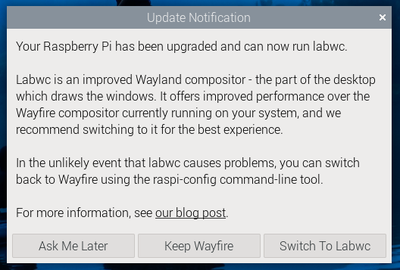
When installing new systems, labwc is engaged by default, while users of previously installed systems will be prompted on the first boot after the update to switch to using labwc or continue working in environments based on the Wayfire composite server or the combination of the X server and Openbox. From the user’s perspective, the desktop environment has not changed, except for the discontinuation of support for some animated effects. Launching applications that use X11 is facilitated via Xwayland.

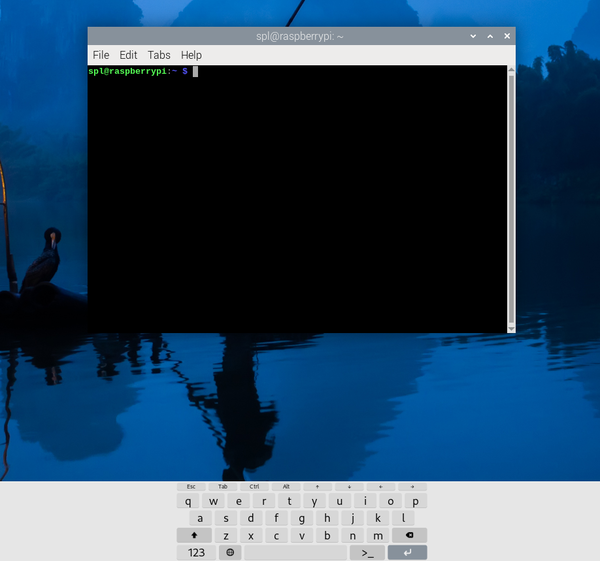
- Support for working with touch screens has been significantly improved. The automatic display of the Squeekboard on-screen keyboard is implemented when input is needed, and screen gestures equivalent to double-clicking and right-clicking have been added.

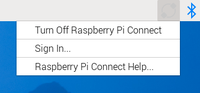
- Improved integration with the Raspberry Pi Connect service, designed for remote desktop access through a web browser. A default indicator for Connect has been added to the system tray, allowing you to activate or deactivate the service.

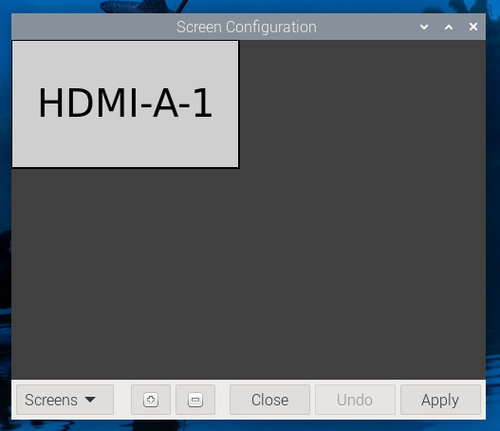
- A new raindrop screen configurator has been added, which resembles the old arandr configuration interface but is completely rewritten with composite work in mind. proxy server labwc and touch screens.

- The application top panel has been rewritten. In the new version, the logic for loading plugins has changed, and they no longer remain in memory after being removed from the panel (each plugin is now handled in a separate library).
- Synchronization has been carried out with the current package base of Debian 12.
Source: opennet.ru
