

The release of Lima toolset 1.0 has been published, which initially developed a layer similar to WSL2 (Windows Subsystem for Linux) for running Linux applications on macOS (Linux-on-Mac), but has since evolved into a universal toolset for running virtual machines with Linux across various operating systems. Currently, Lima can be used on macOS, Linux, Windows, and BSD systems. The key objective of the project is to provide an easy way to run arbitrary Linux distributions in isolated containers or virtual environments, ensuring automatic network port redirection and file sharing. The project's code is written in Go and is distributed under the Apache 2.0 license.
Runtime containerd and various container isolation engines (Apptainer, Docker, Podman, LXD) can be used for isolated Linux environment execution in Linux and BSD systems. On macOS, QEMU with the HVF accelerator is used, or the native macOS virtualization tool Virtualization.framework. The WSL2 (Windows Subsystem for Linux) layer is used to run Linux environments on Windows. Support is provided to run Linux distributions built for the x86_64 architecture on ARM64 host systems and vice versa. Experimental support for riscv64 and ARM32 architectures is also available.
To organize access to the host environment's files, SSHFS, virtio-9p-pci/virtfs (by default), and virtiofs can be used. Network port redirection is carried out by tracking network calls through /proc/net/tcp and iptables, followed by the automatic launch of 'ssh' with the '-L' option. Experimental features include sound system access through ALSA and remote connection setup via VNC.
Templates prepared for different versions of the AlmaLinux, Alpine, Arch Linux, Debian, Fedora, Gentoo, openSUSE, Oracle Linux, Rocky, and Ubuntu distributions are provided for quick environment deployment. The BuildKit toolset is recommended for building custom system images. The capability to use Lima for running Linux environments is integrated into the Finch (Amazon), Rancher Desktop (SUSE), Colima, and Podman Desktop (Red Hat) toolsets. Additionally, the Lima GUI, developed using Qt, is being created as a standalone graphical user interface.
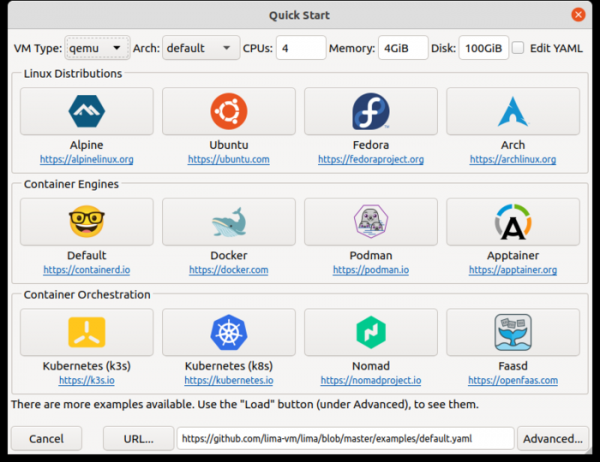
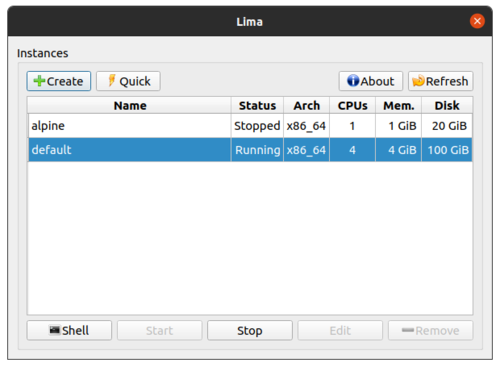
Lima version 1.0 marks the first stable release of the project, summarizing three years of development and incorporating some changes that disrupt backward compatibility. The vz driver support has been stabilized, utilizing the Virtualization.framework on the macOS platform. On systems starting with macOS 13.5, the vz driver is now used by default. The 9p driver for file sharing and the user-v2 driver for network access have also been promoted to stable status. Support for UDP port forwarding has been added. Many distribution installation templates have been updated, including new templates for Fedora 41 and Ubuntu 24.10.
Source: opennet.ru
