

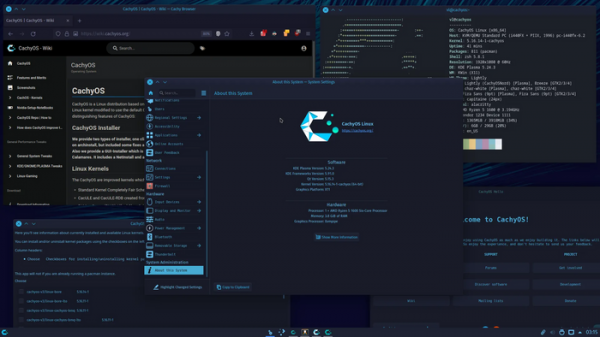
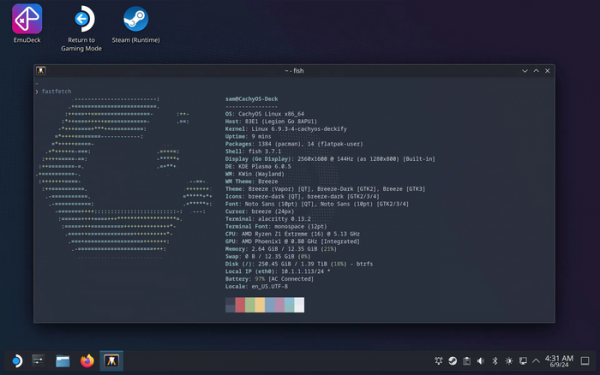
The release of the CachyOS 241110 distribution has been published, based on the Arch Linux package base and developed within a continuous delivery model for updates. This distribution is notable for including optimizations to enhance performance and the ability to install various desktop environments. In addition to the default KDE-based environment, available for installation are GNOME, XFCE, i3WM, Wayfire, LXQT, OpenBox, Cinnamon, Cosmic, UKUI, LXDE, Mate, Budgie, Qtile, Hyprland, and Sway. The size of the installation ISO image is 2.7 GB. Separate builds (2.9) are provided for handheld devices with a GameMode-style interface and components for gaming enthusiasts.
The filesystem options include btrfs, zfs, ext4, xfs, and f2fs. By default, the BORE task scheduler is enabled, optimized to reduce latency on the desktop and prioritize interactive processes. The kernel and packages are compiled with LTO optimizations and utilize instructions available in processors based on the x86-64-v3, x86-64-v4, and Zen4 microarchitectures. For building the base packages, additional optimizations such as PGO (Profile-Guided Optimization) or BOLT (Binary Optimization and Layout Tool) are employed. The distribution includes the Cachy-Browser web browser, based on Firefox and featuring changes to enhance security and improve performance, as well as patches from the Librewolf project.
Key Changes:
- The kernel package has been backported with the THP Shrinker mechanism, intended for inclusion in the Linux 6.13 kernel, which works to identify and separate underutilized (with many unchanged areas) transparent huge pages of memory. The THP Shrinker attempts to find an optimal balance between performance enhancement and excessive memory consumption—using 2MB memory pages instead of 4KB reduces the memory page table size and improves its caching efficiency at the cost of less economical memory usage. On systems with a constant use of large memory pages, where the parameter /sys/kernel/mm/transparent_hugepage/enabled is set to 'always', the application of the THP Shrinker allows for reduced memory usage without negatively impacting performance.
- The package includes the AMD Cache Optimizer driver, which allows the use of AMD 3D V-Cache technology to enhance the performance of individual CPU cores by increasing the size of the available L3 cache (Cache mode) or increasing frequency (Frequency mode).
- Patches have been transferred from the experimental branch of the AMD pstate driver into the kernel, significantly improving performance on Strix Point laptops.
- When a user manually installs the proprietary NVIDIA driver, the GSP firmware is automatically disabled (often users manually install another proprietary NVIDIA driver due to issues with the GSP Firmware).
- On laptops with NVIDIA GPUs, the nvidia-powerd service is enabled by default, providing support for the Dynamic Boost mechanism, which balances power consumption between the CPU and GPU to enhance performance.
- The proton-cachyos package includes patches for NVIDIA Optical Flow support, enabling the use of DLSS (Deep Learning Super Sampling) technology during intermediate frame generation.
- A patch has been added to resolve synchronization issues on screens with a resolution of 5120x1440p and a refresh rate of 240Hz.
- The kdeplasma-addons package has been added to KDE installations.
- The old behavior for installing the rEFInd boot manager has been restored, removing limitations related to the use of file systems.
- The Calamares installer has been updated to the latest version.
- New versions of packages have been proposed, including Linux kernel 6.11.7, NVIDIA driver 565.57.01, and Mesa 24.2.6.
- A linux-cachyos-autofdo kernel variant has been added, featuring the experimental AutoFDO (Auto-Feedback-Directed Optimization) optimization.
Source: opennet.ru
