

The Raspberry Pi project has announced the release of the new Raspberry Pi Compute Module 5, which is a portable version of the Raspberry Pi 5 model, measuring only 55 × 40 mm. The board's price ranges from $45 to $135, depending on the memory size and Wi-Fi support.
The board is equipped with the BCM2712 SoC, which is also used in the Raspberry Pi 5, and includes four 64-bit ARMv8 Cortex-A76 cores running at 2.4GHz, along with the VideoCore VII graphics accelerator. It features two HDMI video outputs (4Kp60). The graphics accelerator supports Vulkan 1.3 and OpenGL ES 3.1 graphics APIs and can decode H.265 (HEVC) video at 4Kp60 quality. The board includes a PCI Express 2.0 interface, two four-lane MIPI DSI interfaces for display (DSI) and camera (CSI-2), Gigabit Ethernet, 2 × USB 3.0, a 30-pin GPIO, 6 × UART, 5 × I2C, 5 × UART, 4 × PWM, 5 × SPI, and SDIO 2.0.
The board is offered in variants with different RAM sizes (1GB, 2GB, 4GB, 8GB SDRAM) and eMMC Flash (0GB, 16GB, 32GB, 64GB), also with or without wireless support (2.4 GHz, 5.0 GHz IEEE 802.11 b/g/n/ac and Bluetooth 5.0, BLE). A variant with 16GB of RAM is expected to be available next year. The operating temperature range is from -20 to 85°C (the previous board version operated in a range from 0°C to 80°C).
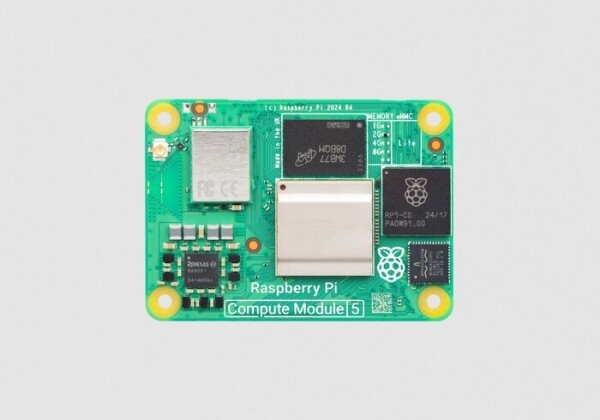
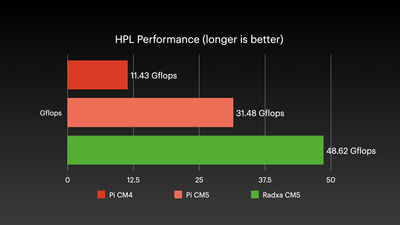
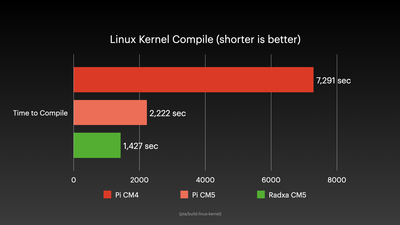
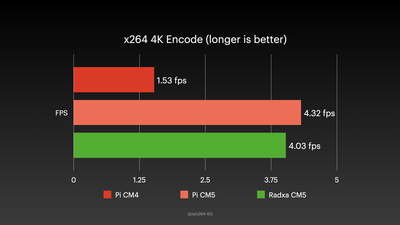
The connector for the board is compatible with the previous Raspberry Pi Compute Module 4 model and is compatible with it, allowing the new board to be used with most accessories released for the Compute Module 4. The differences in pinout are limited to the removal of two additional USB 3.0 ports and two dual-channel MIPI interfaces. In terms of performance, the new board outperforms the Raspberry Pi Compute Module 4 by 2-3 times.
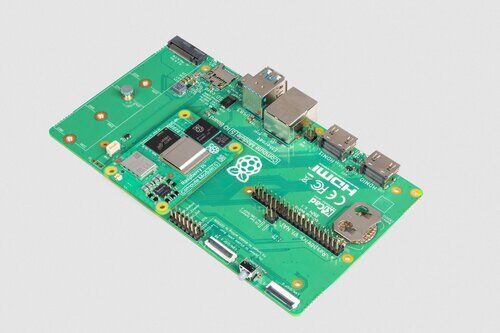
Additionally, an expansion board for the Compute Module 5 is offered, adding extra input/output ports (Compute Module 5 IO Board), equipped with two full-size HDMI 2.0 ports, Gigabit Ethernet with PoE+, two USB 2.0 ports, MicroSD, PCI Express Gen 2, 40-pin GPIO, slots for a camera and display, a battery for the built-in clock, and a connector for attaching a cooling fan.
Additionally, the Raspberry Pi project has introduced the Raspberry Pi Pico 2 W board, which continues the development of the Mini Pico 2 board equipped with the RP2350 microcontroller, designed in-house. The 'W' variant features support for Bluetooth 5.2 and Wi-Fi (2.4GHz 802.11n), implemented on the Infineon CYW43439 chip. Otherwise, the new board matches the specifications of the Pico 2 model. The price of the Pico 2 W is $7, which is $2 more than the non-Wi-Fi version. The Raspberry Pi Pico series is primarily aimed at being used alongside Raspberry Pi computers, for developing embedded systems and managing various device control systems.
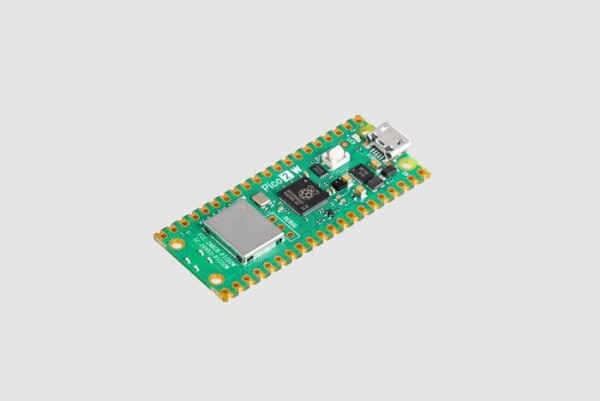
The RP2350 microcontroller includes a dual-core ARM Cortex-M33 processor with DSP and a floating-point calculation unit operating at 150MHz, as well as two optional Hazard3 cores with a RISC-V instruction set architecture, which can be switched during boot to serve as replacements for the ARM Cortex-M33 cores. The chip is equipped with 520 KB of built-in RAM, allows connecting external QSPI PSRAM memory modules, and provides expanded security features. The board comes with 4MB QSPI Flash and is fully compatible with previous Pico 1 models at the hardware interface and software levels used for application development.
The microcontroller is equipped with built-in hardware protections against fault injection attacks and supports Arm TrustZone technology, which can be used for verifying boot integrity via digital signatures. It provides instructions for accelerating SHA-256 hash computations and reliable random number generation (TRNG, True Random Number Generator). Additionally, it features 8 KB of one-time programmable memory, allowing for data to be written that cannot be altered or deleted afterwards.
To create applications for the Raspberry Pi Pico 2, you can use programming languages such as C, C++, MicroPython, or CircuitPython. Development in C/C++ can be carried out in Visual Studio Code, for which a special extension is available. The chip's capabilities are sufficient to run applications for solving machine learning tasks, for which a port of the TensorFlow Lite framework is available. For network access, the lwIP network stack is recommended, which is included in the Pico SDK for application development in C, as well as in the firmware with MicroPython.
Source: opennet.ru
