

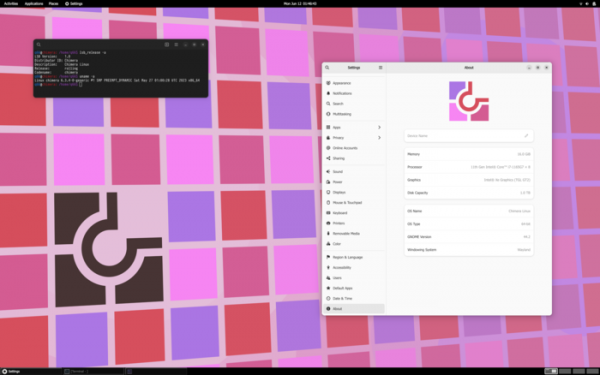
After three years of development and a year and a half since the formation of the first alpha version, the Chimera Linux distribution has entered the beta testing phase. This distribution is notable for its use of the Linux kernel, combined with utilities from FreeBSD, the system manager dinit, and the standard C library Musl. The build is carried out using the Clang compiler. The project is led by Nina Kolesa from Igalia, which contributes to the development of WebKit, Enlightenment, and Void Linux. Bootable Live images have been created for the architectures x86_64, ppc64le, aarch64, riscv64, and ppc64, available in versions with GNOME (1.5 GB) and KDE (2.2 GB).
The project aims to provide a Linux distribution with an alternative toolset, built on lessons learned from the development of Void Linux (the creator of Chimera is a former maintainer of Void, responsible for the POWER and PowerPC architectures). Like Void Linux, this project is developed using a rolling model (continuous version update cycle). FreeBSD user components have been selected as less complex and more suitable for lightweight and compact systems than the standard GNU toolset.
In addition to utilities from FreeBSD, supplied instead of packages like coreutils, findutils, diffutils, sed, and grep, the distribution involves GNU Make, util-linux, syslog-ng, udev, pam, dinit, clang, lld, libc++, and musl. Memory allocation functions in musl have been replaced with mimalloc. The ZFS file system is employed. The /var partition does not retain its state between reboots (stateless). PipeWire is used for managing multimedia streams. By default, the Wayland display server is utilized in graphical environments.
For installing additional programs, both binary packages and a custom build system from source code — cports, written in Python — are offered. Currently, about 2800 ports are maintained. The build environment runs in a separate unprivileged container created using the bubblewrap tool. The package manager APK (Alpine Package Keeper, apk-tools) is used for managing binary packages, and Flatpak can be used as an option.
Source: opennet.ru
