

After a year of development, the Enlightenment 0.27 desktop environment has been released. It is based on the EFL (Enlightenment Foundation Library) and Elementary widgets. The release is available in source code form without the publication of ready-made builds. The change log for version 0.27 has not been formed; only a list of commits is available, mainly detailing bug fixes and minor improvements to the widgets.
The desktop in Enlightenment is composed of various components such as a file manager, a set of widgets, an application launcher panel, and graphical configurators. The graphical configurators offer both high-level configuration tools (like changing themes, adjusting virtual workspaces, managing fonts, screen resolution, keyboard layout, localization, etc.) and low-level tuning capabilities (for example, you can configure caching parameters, graphics acceleration, power consumption, and modify window manager logic).
To extend functionality, modules (gadgets) are suggested, and themes can be used for visual redesign. Modules are available for displaying a calendar-planner, weather forecasts, monitoring data, a volume control widget, and a battery charge indicator on the desktop. The components of Enlightenment are not rigidly bound to one another and can be used in other projects or to create specialized environments, such as shells for mobile devices.
Mandatory dependencies include EFL, libexif, and libpam (only on Linux). Among the recommended dependencies necessary for full functionality are: connman for network configuration; bluez5 for Bluetooth support; bc for the built-in calculator; pulseaudio for managing audio devices; acpid for handling various hardware events; packagekit for tracking system updates; udisks2 for mounting external drives; ddcutil for controlling screen brightness; gdb for tracing crashes.
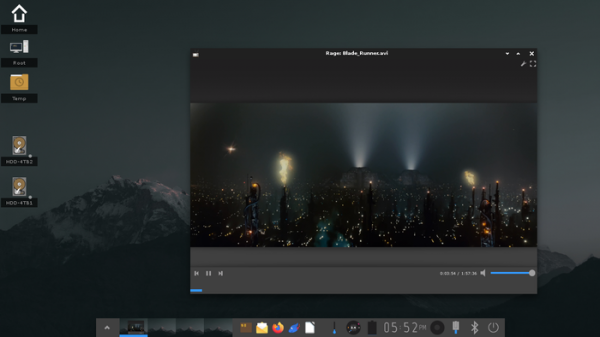
At the same time, the Enlightenment project has released a set of EFL 1.28 libraries (Enlightenment Foundation Library), which allow for the creation of visually appealing graphical interfaces characterized by compactness, low resource consumption, and high performance. Despite its original development as a basis for the Enlightenment environment, EFL components are often used to build interfaces for consumer electronics and mobile devices. For example, EFL is part of the Tizen mobile platform, is used in Electrolux appliances, Samsung products, ProFUSION, Free.fr, and Calaos.
Composition of EFL:
- Eina — a library that implements data types (array, hash, list, tree) and auxiliary tools (working with logs, performance evaluation, format conversion, etc.).
- Eet — a library for writing arbitrary sets of data blocks to a file for subsequent fast reading in any order.
- Evas — a rendering system for organizing output to the screen. Evas treats the screen's content as a scene with objects whose states can be tracked. Operations such as scaling, rotation, and 3D transformations can be performed on the scene. This approach, abstracted from the placement of screen elements, allows for developing the user interface from a designer's perspective rather than a programmer's (in the code, one only needs to define the logic without worrying about rendering and output to the screen). Evas also abstracts the output method, allowing the same code to be used with both software and hardware-accelerated rendering.
- Ecore — a library for organizing the event processing cycle, offering a set of modules to simplify tasks related to event processing, such as working with Evas, threads, network connections, and so on.
- Embryo — a library for writing small compileable applications for embedded devices.
- Edje is a graphics library that separates appearance from code (the design is defined through a template loaded from a file). Edje occupies a niche between HTML+CSS and SVG. With this library, you can create a user interface equipped with animated visual effects and supporting dynamic styling (the appearance can be completely changed simply by switching the EDJ template without modifying the code; unlike visual themes, the layout of elements can be arbitrarily altered).
- Efreet is a library that enables applications to use Freedesktop.org specifications for working with icons, desktop files, and menus.
- Eeze is a library for managing interactions with external devices through udev, HAL, and other mechanisms.
- Expedite is a performance measurement toolkit that can test various Evas engines, such as X11, XRender, OpenGL, SDL, and DirectFB.
- Evil is an implementation of compatibility layer for running on the Windows platform.
- Eio is an abstract interface for accessing the file system and implementing asynchronous input/output.
- Emotion is a library for integrating audio and video playback handlers into applications. Video playback can utilize Gstreamer, Xine, or other external plugins (such as VLC), with video displayed as a standard object in Evas.
- Ethumb is a library for creating image thumbnails that comply with freedesktop.org standards. Ethumb is implemented as a dbus service and a client library that interacts with this service.
- Elementary is a set of widgets with pre-implemented various graphical elements (from buttons and controls to calendars and text editing modules).
- Eldbus is a layer built on top of DBus.
- Ephysics provides means to utilize the Bullet physics simulation engine in applications based on EFL. Ephysics ensures the connection between Bullet and the Ecore and Evas libraries.
- Ecore Audio is an API for sound manipulation.
Source: opennet.ru
