

Google has announced the first beta version of the open mobile platform Android 16. To evaluate the new capabilities of the platform, a pre-testing program has been proposed. Firmware builds are prepared for devices such as Pixel 6/6a/6 Pro, Pixel 7/7a/7 Pro, Pixel 8/8a/8 Pro, Pixel 9/9 Pro/9 Pro XL/9 Pro Fold, Pixel Fold, and Pixel Tablet. The release of Android 16 is scheduled for the second quarter of 2025.
Among the changes in Android 16 Beta 1:
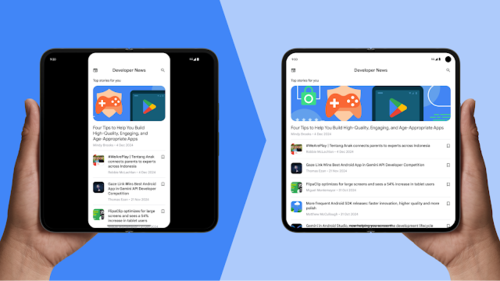
- Transition to an adaptive interface on devices with larger screens, such as tablets, desktop systems, and smartphones with foldable screens. On devices with a screen width of more than 600 dp, the platform will now display apps in resizable windows. Manifest file parameters for apps (not games) that limit window size and lock screen orientation will be ignored on large screens. Until 2026, developers will have the option to disable this new behavior.

- A new type of notification has been proposed — live updates that allow tracking changes related to a specific activity (for example, displaying delivery stages or route movements). A ProgressStyle has been introduced for new updates, enabling the creation of a block for displaying the progress of an operation.
- Support for the APV (Advanced Professional Video) codec has been added, intended for recording and processing video at a professional level of quality, close to the original content quality with lossless compression. To simplify usage during video editing, the APV format provides high bandwidth and low intra-frame coding complexity, while ensuring there is no loss in quality during re-encoding. Resolutions of 2K, 4K, and 8K are supported, along with HDR10/10+, frame tiling for parallel encoding/decoding, various color sampling formats, multi-view video, and metadata add-ons (depth, transparency, preview data). The implementation is based on the OpenAPV library and utilizes the APV 422-10 profile (YUV 422 and 10-bit per channel), supporting bitrates up to 2Gbps.
- For applications that work with the camera, the capability to detect the use of night shooting mode has been provided.
- A low-level API for vertical text rendering has been added. The Paint class now supports the VERTICAL_TEXT_FLAG, which allows for handling vertical text parameters at the same level as horizontal text.
- The RangingManager API has been added, enabling the determination of distances and angles between the user's current and external devices, using various distance estimation techniques based on the analysis of channel parameters and the received BLE (Bluetooth Low Energy) signal, as well as response time assessments via Wi-Fi.
- To optimize performance, the internal structures of the Android Runtime (ART) have been modified, which will require updates to applications using such structures.
- By default, a 'predictive' animation is invoked for operations returning to the home screen when performing the 'back' gesture, as well as when switching between tasks and activities. The essence of the predictive return lies in the ability to preview the area to which the transition will occur (for example, if returning to the home screen, the application window shrinks, displaying the home screen). Support for predictive return in the new version is realized not only for gestures but also for navigation using the 'Back,' 'Home,' and 'Overview' buttons.
Source: opennet.ru
