

The developers of Arch Linux have announced an agreement with Microsoft to publish official builds for the Windows Subsystem for Linux (WSL). These builds will be included in the list of Linux distributions available for quick installation through the WSL repository (to install Arch, it will be sufficient to run the command “wsl —install ArchLinux”). Since Arch Linux follows a rolling update model, the builds are expected to be updated once a month.
The builds will be formatted in a new way that allows the distribution to be shared from its own... servers without downloading to the Microsoft Store, packaging in appx format, and without placing Windows-specific code in the build. The new method involves hosting a tar archive with the system environment of the distribution and a file /etc/wsl-distribution.conf that contains metadata such as name, icon, default user ID, and environment setup scripts executed at first launch.
Yesterday, Canonical also announced the start of distributing Ubuntu builds for WSL in the new format. The Ubuntu build is already included in the official list of distributions for WSL, so to install it, simply run the command “wsl —install ubuntu” in Windows. If changes need to be made to the build, it can be downloaded to the local system and then installed using the command “wsl —install —from-file ubuntu.tar.wsl”. Available versions of Ubuntu include 24.04, 22.04, 20.04, and 18.04. By default, when specifying “ubuntu,” version 22.04 is installed.
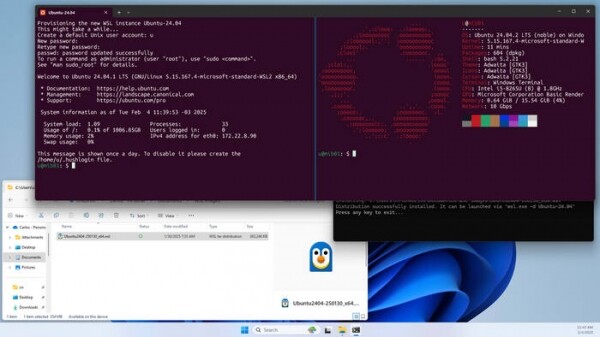
Other distributions added to the WSL list include openSUSE Leap, openSUSE Tumbleweed, SUSE Linux Enterprise, Kali Linux, Debian GNU/Linux, and Oracle Linux. The Fedora Linux distribution is also seeking inclusion in the list, as its technical committee recently approved a proposal to create official Fedora builds for WSL. Fedora builds for WSL will start being delivered with the release of Fedora 42. It is noted that the project previously did not publish builds for WSL because hosting them in the Windows Store required signing an agreement, the terms of which conflicted with Fedora's policy. The direct delivery in the new format (tar archive with a manifest) will resolve this issue.
WSL provides a virtual machine with a full Linux kernel (based on 6.6 or 5.15 branches), in which specially adapted Linux distributions for WSL can run. The kernel includes WSL-specific changes, such as optimizations for reduced startup time and lower memory consumption, the ability to free Linux-process memory back to Windows, and configurations to exclude unnecessary drivers and subsystems. The system is installed in a separate disk image (VHD) with an ext4 filesystem and a virtual network adapter.
Source: opennet.ru
