

Jon Seager, Vice President of Engineering at Canonical and Technical Leader of the Ubuntu project, has introduced an initiative to replace system utilities in Ubuntu with equivalents written in Rust. The first goal of this initiative is to transition Ubuntu 25.10 to use the uutils toolkit by default instead of the GNU Coreutils suite. If the experiment is deemed successful, uutils will also be used by default in the LTS branch of Ubuntu 26.04.
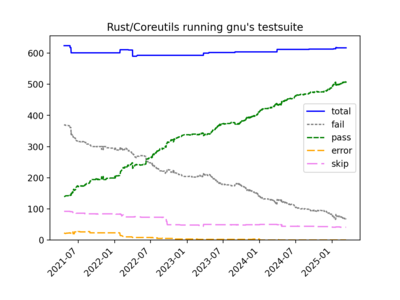
The replacement will affect over a hundred utilities that are part of Coreutils, including sort, cat, chmod, chown, chroot, cp, date, dd, echo, hostname, id, ln, and ls. Currently, uutils are already used by default in the Apertis distribution, based on Debian, and in the independent distribution AerynOS (SerpentOS). The release of the uutils coreutils package 0.0.30 published last week has successfully passed 507 tests (up from 506 in the last release and 476 in the previous one) from the reference test suite of GNU Coreutils. 69 tests failed, and 41 tests were skipped. In the coming weeks, work is also expected to begin on replacing the utilities su and sudo in Ubuntu with the sudo-rs package. Additional projects under consideration include zlib-rs and ntpd-rs.
The reason for the migration is cited as the desire to enhance the reliability and security of the utilities that form the foundation of the distribution. Using Rust will reduce the risk of memory-related errors, such as accessing memory after it has been freed and buffer overflows. According to Jon Seager, protection against such errors will enhance security guarantees, and with increased security, the overall reliability of the system's operation will also improve.
It is noted that Canonical is exploring various methods to improve quality, one of which is to supply software that is originally developed with an eye toward security, reliability, and correctness. This is particularly important for the core components of the distribution, as issues in low-level software can impact the performance of all higher-level layers. For example, if there are performance issues in the core packages, they will also affect the performance of other subsystems.
To test the replacement of system components in Ubuntu, the project oxidizr has been prepared, offering a command-line toolkit for managing experiments with the system related to replacing traditional utilities with alternatives written in Rust. Currently, oxidizr provides experiments to enable the default use of the uutils coreutils, uutils findutils, uutils diffutils, and sudo-rs packages. For example, to replace coreutils and findutils in your system, simply execute the command "sudo oxidizr enable —experiments coreutils findutils", and to revert to the original state, you can use the command "oxidizr disable".
Source: opennet.ru
