

The latest flagship mobile processor AMD Ryzen AI Max+ 395 from the Strix Halo family offers up to 12 times higher performance when working with various large AI language models than Intel Lunar Lake chips. This was shared by AMD on its official blog, along with relevant diagrams.
With 16 Zen 5 compute cores, 40 RDNA 3.5 graphics blocks, and the NPU XDNA 2 delivering 50 TOPS (trillions of operations per second), the Ryzen AI Max+ 395 provides up to 12.2 times higher performance in specific LLM scenarios compared to the Intel Core Ultra 258V. It's worth noting that the Intel Lunar Lake chip includes only four P-cores and four E-cores, amounting to half as many as the Ryzen AI Max+ 395. However, the performance difference between the platforms is much more pronounced than just twice.
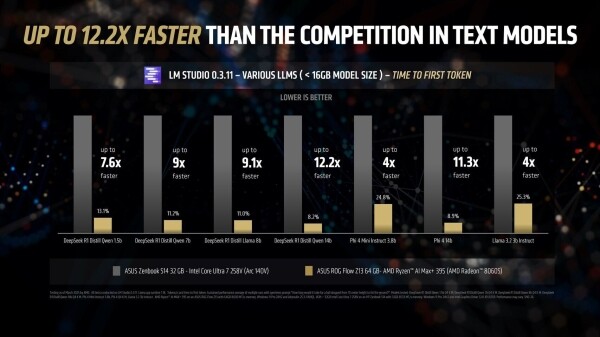
The advantage of the Ryzen AI Max+ 395 chip becomes even more evident as the complexity of language models increases. The largest performance disparity between platforms is observed when working with LLMs with 14 billion parameters, which require more RAM. Recall that Lunar Lake represents hybrid processors equipped with up to 32 GB of onboard RAM.
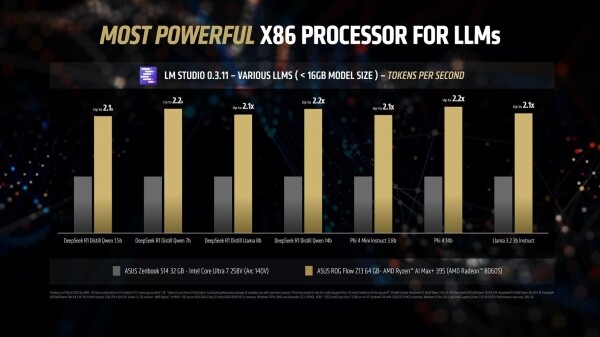
In LM Studio tests using the Asus ROG Flow Z13 with 64 GB of unified memory, the integrated Radeon 8060S graphics of the Ryzen AI Max+ 395 demonstrated a 2.2 times higher token throughput compared to Intel Arc 140V across various AI models. In Time-to-First-Token tests (a performance metric for language models that measures the time from sending a request to generating the first token of a response), the AMD chip showed a fourfold advantage over the competitor in models like Llama 3.2 3B Instruct, and increased the lead to 9.1 times in models supporting 7-8 billion parameters, such as DeepSeek R1 Distill.
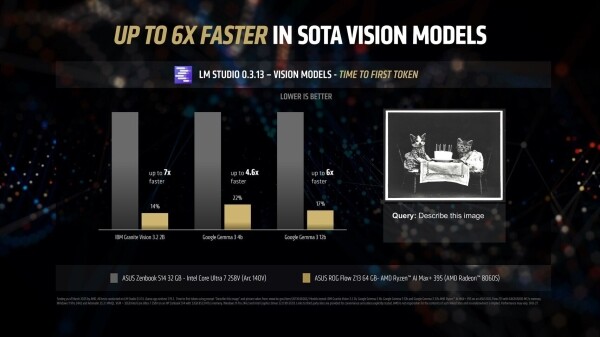
The AMD processor particularly excelled in multimodal vision tasks, processing complex visual input data up to 7 times faster in IBM Granite Vision 3.2 3B and 6 times faster in Google Gemma 3 12B compared to the Intel chip. Support for Variable Graphics Memory technology by AMD allows for allocation of up to 96 GB of memory as VRAM from systems with up to 128 GB of unified memory, enabling the deployment of modern language models like Google Gemma 3 27B Vision.
The performance advantages of AMD processors over the competition are evident in practical AI applications, such as medical image analysis and coding assistance using high-precision 6-bit quantization in the DeepSeek R1 Distill Qwen 32B model.
Sources:
Source: 3dnews.ru
